Five Misconceptions About Missouri Insurance Law That Cost Practitioners Cases
Key Takeaways
- Inexperienced attorneys often misunderstand Missouri Insurance Law, leading to compounding errors in coverage disputes.
- Key misconceptions include the duty to defend being a simple four-corners rule and the incorrect belief that insurer exposure only caps at policy limits.
- Attorneys should recognize that a reservation of rights creates conflicts of interest and affects strategy in defending claims.
- Misapprehending burdens of proof regarding exclusions can lead to significant loss of coverage opportunities.
- Practitioners must document insurer communications from the start and view litigation steps as interconnected in the broader context of Missouri Insurance Law misconceptions.
Introduction
Insurance coverage litigation in Missouri is governed by a body of statutory and common law that is, in its broad outlines, familiar to most civil practitioners. The duty to defend, the duty to indemnify, the vexatious refusal statute, the fiduciary relationship between insurer and insured — these doctrines appear in continuing legal education (CLE) materials and bar journal articles with regularity. The problem is not that Missouri attorneys are unaware of these doctrines. The problem is that there are often misconceptions about how Missouri insurance law applies or how the doctrines operate together. Thes misconceptions produce errors that compound across the life of a case: a defense tender that should have been refused is accepted, a coverage argument that should have been pressed is abandoned, a statutory remedy that should have been invoked is overlooked.
This post identifies five areas where attorneys inexperienced with the insurance law side of personal injury might miss an opportunity to help their client to a better outcome. Each misconception is corrected by reference to the governing authority as discussed in the companion posts on this blog. The goal is not to survey Missouri insurance law comprehensively; the individual posts linked throughout this article do that. The goal is to isolate the specific analytical errors that cost practitioners cases and to explain why the correct analysis matters.
I. The Duty to Defend Is a Four-Corners Exercise
The phrase “corners rule” is so embedded in coverage parlance that many practitioners treat the duty to defend as a mechanical comparison: match the petition allegations against the policy language, and if the allegations fall within an exclusion, there is no duty to defend. That framing is incomplete under Missouri law, and reliance on it leads to analytical errors in both directions — insurers deny defenses they owe, and insureds accept denials they should contest.
The real test is eight corners plus. The Missouri Supreme Court in Allen v. Bryers, 512 S.W.3d 17, 31 (Mo. 2016), articulated a three-part standard that extends the comparison beyond the petition. The duty to defend is determined by comparing the policy language with facts (1) alleged in the petition, (2) the insurer knows at the outset of the case, or (3) that are reasonably apparent to the insurer at the outset of the case. The second and third prongs are what distinguish Missouri’s approach from a strict four-corners jurisdiction. An insurer that confines its analysis to the petition allegations and ignores facts it knows from its own claims file — a police report it obtained, a statement from a witness, information the insured provided in the notice of claim — has applied the wrong legal standard. As discussed in this blog’s comprehensive treatment of the duty to defend, the foundational case on the comparison test, McCormack Baron Management Services, Inc. v. American Guarantee & Liability Insurance Co., 989 S.W.2d 168, 170 (Mo. banc 1999), established that the duty to defend is broader than the duty to indemnify and arises whenever the petition states a claim potentially within coverage.
The threshold matters. The question is not whether the claim is likely covered or whether the claim will succeed. The question is whether it is possibly covered. Prairie Framing, LLC v. United Fire Group, 162 S.W.3d 67, 83 (Mo. App. W.D. 2005). Any ambiguity regarding the scope of the duty to defend is resolved in the insured’s favor. Millers Mutual Insurance Association of Illinois v. Shell Oil Co., 959 S.W.2d 864, 867 (Mo. App. E.D. 1997). A petition that characterizes the defendant’s conduct as intentional when the underlying facts could support a negligence theory does not permit the insurer to decline the defense on the strength of the intentional acts exclusion — what matters is the facts alleged, not the legal labels the plaintiff chose.
The practical consequence of misunderstanding the Allen v. Bryers standard is significant. An insured who receives a denial based on the petition alone has a viable argument that the insurer failed to consider facts known to it or reasonably apparent at the outset — and that failure is itself evidence of unreasonable conduct in a subsequent vexatious refusal claim under Mo. Rev. Stat. § 375.420. The duty to defend analysis is not merely a threshold coverage question; it is the first chapter of the bad faith case.
Practice Tip: When evaluating a duty to defend denial, do not limit the analysis to the petition. Identify every fact the insurer knew or should have known at the outset — claims file materials, the insured’s notice, police reports, prior claims history — and test whether any of those facts, combined with a liberal reading of the petition, create even a possibility of coverage. If they do, the denial was wrong under Allen v. Bryers, and the insurer’s analytical shortcut is evidence of unreasonable conduct. Your client may want damages for breach, or they may want the insurer to change their position and perform. If your client wants a defense don’t be afraid to supply facts to an insurer who has denied coverage and ask them to reconsider.
II. A Reservation of Rights Must Be Accepted
Don no treat a reservation of rights letter as a binary signal: the insurer is defending, so the coverage question will be sorted out later. That understanding misses the structural problem that the reservation creates and the powerful right Missouri gives the insured in response.
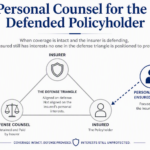
A reservation of rights creates actual conflict of interest between the insurer and the insured. The insurer is simultaneously the insured’s defender and a potential adversary on the coverage question. Defense counsel retained and paid by the insurer has a fiduciary relationship with both the insured and the insurer — but the insurer has a direct financial interest in developing facts that support non-coverage. State ex rel. Rimco, Inc. v. Dowd, 858 S.W.2d 307, 308 (Mo. App. E.D. 1993), held that a defense under reservation presents a potential conflict because the insurer may have a greater interest in developing facts establishing non-coverage than in defending against the insured’s liability. As discussed in this blog’s treatment of reservation of rights practice, the conflict is structural and unavoidable — it arises from the triangular relationship itself, not from any particular act of bad faith by defense counsel.
See: Reservation of Rights in Missouri: Appointed Counsel, Conflicts of Interest, and the Insured’s Right to Refuse., and Reservation of Rights Letters in Missouri: What They Mean and How to Respond.
Missouri allows the insured to refuse a defense offered under a reservation of rights. State Farm Mutual Automobile Insurance Co. v. Ballmer, 899 S.W.2d 523, 527 (Mo. banc 1995). This is not an academic right. An insured who refuses the reservation-of-rights defense shifts the consequences of the coverage dispute onto the insurer. If the insurer was wrong about coverage — if the claim is ultimately determined to be covered — the insurer is liable for all defense costs the insured incurred, plus the judgment, plus potential vexatious refusal penalties and attorney fees. The insurer that would have controlled the defense for the cost of appointed counsel’s fees now faces exposure that dwarfs what a defense would have cost.
The decision to accept or refuse a reservation-of-rights defense is a strategic one that depends on the facts of each case, but the point is that it is a decision — not a foregone conclusion. A valid reservation must identify the specific policy provisions at issue, explain how those provisions apply to the specific facts, and inform the insured of the conflict and the insured’s options. Brooner & Associates Construction, Inc. v. Western Casualty & Surety Co., 760 S.W.2d 445 (Mo. App. W.D. 1988). A boilerplate letter that simply reserves all rights without identifying what those rights are may be insufficient. A reservation that does not timely, fully, or unambiguously explain the insurer’s coverage position may not satisfy Missouri’s requirements. Advantage Buildings & Exteriors, Inc. v. Mid-Continent Casualty Co., 449 S.W.3d 16 (Mo. App. W.D. 2014).
Practice Tip: Before advising an insured to accept a reservation-of-rights defense, evaluate the specific coverage question the insurer has identified and the strength of the insurer’s position. If the coverage defense is weak and the insurer’s reservation letter is vague or boilerplate, refusing the defense may be the superior strategy — it shifts the risk of being wrong about coverage entirely to the insurer and preserves the full range of remedies, including vexatious refusal and excess judgment exposure. Also don’t be scared to negotiate. Rember reservation of rights is a safe harbor for insurers from the consequences of anticipatory repudiation. Don’t be afraid to push back, to seek to limit the reservation or work out an agreement that protects your client. Sometime accepting or rejecting are not your only options.
III. An Exclusion That Arguably Applies Defeats Coverage
The analytical error here is one of burden allocation. Practitioners who see an arguably applicable exclusion and conclude that coverage is defeated have inverted the framework. Under Missouri law, the insured’s initial burden is to show that the claim falls within the insuring agreement — and that burden is met by demonstrating that the claim potentially falls within the coverage grant on a reasonable reading of the policy language. Weathers v. Royal Indemnity Co., 577 S.W.2d 623, 626 (Mo. 1979). Once that threshold is satisfied, the burden shifts to the insurer to establish that an exclusion clearly and unambiguously applies to the specific facts alleged.
This burden-shifting framework, discussed in this blog’s treatment of policy structure and interpretation, is outcome-determinative in a remarkable number of cases. Exclusions are drafted by the insurer, and under Missouri’s rules of policy interpretation they are construed narrowly against the insurer. Coverage provisions are construed broadly in favor of the insured. If there is any reasonable reading of an exclusion that would preserve coverage, the insurer cannot rely on it to defeat either the duty to defend or the duty to indemnify. The insurer that relies on an exclusion whose application is genuinely debatable has not established its burden — and its reliance on that debatable exclusion to deny coverage is evidence that the denial lacked reasonable cause for a potential vexatious refusal claim under § 375.420.
Where a petition contains multiple claims and some are potentially covered while others clearly are not, the duty to defend the entire action arises from the potentially covered claims. The insurer cannot parse the petition and defend selectively. Facts relevant to an excluded claim may also be relevant to a covered claim, and defense of one necessarily involves defense of others. An insurer that denies the defense entirely because one count triggers an exclusion, when another count is potentially covered, has breached the duty to defend — and that breach carries consequences that typically exceed the cost of providing the defense.
Practice Tip: When an insurer invokes an exclusion, frame the analysis in terms of burden: the insurer must prove the exclusion clearly and unambiguously applies to the specific facts of the claim. If the exclusion is ambiguous as applied — if there is any reasonable reading that preserves coverage — the insurer has not met its burden. Practitioners representing insureds should resist the temptation to argue about what the exclusion means in the abstract and instead force the analysis onto the specific facts, where ambiguity is most likely to emerge. Not every case can be won but never accept an insurer’s attempt to apply exclusions generically or read them broadly.
IV. The Insurer’s Exposure Is Capped at Policy Limits
This misconception reflects a fundamental misunderstanding of the relationship between the contractual obligation to indemnify and the fiduciary duty that Missouri law imposes on liability insurers. The policy limits cap the insurer’s indemnity obligation — the contractual promise to pay damages on behalf of the insured. They do not cap the insurer’s liability for breach of its fiduciary duty, which can produce exposure many multiples of the policy limits.
The foundational authority is Zumwalt v. Utilities Insurance Co., 228 S.W.2d 750, 755 (Mo. 1950), which held that when a liability insurer assumes control of the defense and retains the exclusive right to settle, a fiduciary relationship arises and the insurer is obligated to discharge its duties with the utmost good faith. As discussed in this blog’s treatment of the insurer’s fiduciary duty, the practical content of this obligation is demanding: where the interests of the insured and the insurer diverge — as they inevitably do when the claim value approaches or exceeds policy limits — the insurer must pursue the insured’s interests even when doing so is contrary to the insurer’s financial interest. The insurer with a $100,000 policy facing a claim with a genuine verdict range of $500,000 to $1,000,000 cannot evaluate a within-limits demand solely through the lens of its own exposure. It must give equal, and if necessary superior, weight to the insured’s exposure to an excess judgment.
When the insurer breaches this duty — by refusing a reasonable within-limits demand, by failing to investigate adequately, by gambling on a defense verdict when the insured’s personal exposure is catastrophic — the consequences extend well beyond the policy limits. Missouri law provides multiple interlocking mechanisms that transform the insurer’s fiduciary breach into liability for the full excess judgment. Mo. Rev. Stat. § 537.065 allows the injured party and the abandoned insured to resolve the underlying tort claim by agreement, with collection limited to insurance, while preserving the right to hold the insurer accountable. As discussed in this blog’s treatment of § 537.065, the 2021 amendments added insurer notice requirements and intervention rights, but the core mechanism remains: the insured assigns the bad faith claim to the injured party, who pursues the insurer for the full amount of the excess judgment. The consent judgment paired with an assignment of the insured’s bad faith claim, discussed in this blog’s treatment of consent judgments and bad faith assignments, can transform an otherwise uncollectable excess judgment into a significant recovery — and the insurer’s bad faith exposure includes punitive damages that are, by definition, uncapped by the policy.
Equitable garnishment under Mo. Rev. Stat. § 379.200, discussed in this blog’s treatment of equitable garnishment practice, provides the collection mechanism. After a final judgment is entered and remains unsatisfied for thirty days, the judgment creditor may proceed against the insurer. The equitable garnishment proceeding is frequently the arena in which the coverage dispute is finally litigated — and Missouri law limits what the insurer may contest in garnishment when it had the opportunity to participate in the underlying litigation and chose not to.
These doctrines — the Zumwalt fiduciary duty, § 537.065, consent judgment practice, and § 379.200 equitable garnishment — are not independent remedies that operate in isolation. They are components of a single integrated framework that Missouri law provides for holding insurers accountable when they breach their obligations to their insureds. The insurer that understands its exposure as capped at policy limits has misread the framework, and the practitioner who advises an insured or a claimant on that assumption is leaving significant recovery on the table.
Practice Tip: In every case where the claim value approaches or exceeds policy limits, evaluate the insurer’s conduct through the Zumwalt fiduciary lens from the beginning of representation. Document the insurer’s investigation, its communications with the insured, and its response to settlement demands. If the insurer refuses a reasonable within-limits demand, the practitioner should immediately begin planning the § 537.065 and consent judgment framework — not as an afterthought when the case goes sideways, but as a deliberate strategic arc that treats the insurer’s refusal as the first step toward excess judgment exposure.
V. Reliance on The Missouri’s Unfair Claims Settlement Practice Act (UCSPA)
Missouri’s Unfair Claims Settlement Practices Act (UCSPA), codified at Mo. Rev. Stat. §§ 375.1000–375.1018, establishes a detailed catalogue of prohibited insurer conduct: misrepresenting policy provisions, failing to investigate promptly, refusing to pay without a reasonable investigation, compelling litigation to recover amounts due, and similar practices. The specificity of these prohibitions makes them attractive to practitioners, and the temptation is to plead UCSPA violations as independent causes of action. That approach is analytically fragile under Missouri law.
As discussed in this blog’s treatment of the UCSPA’s enforcement mechanisms, the Act is primarily enforced by the Missouri Department of Insurance through administrative proceedings, and administrative enforcement typically requires a showing that the prohibited conduct constitutes a general business practice rather than an isolated occurrence. Mo. Rev. Stat. § 375.1000(1).
The more effective approach — and the one that Missouri courts have consistently supported — is to deploy UCSPA violations as evidence within established causes of action. The UCSPA’s catalogue of prohibited practices provides a ready-made framework for proving that an insurer’s conduct was unreasonable for purposes of a vexatious refusal claim under § 375.420 or a common law bad faith claim. Evidence that an insurer violated specific UCSPA standards — that it failed to adopt reasonable standards for prompt investigation, that it did not attempt in good faith to effectuate a prompt and fair settlement once liability became reasonably clear, that it compelled the insured to institute litigation to recover amounts due — is admissible and highly persuasive to a jury evaluating whether the insurer’s refusal to pay was without reasonable cause or excuse.
The evidentiary approach also opens discovery that might otherwise be resisted. Requests for the insurer’s claims handling guidelines and manuals, deposition questions directed at compliance with specific UCSPA provisions, and interrogatories about how similar claims were handled by the same insurer are all grounded in the UCSPA’s regulatory standards and are difficult for the insurer to resist on relevance grounds.
Even more compelling is combing Expert testimony on industry-standard claims practices, as well as treaties and books on proper claims practices or training materials from the Associate In Claims (AIC) designation — as a guide for measuring the insurer’s conduct — provides the jury with a concrete framework for evaluating reasonableness.
Practice Tip: Plead vexatious refusal under § 375.420 and/or bad faith as the primary causes of action. Then build the evidentiary case for unreasonable conduct by targeting discovery at specific UCSPA violations and deviations from proper claims handling practices— claims manuals, adjuster training materials, prior regulatory actions, and the insurer’s own internal standards. The UCSPA and these other standards are most powerful as a measuring stick the jury can use to evaluate the insurer’s conduct, not as a standalone cause of action or violation.
VI. Practical Guidance for Navigating the Framework and Avoid Misconceptions
The first discipline is to obtain and read the complete policy before making any coverage determination. Not the declarations page alone, not a certificate of insurance, not the denial letter’s characterization of the policy — the actual policy with every form and endorsement listed on the declarations page. As discussed in this blog’s treatment of policy structure, every liability policy has five principal components — the declarations page, the insuring agreement, the exclusions, the conditions, and the definitions — and each component interacts with the others in ways that the insurer’s denial letter will not explain. An endorsement attached to the base policy may expand coverage that the exclusions section appears to restrict. A defined term may give a word in an exclusion a meaning narrower than its ordinary usage. These interactions are only visible in the complete policy.
Practice Tip: Be aware of choice of law and adjuster location issues. If the insured contract was sold out of state and the occurrence occurred in Missouri a choice of law issue may be in play regarding the contract, but it may also affect how the claim is adjusted. You may find out of state adjusters who follow their home state rules. You find inhouse claims counsel who give opinions on coverage or claims handling advice but are not licensed in Missouri. In an egregious example from a bad faith case an inhouse claims lawyer who denied coverage to an insured and refused to settle admitted under oath to not being licensed anywhere and ignoring a coverage letter from Missouri outside counsel that coverage should be afforded to the insured. In another a head of claims testified to relying on his understanding of the law which was correct for New Jersey but wrong for Missouri.
The second discipline is to build the record of insurer conduct from the first communication. The insurer’s course of conduct — timeliness of investigation, adequacy of the denial letter, responsiveness to settlement demands, compliance with UCSPA and good claim handling standards — is the evidentiary foundation of every bad faith and vexatious refusal claim. That record must be built contemporaneously: confirm oral communications in writing, preserve every document, and frame correspondence so that the insurer’s failures are documented in real time rather than reconstructed after the fact.
The third discipline is to think in terms of the full litigation arc rather than the immediate coverage question. The duty to defend analysis feeds the vexatious refusal claim. The insurer’s response to the reservation of rights creates the conflict that justifies refusal and shifts risk. The fiduciary duty imposes obligations that extend beyond the policy limits. Section 537.065, a non-prosecution agreement, or other settlement provides for resolution when the insurer abandons the insured Equitable garnishment under § 379.200 provides the collection mechanism. These are not separate doctrines to be invoked as needed — they are stages in a single integrated framework, and the practitioner who understands how each stage connects to the next is in a fundamentally different strategic position than one who approaches each question in isolation.
Each of the doctrines discussed in this post is addressed at length in the corresponding articles on this blog. Practitioners handling Missouri insurance coverage disputes are encouraged to review those companion posts for the. treatment of governing authority, procedural requirements, and strategic considerations that this survey necessarily condenses.