Reservation of Rights Letters in Missouri: What They Mean and How to Respond
A practical guide for plaintiff’s counsel navigating coverage defenses in third-party liability cases
Missouri Injury & Insurance Law | missouriinjuryandinsurancelaw.com
Introduction
When a liability insurer issues a reservation of rights letter, it signals that the insurer is accepting the defense of the claim while reserving the right to later disclaim coverage. For plaintiff’s counsel, the reservation of rights letter is both a warning and an opportunity. It is a warning because the insurer may ultimately seek to avoid paying a judgment; it is an opportunity because a reservation of rights situation creates a conflict of interest between the insurer and insured that can be strategically exploited. This post examines how reservation of rights letters work under Missouri law, how they affect the insurer-insured relationship, and what plaintiff’s counsel should do when they learn a reservation of rights has been issued.
The Legal Effect of a Reservation of Rights
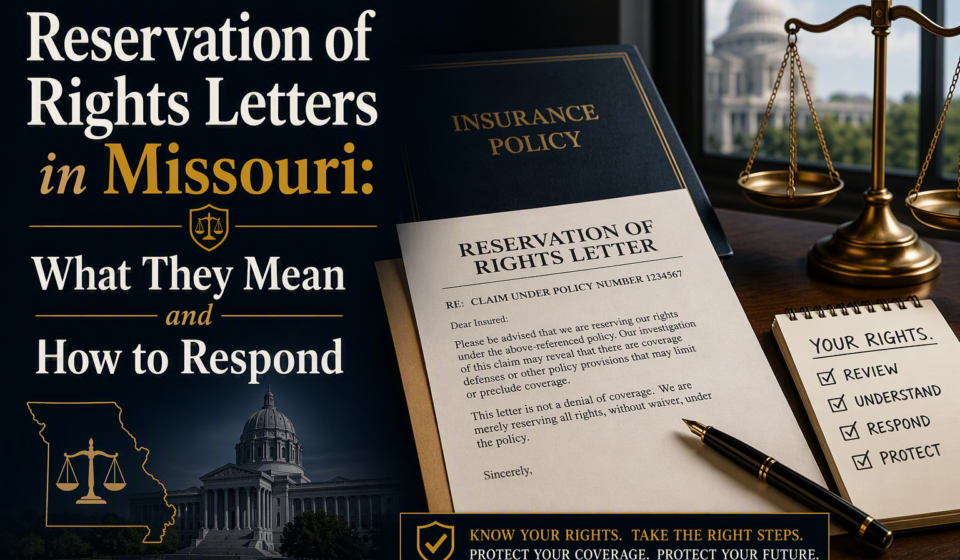
A reservation of rights letter notifies the insured that the insurer is defending the claim under a reservation—i.e., without waiving its right to later contest coverage. Under Missouri law, an insurer that defends without issuing a reservation of rights may be estopped from later asserting coverage defenses, depending on the circumstances. The reservation of rights letter is the insurer’s mechanism for preserving its coverage defenses while fulfilling its duty to defend.
Missouri courts apply principles of waiver and estoppel in coverage disputes. Mo. Rev. Stat. § 379.195 (2023) and related case law establish that an insurer who takes action inconsistent with a coverage defense—such as defending without reservation—may waive that defense. Practitioners representing injured plaintiffs should monitor reservation of rights correspondence carefully because the insurer’s failure to properly reserve rights can result in a broader coverage obligation.
Conflict of Interest and Independent Counsel
One of the most important consequences of a reservation of rights is the potential conflict of interest it creates between the insurer and its insured. When coverage is disputed, the insurer-appointed defense counsel has an inherent conflict: a defense strategy that benefits coverage (e.g., establishing that the insured’s conduct was intentional) may harm the insured’s personal interests. Missouri courts have recognized this conflict.
In reservation of rights situations, Missouri insureds may have the right to retain independent counsel at the insurer’s expense. Practitioners representing injured plaintiffs should be alert to this issue because an insured who understands its right to independent counsel is more likely to cooperate with plaintiff’s counsel in ways that can benefit the injured party, including through the negotiation of consent judgments and bad faith assignments.
What Plaintiff’s Counsel Should Do
When plaintiff’s counsel learns—through discovery, informal communication, or other means—that a reservation of rights has been issued, several strategic steps should be considered. First, request a copy of the reservation of rights letter through discovery. The letter will identify the specific coverage defenses the insurer is preserving and will guide subsequent discovery into those issues.
Second, consider whether the reservation of rights situation creates an opportunity to negotiate a consent judgment and bad faith assignment. An insured who is being defended under a reservation of rights has a personal financial interest in the outcome of both the liability case and the coverage dispute, making cooperation with plaintiff’s counsel more likely.
Third, document all settlement communications with the insurer carefully. An insurer that issues a reservation of rights and then fails to make reasonable settlement efforts within policy limits may face enhanced bad faith exposure because the conflict of interest undermines the adequacy of the insurer’s representation of its insured’s interests.
Declaratory Judgment Actions
Insurers frequently file declaratory judgment actions to resolve coverage questions in reservation of rights situations. Mo. Rev. Stat. § 527.010 (2023) provides the procedural vehicle for such actions in Missouri. Practitioners should be prepared to intervene in or respond to declaratory judgment actions when the coverage determination will affect the injured party’s ability to collect a judgment. Missouri courts have jurisdiction to adjudicate coverage questions in actions where the injured party has a direct interest in the outcome.
Conclusion
Reservation of rights situations are among the most complex scenarios in liability insurance practice. For plaintiff’s counsel, they present both risk and opportunity. The practitioner who monitors insurer-insured communications, understands the conflict of interest dynamics, and positions the case for a consent judgment and bad faith assignment when appropriate will be best equipped to serve the client’s interests in these situations.