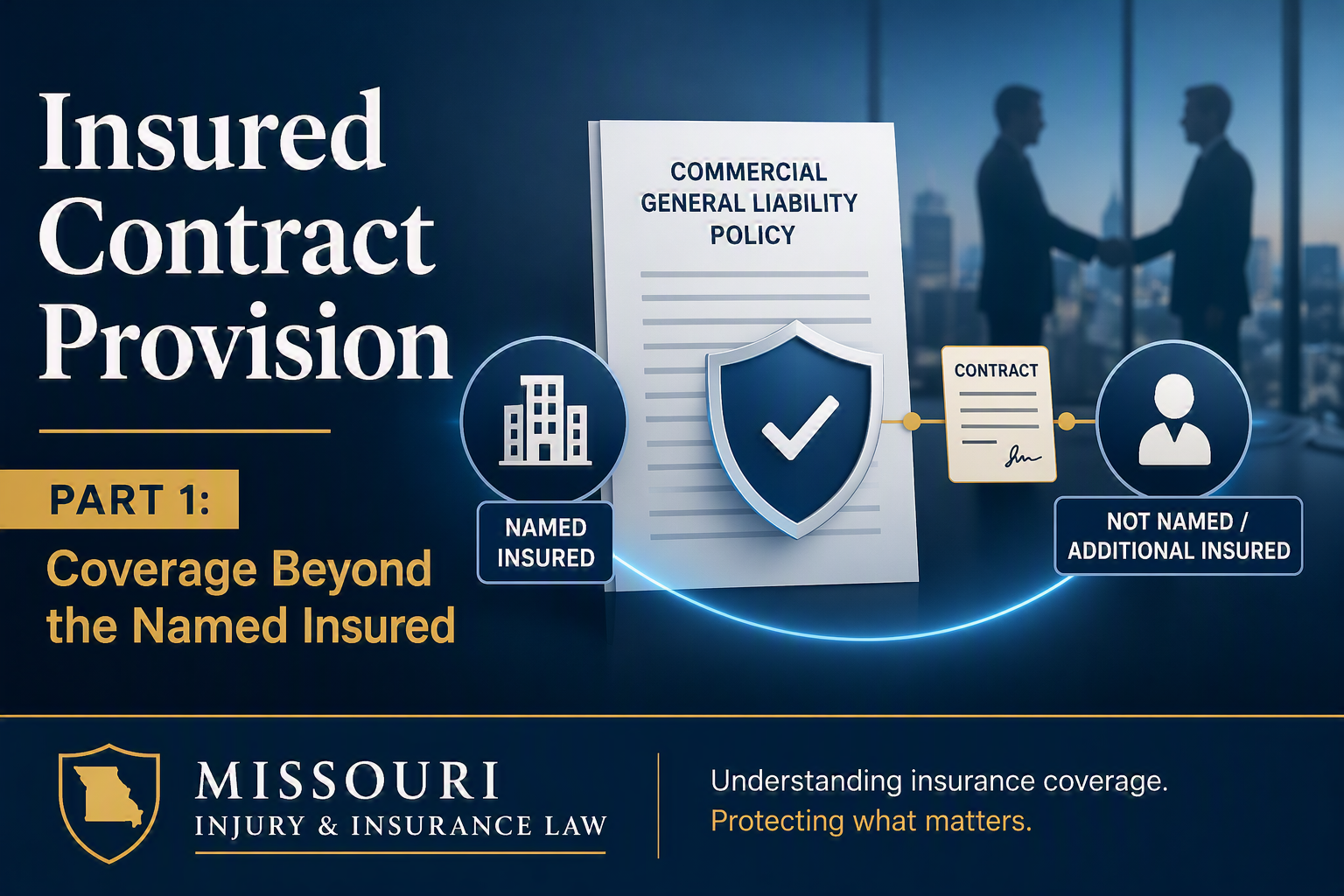
The Insured Contract Provision
An Overlooked Path to Coverage for Parties Who Are Neither Named Insureds Nor Additional Insureds
Key Takeaways
- The Insured Contract Provision allows coverage for parties not named in insurance policies if a contract assumes liability.
- This provision activates when an injury occurs after a contract with liability assumptions is executed, broadening coverage opportunities.
- The article outlines six categories of agreements that qualify as insured contracts, highlighting their importance in liability cases.
- A detailed analysis is crucial, as coverage can exist independently of additional insured status, relying on contract definitions.
- The insured contract provision can help uncover hidden avenues for recovery, making coverage and liability separate yet linked inquiries.
When a plaintiff’s attorney evaluates available coverage in a serious injury or wrongful death case, the instinct is to identify the tortfeasor, locate the policy that names the tortfeasor or the tortfeasor’s employer, and measure the claim against those limits. That instinct is correct as far as it goes. But it stops short in one recurring situation: where the person who caused the injury was, at the moment it happened, performing work for a business other than the one that signs their paycheck, under a written contract between the two. In that setting, the policy behind the claim may insure more parties — and more limits — than the declarations page reveals. One mechanism is the insured contract provision, and this three-part series is devoted to it.
Part One introduces the provision: where it lives in the three liability forms most commonly encountered, how it is triggered, why it can reach parties who appear nowhere on the policy as named or additional insureds, and why a party pulled into coverage this way may be liable derivatively — as an employer, principal, or joint venturer — rather than as the direct tortfeasor. Part Two turns to the insured contract itself — the indemnification and assumption-of-liability language that drives the analysis, and whether that language is truly necessary to trigger coverage under the various policy forms sold today. Part Three addresses what happens when a carrier ignores the provision: the excess judgments, bad faith exposure, and breach of fiduciary duty claims that can follow.
The Doctrinal Engine: A Broad Exclusion With a Broader Exception
Start with the standard occurrence-based Commercial General Liability (“CGL”) form. The Insurance Services Office (“ISO”) — the industry organization that drafts the standardized policy language most carriers license and issue with little modification — publishes that form as CG 00 01 [insert edition]. Buried among its exclusions is one for contractual liability: the policy will not cover liability the insured takes on merely by agreeing, in a contract, to be responsible for it.
Read in isolation, that exclusion would be devastating. Nearly every commercial contract written today allocates risk through indemnification — the promise by one party to answer for certain losses of another. If the CGL excluded all contractually assumed liability, the coverage would evaporate exactly where modern business needs it most. So the exclusion carries two exceptions. The first restores coverage for liability the insured would have faced even without any contract — ordinary tort liability. The second, and the engine of this series, restores coverage for liability the insured assumed in a contract that qualifies as an “insured contract.”
Think of it as a fence with a gate. The contractual liability exclusion is the fence: it walls off contractually assumed liability from coverage. The insured contract definition is the gate: any assumption of liability that fits through it is back inside the covered yard. The whole question, in practice, is whether a given contract fits through the gate — a question Part Two takes up in detail.
The Six Categories — Each One Matters
The CGL’s definitions section lists six categories of agreement that qualify as insured contracts: a lease of premises; a sidetrack agreement (a railroad track-maintenance obligation); an easement or license agreement; an obligation to indemnify a municipality; an elevator maintenance agreement; and a broad catch-all reaching that part of any other business-related contract under which the insured assumes the tort liability of another party for bodily injury or property damage to a third person. It is tempting to treat the first five as boilerplate and jump straight to the catch-all, but that is a mistake. Each of the six is a genuine coverage provision, and any one of them can be the difference between a viable claim and a dead one in a personal injury or wrongful death case.
Several of the enumerated categories map onto common injury fact patterns. A lease of premises can carry contractual liability coverage into a premises-injury case; an elevator maintenance agreement can be the path to a solvent defendant where a maintenance contractor assumed liability. The municipal-indemnification category deserves particular attention, because it intersects with sovereign immunity in a way that can revive a case that otherwise looks confined to workers’ compensation.
Missouri municipalities enjoy sovereign immunity, but that immunity is not absolute. It is expressly waived for injuries arising from a public employee’s negligent operation of a motor vehicle and for injuries caused by a dangerous condition of public property. § 537.600, RSMo. And — the branch that matters here — a public entity waives immunity to the extent it is covered by applicable liability insurance. §§ 537.600, 537.610, RSMo; see also § 537.605, RSMo (full protection of liability insurance obtained by a public entity is afforded to the entity and to victims of its tortious conduct); Jungerman v. City of Raytown, 925 S.W.2d 202, 204 (Mo. banc 1996). Insurance, in other words, can open a courthouse door that immunity would otherwise hold shut.
Consider a trench collapse on a municipal project. A city hires a contractor to perform the work; the contract requires the contractor to carry a million dollars of liability coverage and to indemnify the city and its employees. A worker is killed when the contractor — the worker’s employer — fails to shore the trench. As against the employer, the claim is barred: the workers’ compensation exclusive-remedy bar forecloses a tort action by an employee against his own employer. § 287.120, RSMo.
But the employer is not the only potentially liable party. If the plaintiff can establish a theory of independent liability against the city, or more likely against an employee of the City — the insured contract provision may make the contractor’s liability policy respond to that liability, because the contractor assumed the tort liability by agreeing to indemnify. The coverage of the contractor for liability may now provide additional recovery.
Which subpart of the definition the trench example falls under is itself a fact-dependent question, and one easy to get wrong. The enumerated municipal category is keyed to ordinance: it covers an obligation, required by ordinance, to indemnify a municipality — but it expressly excepts indemnity in connection with work performed for a municipality. The catch-all, in turn, expressly includes indemnity of a municipality in connection with work performed for it. So the dividing line is not merely whether an ordinance is involved but what the indemnity is tied to. If the contractor was performing work for the city, the municipal indemnity is swept into the catch-all. If instead the contractor was working for a private party while a city ordinance compelled it to indemnify the municipality — a common requirement for work touching the public right-of-way — the same obligation may fall within the enumerated municipal category. The trench scenario can land in either place, depending on who the work was really for and whether an ordinance drove the requirement. The point is not to memorize the taxonomy but to resist assuming it: run the specific facts against the specific subparts.
This is also where the coverage most often goes unnoticed, and it is one reason this series exists. Municipalities routinely impose their insurance requirements by ordinance, and those ordinances frequently demand both that a contractor name the city as an additional insured and that it indemnify the city. Most attorneys spot the additional-insured requirement and stop there. The insured contract route — coverage flowing from the indemnity obligation itself — is a separate path to the same carrier, available in addition to additional-insured status and governed by its own analysis. Overlooking it can mean leaving coverage on the table that was there the whole time.
The catch-all is deliberately broad. It does not list particular contracts. It reaches any qualifying assumption of another’s tort liability, so long as the agreement pertains to the insured’s business and the injury occurs after the contract is signed. A driver-and-equipment supply agreement, a service or maintenance contract, a vendor agreement, a subcontract — none of these is named anywhere in the policy, yet each can fit through the gate. Because it applies in so many more situations than the enumerated categories, the catch-all carries the analysis through Parts Two and Three; the enumerated categories, each capable of carrying a case on its own, are taken up in Part Four.
Three Policies, One Concept
The insured contract concept is not confined to the CGL. It appears, in parallel form, across the three liability policies a plaintiff’s attorney is most likely to encounter behind a commercial defendant.
Commercial General Liability (CG 00 01)
The CGL is the baseline. Its insured contract definition, structured as described above, governs the general-liability exposures of most commercial insureds — premises, operations, and completed work.
Commercial Auto (CA 00 01)
The standard ISO commercial auto form, CA 00 01 [insert edition], carries its own insured contract definition within its liability coverage section. It is not identical to the CGL version, and the difference matters: in any case where a vehicle caused the injury — a tractor-trailer, a service truck, a delivery van — the auto policy is frequently the primary source of coverage, and its definition must be analyzed on its own terms rather than assumed to mirror the CGL.
Businessowners Policy (BOP)
The Businessowners Policy bundles property and liability coverage for smaller commercial insureds — restaurants, dealerships, service operations, and the like. The liability side of most BOP forms is built on CGL-style language and includes a version of the insured contract exception. Because BOP forms vary by carrier more than the standardized CGL does, the specific form number and edition should always be confirmed rather than assumed to track CG 00 01.
The practical lesson is that the same analytical question — does a written contract pull a non-named party into coverage — has to be asked of each policy in the defendant’s program, because the answer can differ from one form to the next.
How the Provision Is Triggered
Two conditions frame the trigger. First, timing: the bodily injury or property damage must occur after the contract containing the assumption was executed. A liability assumed only after the injury does not reach back to cover it. Second, and more substantively, the contract must actually contain an assumption of the other party’s tort liability that fits the definition. Whether an express indemnification clause is strictly required, or whether some contracts qualify on other terms, varies by policy edition and is the central subject of Part Two. For present purposes, the point is that the provision is triggered by the contract’s content, not by anything on the declarations page — and certainly not by whether anyone remembered to add the other party as an insured.
Why This Reaches Non-Named, Non-Additional-Insured Parties
Here is the feature that makes the provision valuable to a plaintiff’s lawyer, and the one most often missed. Coverage for a party who is not the named insured usually comes to mind through additional insured status — a specific endorsement, commonly in the ISO CG 20 10 family, physically added to the policy to extend coverage to a designated party. Additional insured coverage depends on that endorsement being issued, and it typically limits coverage to liability caused, in whole or in part, by the named insured’s own conduct.
The insured contract provision is a different road to a similar destination. It operates through the base form’s definitions, requires no endorsement, and turns solely on whether the underlying agreement meets the definition. That means a party who was never scheduled as an additional insured — a party the carrier may flatly describe as “not an insured under this policy” — can nonetheless be entitled to coverage if the written contract between the parties satisfies the insured contract definition. The two mechanisms are independent, and a carrier’s accurate statement that no additional insured endorsement was ever issued is not an answer to the insured contract question. It answers a different question.
For the attorney hunting coverage, that independence is the opening. Where a tortfeasor’s employer performed work for another business under contract, both the employer’s policy and the other business’s policy deserve an insured contract analysis — and the party who at first looks uninsured, or underinsured, may be covered after all.
Coverage Is One Question; Liability Is Another
There is a second layer here that is easy to miss and missing it can cost real recovery. The insured contract provision answers whether a party is covered. It does not answer whether that party is liable. A party who is covered but bears no liability needs no coverage; the provision delivers value only where the non-named party actually owes the plaintiff and the policy can then respond. So counsel is really putting two independent questions to the same non-named party: does a contract make it an insured, and does the law make it liable?
The liability question is where the analysis reaches past the direct tortfeasor. The party pulled into coverage by the insured contract provision need not be the person who physically caused the injury. Its liability may be derivative — as an employer answerable for its employee under respondeat superior, as a principal answerable for its agent, or as a participant in a joint venture or joint enterprise answerable for the acts of the common undertaking. In each of these, a party who never touched the wheel can still owe the plaintiff; and if that same party is covered through the insured contract provision, coverage and liability meet in a single defendant.
The layered trucking arrangement illustrates it. Suppose the owner of a tractor, who also employs the driver, leases the tractor to a motor carrier; the carrier hitches its own trailer and runs the rig to haul a third party’s freight, all under the carrier’s operating authority. During the haul, the driver is ordinarily presumed to be the carrier’s statutory employee, insured under the carrier’s commercial auto liability policy — the familiar part of the picture. But the tractor owner, the lessor, may itself be an insured under the insured contract provision by virtue of the lease, and, on a separate track, may itself be liable: as the driver’s actual employer, as a principal, or as a joint venturer with the carrier, depending on the real facts of control and operation. The lessor’s coverage under the provision is one question; the lessor’s liability as employer, principal, or joint venturer is another, and both have to be answered.
A federal statute sharpens why the theory of liability matters so much here. The Graves Amendment, 49 U.S.C. § 30106 — named for Missouri Congressman Sam Graves — bars a state from imposing vicarious liability on the lessor of a motor vehicle merely by reason of its ownership, provided the lessor is engaged in the business of renting or leasing vehicles and was not itself negligent or guilty of criminal wrongdoing. In the leased-tractor scenario, then, a plaintiff who pursues the lessor solely as the vehicle’s owner may find that claim preempted. But the Amendment reaches only ownership-based vicarious liability. It does not immunize the lessor from liability grounded in something else — its own negligence, such as negligent maintenance or negligent entrustment, or its status as the driver’s employer under respondeat superior, as a principal, or as a joint venturer or participant in a joint enterprise. The practical lesson tracks the one above: the lessor’s liability, where it exists, must rest on a relationship or on conduct that goes beyond bare ownership — and identifying that footing is what makes the insured contract coverage worth pursuing in the first place.
This is where the trap sits, and why the point deserves its own treatment. A single lease agreement can do two things at once: satisfy the insured contract definition and, in the same breath, disclaim any employment, agency, or joint venture relationship that would create liability. Agreements of this kind routinely recite that the driver is not the lessor’s employee, that no agency is intended, that no joint venture exists. Those recitals are characterizations, not proof. Neither the plaintiff’s attorney nor, ultimately, the fact-finder is bound by how the parties labeled their relationship where the evidence — the right to control the work, the financial arrangements, the operational reality — shows the relationship to be something the contract’s language denies. A defendant may be entirely content to let its own contract’s disclaimer stand unchallenged; the plaintiff’s attorney should not be, where proof of the true relationship exists.
The practical consequence is that locating the insured contract is the beginning of the work, not the end. Having found a contract that makes a non-named party an insured, counsel must separately build the theory and the proof that the same party is liable — frequently derivatively — whatever disclaimer the contract may contain. Coverage without liability is an empty box; liability without coverage is an uncollectible judgment. The insured contract provision earns its keep precisely where both are present, and establishing both is the task.
Coming Next
Part Two examines the insured contract itself: the difference between broad-form, intermediate-form, and limited-form indemnification; how assumption-of-liability language is read; and whether an express indemnity provision is actually necessary to trigger coverage under the CGL, commercial auto, and BOP forms as they are sold today. It also previews a wrinkle that becomes decisive in Part Three — that the law governing the indemnity agreement and the law governing the insurance policy are not always the same.