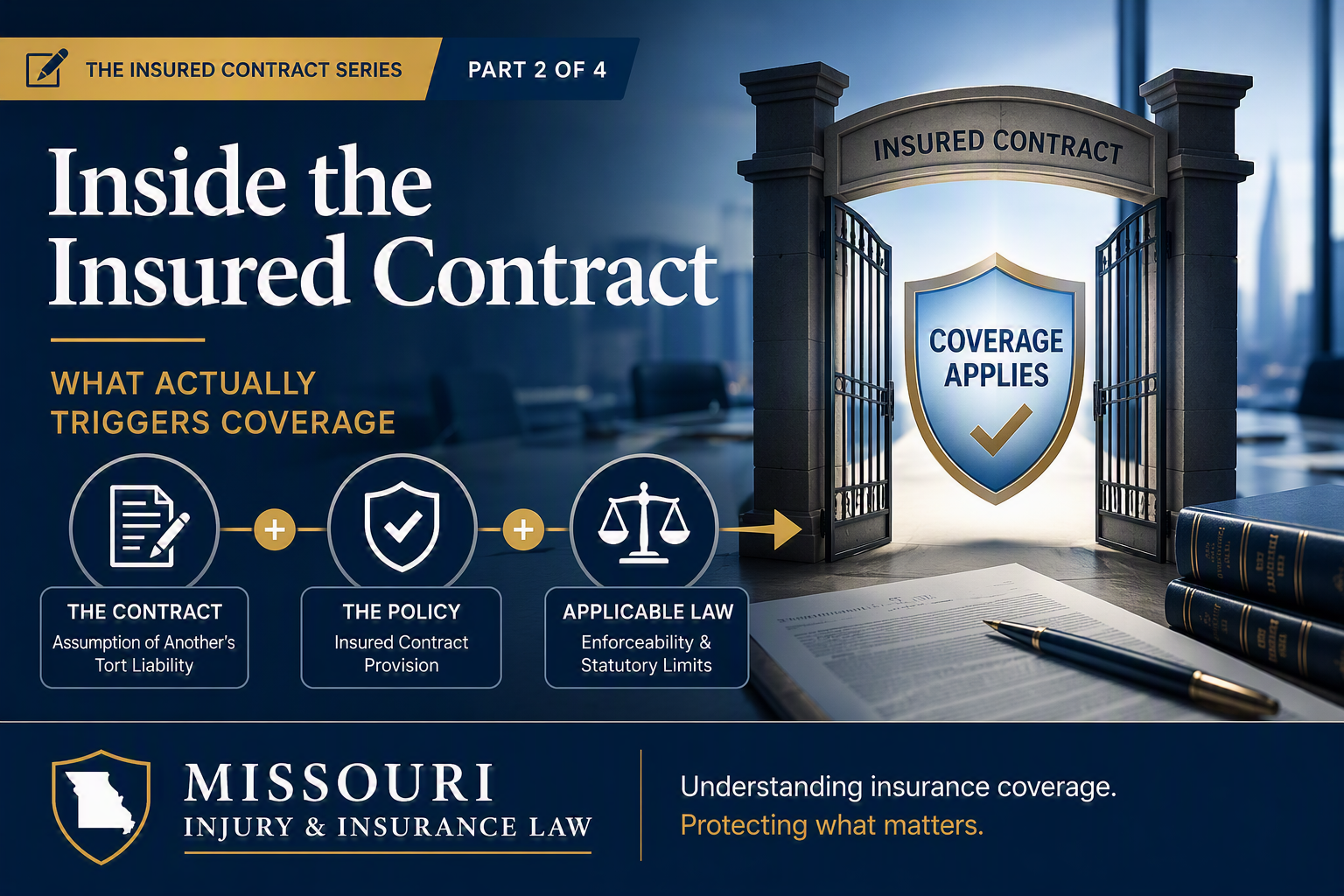
Inside the Insured Contract
Key Takeaways
- Indemnification assures coverage for liability assumed under contracts but hinges on specific legal language and policy forms.
- Three forms of indemnification exist: broad, intermediate, and limited, each varying in liability coverage and implications.
- An express indemnification clause is beneficial but not strictly necessary; assumptions of liability can also exist outside labeled clauses.
- Coverage and enforceability rely on the intersection of contract, policy, and law, necessitating careful analysis of each.
- Different policy forms may redefine coverage definitions, making it essential to check endorsements alongside contract language.
Indemnification, Assumption of Liability, and What Actually Triggers Coverage
Part One introduced the insured contract provision identifying it in the three liability forms most often standing behind a commercial defendant — the Commercial General Liability (“CGL”) form, the commercial auto form, and the Businessowners Policy (“BOP”). Part One of this series also described the provision as a gate in the fence of the contractual liability exclusion: an assumption of another party’s tort liability that fits the definition passes back into coverage. Part Two discusses how to walk through the gate. What kind of contractual language qualifies, whether an express indemnification clause is strictly necessary, and how the answer may shift across policy editions and forms.
The Core Requirement: Assumption of Another’s Tort Liability
The catch-all category of the CGL’s insured contract definition turns on a single act: the insured’s assumption of the tort liability of another party for bodily injury or property damage to a third person. Tort liability, in this context, means liability that the law would impose even without the contract. The provision is therefore not about ordinary contract damages — a breach-of-warranty claim, a failure to perform — but about one party stepping into the shoes of another for the kind of liability that arises from injury to a third person.
The vehicle for that assumption is almost always an indemnification or hold-harmless clause. Indemnification is simply a promise by one party (the indemnitor) to answer for specified losses of another (the indemnitee). When that promise reaches the indemnitee’s tort liability for injury to a third person, and the agreement pertains to the insured’s business, the clause is what carries the contract through the gate.
Three Forms of Indemnification
Not all indemnification clauses assume the same amount of liability, and the difference controls how much the insured contract provision pulls into coverage. Three forms recur:
Broad form. The indemnitor assumes liability for the indemnitee’s losses without regard to fault — including losses caused entirely by the indemnitee’s own negligence. This is the most sweeping assumption, and, as discussed below, the one most likely to run into statutory limits.
Intermediate form. The indemnitor assumes liability except to the extent the loss is caused by the indemnitee’s sole negligence. The indemnitor answers for its own fault and for shared fault, but not for the indemnitee’s fault standing alone.
Limited form. Each party bears responsibility only for the liability its own conduct caused. The indemnitor assumes nothing beyond what its own fault would already impose.
An analogy helps. Picture two drivers splitting responsibility for whatever happens on a shared trip. Broad form is one driver agreeing to pay for every accident, even the ones the other driver alone caused. Intermediate form is that driver paying for everything except the crashes that were purely the other’s doing. Limited form is each driver simply paying for their own crashes. The further toward broad form the clause reaches, the more of the indemnitee’s exposure the insured contract provision stands to cover — and the more scrutiny the clause may draw under state indemnity law. An important note on the word indemnity. Insurance companies provide indemnity to their insureds, but here indemnity does not refer to the insurer-insured relationship which has special rules. In this article indemnity means common law indemnity between two contracting parties, neither one who is an insurance company.
Is an Express Indemnification Clause Necessary?
This is the question that separates a careful coverage analysis from a superficial one, and the honest answer is: it depends on the form and edition of the policy, and it should never be assumed.
The catch-all definition speaks of liability “assumed” in a contract. An express indemnification or hold-harmless clause is the clearest and most common way to assume another’s tort liability, and in the ordinary case it is what the analysis looks for. But the definitional language keys on the fact of assumption, not on any magic words, so the better practice is to read the entire agreement for any provision under which one party takes on the other’s tort exposure — not merely to search for a clause captioned “Indemnification.”
Two structural points sharpen this. First, some agreements accomplish the same assumption through operational or allocation-of-risk provisions that do not use indemnity vocabulary at all. For example, a service agreement may never use the words “indemnify” or “hold harmless,” but may provide that the contractor is “solely responsible for all claims, losses, damages, and expenses arising out of bodily injury to third persons during the contractor’s work, including claims asserted against the premises owner.” If an injured third party sues the premises owner for negligence, that operational allocation may function as an assumption of the owner’s tort liability even though the clause is not labeled as indemnity. Second, and cutting the other way, some policy forms or endorsements narrow the definition so that even clear assumption language is not enough. The result is that the presence of an indemnity clause is strong evidence the gate is open, but its absence is not conclusive that the gate is shut, and its presence is not conclusive that the gate is open. The controlling text is always the specific policy form in front of you, read together with the specific contract.
| Practice Tip The point is not that any one category of agreement is special. The assumption may be buried in agreements lawyers do not instinctively associate with insured-contract coverage: management agreements, franchise agreements, equipment-rental documents, facility-use contracts, vendor terms, service agreements, or even internal governance agreements. The label on the document does not control. The question is whether some provision, wherever located, shifts responsibility for third-party bodily injury or property-damage liability from one party to another. |
How the Forms and Editions Differ
CGL Editions and the Endorsements That Reshape the Definition
The CGL’s treatment of contractually assumed liability has evolved across editions, and two endorsements show why the prior section’s caution matters. The Contractual Liability Limitation endorsement, ISO form CG 21 39, deletes the catch-all category from the insured contract definition entirely — leaving only the narrow enumerated categories. Where that endorsement is attached, no amount of non-enumerated assumption language will open the gate. Separately, the Amendment of Insured Contract Definition endorsement, ISO form CG 24 26, narrows the catch-all so that it reaches assumed tort liability only where the injury is caused, in whole or in part, by the named insured or those acting on the named insured’s behalf. That is a meaningful contraction: under the amended definition, an assumption of the other party’s independent fault may fall outside coverage.
The lesson is procedural as much as substantive. Confirming that a policy is written on CG 00 01 is not the end of the inquiry; the endorsement schedule has to be checked for CG 21 39, CG 24 26, or any other modification of the definition before concluding that a given contract triggers coverage.
Commercial Auto
The commercial auto form, CA 00 01, defines insured contract within its own liability section, and its structure does not track the CGL word for word. In vehicle cases — where the auto policy is often the primary coverage — the assumption-of-liability analysis must be run against the auto form’s definition directly. It is entirely possible for a contractual relationship to satisfy one form’s definition and not the other’s, which is why a program containing both a CGL and a commercial auto policy requires the analysis to be performed twice, separately.
BOP
BOP liability sections generally mirror CGL contractual-liability language, including a version of the insured contract exception, but the forms are less uniform across carriers. A BOP definition should be read in its own text rather than presumed identical to CG 00 01, and the same endorsement caution applies — a carrier’s proprietary BOP may narrow the definition in ways the standardized CGL endorsements would.
Enforceability Is a Separate Question From Coverage
A point that is easy to blur: whether an indemnification clause is enforceable as a matter of contract law and whether the liability it assumes is covered under the policy are two different questions, governed by two potentially different bodies of law. A clause can be enforceable yet fall outside the insured contract definition; it can fit the definition yet be unenforceable under the governing state’s indemnity statute. Both questions have to be answered under the correct law.
Missouri supplies a concrete example in the construction context. Section 434.100, RSMo, voids broad-form indemnification in construction contracts to the extent a party attempts to be held harmless from its own negligence or wrongdoing. The statute preserves certain arrangements — notably a party’s promise to name another as an additional insured, and an indemnity obligation capped at the limits of insurance the indemnitor was required to carry and had the opportunity to price into the contract. See § 434.100.2, RSMo. The upshot is that the same broad-form language that would be void in a Missouri construction subcontract can be entirely enforceable in a trucking, equipment-service, or vendor agreement, because § 434.100 reaches only construction work. A clause’s enforceability, in other words, can turn on the industry and the state — which is precisely why the coverage analysis cannot be separated from the indemnity-law analysis.
The Choice-of-Law Preview
That last point opens onto a larger one, developed in Part Three. The indemnification agreement and the insurance policy are separate instruments, and they are not necessarily governed by the same law. A supply or service contract may have been negotiated and performed in one state, with its own choice-of-law clause, while the policy that must respond is interpreted under the law of another. When the indemnity obligation is governed by one state’s law and the coverage question by another’s, the analysis becomes genuinely two-dimensional — and getting either dimension wrong can defeat an otherwise valid claim to coverage.
| Practice Tip Treat the contract and the policy as separate instruments. The indemnity clause may be governed by one state’s law, while the coverage question is governed by another. Do not automatically default to your home state’s law. In many cases, more than one state’s law is a plausible candidate depending on the contract, the policy, the parties, and the underlying loss. Research whether another state’s law is more favorable to the indemnity or coverage position, then frame the issue accordingly. |
The Takeaway: The Gate Opens Only When Contract, Policy, and Law Line Up
The main point of Part Two is simple, but easy to miss in practice. Insured-contract coverage is not triggered merely because a contract exists, and it is not defeated merely because the agreement lacks a clause captioned “Indemnification.” The question is whether the insured has assumed another party’s tort liability for bodily injury or property damage to a third person, whether the policy form and endorsements recognize that assumption, and whether the obligation is enforceable under the law that governs it. The analysis works only when the contract, the policy, and the governing law are all read together.
Coming Next
Part Three turns to consequences. A successful assertion may find more coverage for an injured party and provide a defense and indemnitee to a potentially liable party. When insured contract coverage exists and a carrier fails to recognize the issue, or worse declines — fails to defend or settle on that party’s behalf, or obtains a release that omits it — the result can be an excess judgment and extra-contractual exposure. The next installment examines Missouri bad faith and breach of fiduciary duty doctrine, the discipline of mapping every covered party at the outset, the choice-of-law problems that arise when indemnity and coverage are governed by different states’ law, and the systematic plan these technical claims require.