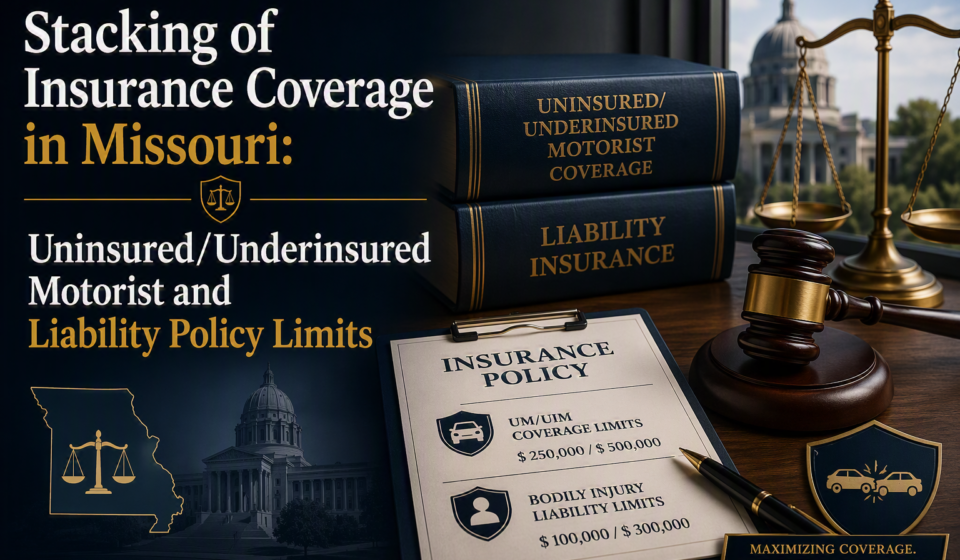
Stacking of Insurance Coverage in Missouri: Uninsured/Underinsured Motorist and Liability Policy Limits
Navigating Missouri’s stacking rules to maximize recovery for seriously injured clients
Missouri Injury & Insurance Law | missouriinjuryandinsurancelaw.com
Introduction
For seriously injured clients whose damages exceed a single policy’s limits, the availability of multiple layers of insurance coverage can be the difference between adequate compensation and financial ruin. Missouri’s rules governing the stacking of insurance policies—both within a single policy and across multiple policies—are nuanced and require careful analysis in every significant injury case. This post addresses stacking principles under Missouri law, the relevant statutory framework for uninsured and underinsured motorist coverage, and practical strategies for identifying and accessing all available coverage.
What Is Stacking?
Stacking refers to the practice of combining coverage from multiple insurance policies, or multiple coverages within a single policy, to increase the total amount available to compensate an injured person. Two types of stacking are recognized: inter-policy stacking, which involves combining coverage from separate policies issued by different insurers; and intra-policy stacking, which involves combining coverages within a single policy—for example, stacking uninsured motorist coverage across multiple vehicles listed on a single policy.
Missouri’s Uninsured and Underinsured Motorist Stacking Rules
Missouri requires all automobile liability policies to include uninsured motorist coverage. Mo. Rev. Stat. § 379.203 (2023). Underinsured motorist coverage is also required under Missouri law. The stacking of UM/UIM coverage in Missouri is governed both by statute and by the specific anti-stacking language in the policy at issue.
Missouri courts have addressed the enforceability of anti-stacking provisions in UM/UIM policies. Generally, an insurer may prohibit intra-policy stacking through clear and unambiguous anti-stacking language. However, anti-stacking provisions that conflict with the minimum coverage requirements of § 379.203 or that are ambiguous will be construed against the insurer. Practitioners should scrutinize anti-stacking language carefully for ambiguity, particularly in multi-vehicle policies.
Commercial Policy Considerations
Cases involving commercial vehicles, fleet policies, or umbrella coverage present additional stacking opportunities. Commercial automobile policies may cover multiple vehicles under a single policy with per-vehicle limits that can potentially be stacked depending on the policy language. Umbrella and excess policies may provide additional layers of coverage above the primary liability limits, subject to their own terms and conditions.
Practitioners handling commercial vehicle cases should request complete copies of all policies in the insured’s portfolio, including primary commercial auto, excess, umbrella, and any specialty coverages. A certificate of insurance is not sufficient—the practitioner needs the actual policy documents with all endorsements to conduct a complete coverage analysis.
Employer Liability and Workers’ Compensation Interaction
In cases where the injured party is an employee injured in the course of employment, the intersection of workers’ compensation, employer liability, and automobile insurance coverage requires careful analysis. Missouri’s workers’ compensation exclusivity provisions, Mo. Rev. Stat. § 287.120 (2023), generally bar tort claims against the employer, but exceptions exist—particularly in cases involving intentional acts or where the employer is not the direct tortfeasor.
Practitioners should also analyze whether the employer’s automobile policy, commercial general liability policy, or other coverages may provide additional recovery opportunities beyond the workers’ compensation system, particularly in cases involving third-party tortfeasors. Be aware that many policies contain limitations or exclusions when workers compensation benefits have been recovered. These clause must be scrutinized carefully to determine their application to the facts and whether they are valid and enforceable.
Practical Coverage Investigation
A comprehensive coverage investigation in any significant injury case should include: identification of all potentially liable parties; requests for insurance information under Mo. R. Civ. P. 56.01 and the informal discovery mechanisms available in Missouri; examination of the client’s own insurance portfolio for UM/UIM and medical payments coverage; and investigation of any excess or umbrella policies held by the tortfeasor or the tortfeasor’s employer.
Early coverage investigation is essential. Policy proceeds do not increase over time, but the attorney’s knowledge of available coverage fundamentally affects case strategy, settlement leverage, and the ultimate outcome for the client.
Conclusion
Missouri’s stacking rules reward practitioners who conduct thorough early coverage investigations and who understand both the statutory framework and the specific policy language at issue. In significant injury cases, the difference between adequate and inadequate recovery often lies in the thoroughness of the coverage analysis.