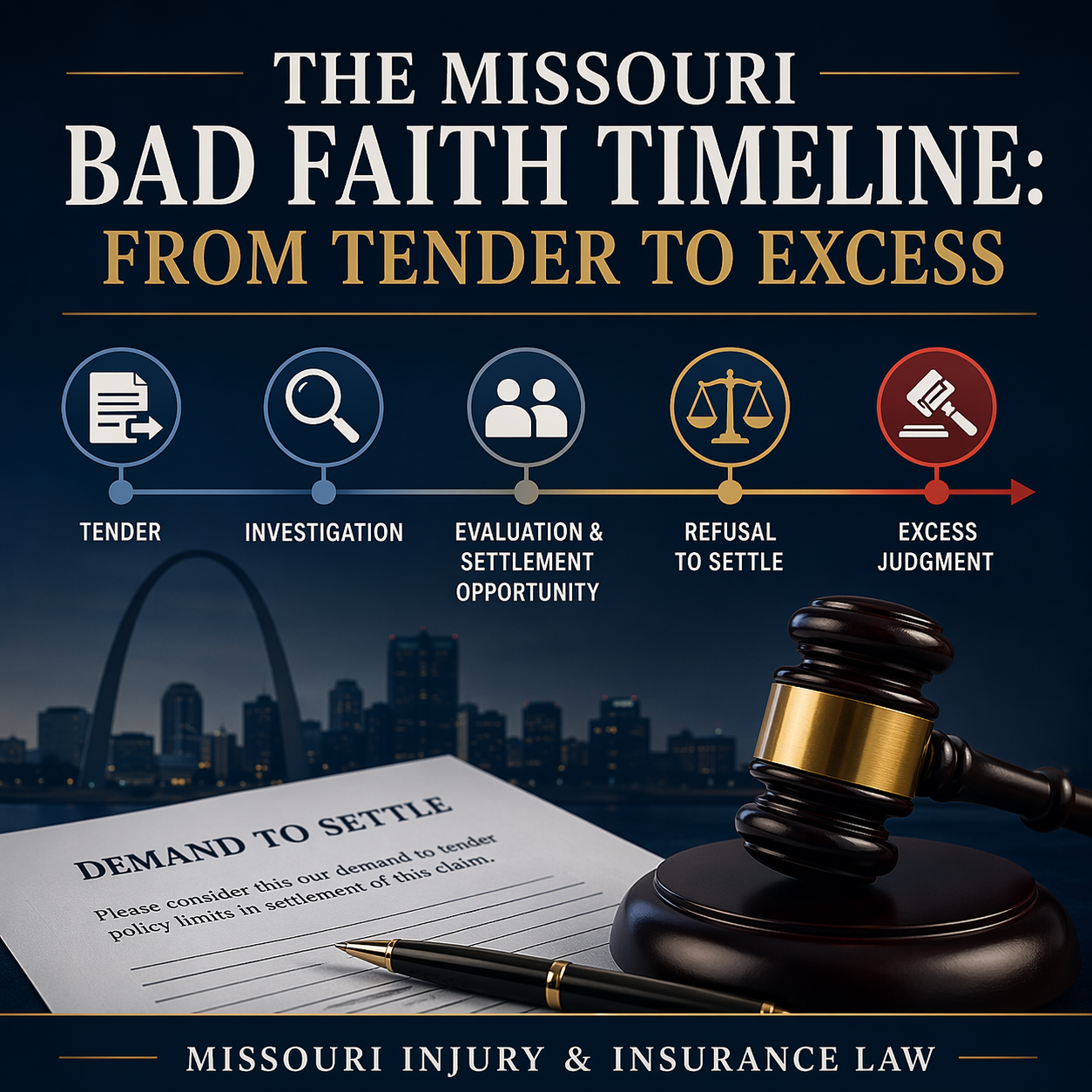
The Missouri Bad Faith Timeline: From Tender to Excess Judgment
A chronological practitioner’s guide to how a Missouri bad faith failure to settle case develops — the elements, the key decision points, what the insurer must do at each stage, and what happens when it does not
Missouri Injury & Insurance Law | missouriinjuryandinsurancelaw.com
I. Introduction
Bad faith failure to settle is one of the most powerful causes of action in Missouri insurance law. When an insurer wrongfully refuses to settle a third-party claim within its policy limits while the insured is exposed to excess liability, and a judgment or settlement in excess of those limits results, the insurer may be liable for the full excess — and potentially for punitive damages beyond that. The cause of action is grounded in the fiduciary relationship between insurer and insured and in the fundamental bargain the insured made when purchasing liability insurance: the insurer controls the defense and the settlement, and in exchange it owes the insured good faith in exercising that control.
Understanding Missouri bad faith law requires more than knowing the elements. It requires understanding the timeline — the sequence of events from the initial claim tender through investigation, settlement demands, refusal, litigation, and ultimate excess judgment — and what the insurer’s obligations are at each stage. A bad faith case is built or lost at each point along that timeline, and the failure to document the insurer’s conduct at any one of those points can be fatal to the claim.
This post walks through the complete Missouri bad faith timeline: the foundational authorities, the elements, the phases of a typical bad faith case, what conduct at each phase constitutes or evidences bad faith, and the strategic considerations for plaintiff’s counsel building a bad faith record.
II. The Foundational Authority: From Zumwalt to Scottsdale
Missouri recognized the tort of bad faith failure to settle in 1950. Zumwalt v. Utilities Insurance Co., 228 S.W.2d 750 (Mo. 1950) established that where an insurer is guilty of fraud or bad faith in refusing to settle a claim against its insured within policy limits, it may be liable to the insured for the resulting excess judgment. Zumwalt defined bad faith as “the intentional disregard of the financial interest of the insured in the hope of escaping the responsibility imposed upon the insurer by its policy.” That definition has remained the touchstone of Missouri bad faith law for over seventy years.
The Missouri Supreme Court’s 2014 decision in Scottsdale Insurance Co. v. Addison Insurance Co., 448 S.W.3d 818 (Mo. banc 2014) reaffirmed and significantly extended Zumwalt. Scottsdale resolved three critical questions that had created uncertainty in Missouri bad faith practice:
No excess judgment required. The insured need not sustain an excess judgment to maintain a bad faith failure to settle claim. A settlement above policy limits, or any other financial exposure caused by the insurer’s bad faith refusal, is sufficient. Scottsdale, 448 S.W.3d at 827-28.
No demand by the insured required. The insured need not have formally demanded that the insurer settle within policy limits. The insurer’s duty to consider settlement runs independently of a formal demand from the insured. Id. at 828.
Bad faith claims are assignable. A bad faith failure to settle claim falls within the category of assignable torts under Missouri law. The insured may assign the claim to the injured party as consideration for settlement. Id. at 829-30.
| Scottsdale in plain terms: bad faith is not limited to cases that end in excess jury verdicts. Any time an insurer’s bad faith refusal to settle causes financial exposure to the insured — including a settlement above policy limits — the bad faith claim exists. And that claim can be assigned directly to the injured party. |
III. The Elements of the Bad Faith Failure to Settle Claim
Drawing from Zumwalt and Scottsdale, the elements of a Missouri bad faith failure to settle claim are:
1. Policy control. The insurer reserved the exclusive right to contest or settle claims under the policy.
2. Settlement prohibition. The insurer’s policy prohibited the insured from voluntarily assuming liability or settling any claim without the insurer’s consent.
3. A reasonable opportunity to settle. The insurer had a reasonable opportunity to settle the claim within the policy limits. This element is implicit in the “refusing” aspect of bad faith itself — an insurer cannot be said to have refused a settlement it never had the chance to make. Purscell v. Tico Ins. Co., 790 F.3d 842, 847 (8th Cir. 2015) (“Implicit in the ‘refusing’ aspect of the bad faith element is a showing that the insurer had a reasonable opportunity to settle within the policy limits.”); State Farm Fire & Cas. Co. v. Metcalf, 861 S.W.2d 751, 756 (Mo. Ct. App. 1993) (“Not having had an opportunity to settle the claim within policy limits, State Farm could not have refused to do so.”). A mere opportunity to participate in mediation is not equivalent to a reasonable opportunity to settle for a specific amount, and the absence of a demand at or within the policy limits may defeat the element altogether. United Fire & Cas. Co. v. Advantage Workers Comp. Ins. Co., 2017 U.S. Dist. LEXIS 167472, at *13-16 (W.D. Mo. June 26, 2017).
4. Refusal in bad faith. The insurer refused to settle the claim within policy limits, and that refusal was in bad faith — the insurer intentionally disregarded the insured’s financial interests in the hope of escaping the insurer’s own responsibility under the policy. Bad faith is more than negligence; the evidence must establish that the insurer intentionally disregarded the insured’s best interests in an effort to escape its full responsibility under the policy. Purscell, 790 F.3d at 847.
5. Resulting financial exposure. The insured sustained financial exposure — an excess judgment, an excess settlement, or other quantifiable loss — as a result of the insurer’s bad faith refusal.
Bad faith is a state of mind, but it need not be proven by direct evidence. Missouri courts apply a totality of the circumstances test. Bad faith can be — and most often is — established through circumstantial evidence of the insurer’s conduct throughout the claims handling process. Zumwalt, 228 S.W.2d at 753; Ganaway v. Shelter Mutual Insurance Co., 795 S.W.2d 554, 562 (Mo. App. 1990). A finding of mere negligence in claims handling does not rise to the level of bad faith. The conduct must reflect an intentional disregard of the insured’s interests, not merely careless or mistaken claims handling.
IV. The Bad Faith Timeline: Phase by Phase
A bad faith case is built across a timeline that typically spans from the initial claim notice through the underlying litigation, the failure to settle, and the resulting exposure. Understanding what the insurer must do — and what it must not do — at each phase is essential to both prosecuting and defending a bad faith claim.
Phase 1 — Claim Notice and Initial Investigation
The insured notifies the insurer of the claim or underlying lawsuit. The insurer’s obligations begin immediately: prompt investigation, evaluation of liability and damages, assessment of policy limits exposure, and communication with the insured about the claim status and the potential for excess exposure.
The insurer’s obligation at the notice and investigation stage is to conduct a thorough, objective, and prompt investigation of the claim. This means obtaining witness statements, reviewing the accident report, obtaining medical records and bills, evaluating the injured party’s current and future damages, and forming an honest assessment of both liability and the probability that a verdict could exceed policy limits.
Missouri courts have held that the following investigative failures are evidence of bad faith: failing to fully investigate and evaluate the third-party claimant’s injuries; failing to recognize the severity of the claimant’s injuries and the probability that a verdict would exceed policy limits; and failing to advise the insured of the potential for an excess judgment. Johnson v. Allstate Insurance Co., 262 S.W.3d 655, 662 (Mo. App. W.D. 2008); Rinehart v. Shelter General Insurance Co., 261 S.W.3d 583, 596 (Mo. App. W.D. 2008). The insurer’s investigation cannot be designed to find reasons to minimize the claim.
Phase 2 — Settlement Demand
The injured party or plaintiff’s counsel makes a settlement demand — often a time-limited demand within or at the policy limits. The insurer must evaluate the demand promptly, honestly, and with equal consideration for the insured’s financial interests. This is the critical decision point in most bad faith cases.
When a settlement demand is received, the insurer’s obligation is to evaluate it from the perspective of both the insurer’s and the insured’s interests simultaneously. The insurer must consider: the strength of the liability evidence; the nature and extent of the claimant’s injuries; the probability that a jury verdict could exceed the policy limits; and the financial consequences to the insured of a judgment in excess of those limits.
The insurer’s failure to respond to a settlement demand, failure to advise the insured of the demand, and failure to advise the insured of the potential for an excess judgment are all independently recognized as evidence of bad faith. Johnson v. Allstate, 262 S.W.3d at 662; Rinehart, 261 S.W.3d at 596.
Missouri’s § 537.058 RSMo (enacted 2017) establishes requirements for time-limited settlement demands to be admissible as evidence of an insurer’s bad faith: the demand must be transmitted to the tortfeasor’s liability insurer in writing by certified mail, must reference the statute, and must be left open for not less than 90 days. A properly made § 537.058 demand that the insurer refuses creates a documented settlement opportunity that becomes central evidence in any subsequent bad faith action.
| Critical documentation point: every settlement demand received by the insurer, every internal evaluation of that demand, every communication between the claims adjuster and supervisors about whether to accept or reject the demand, and every communication with the insured about the demand and the excess exposure is potential evidence in a bad faith case. The claims file is the bad faith case. |
Phase 3 — Refusal to Settle
The insurer declines to accept the demand or allows a time-limited demand to expire without acceptance. This is the act that triggers the bad faith claim. The insurer may have legitimate reasons to decline a specific demand at a specific time. The question is whether the refusal reflected an honest, good-faith evaluation of the insured’s interests or whether it reflected the insurer’s prioritization of its own financial position over the insured’s.
Missouri courts have identified specific conduct that constitutes or strongly evidences bad faith in the refusal to settle:
Gambling on the verdict. The insurer gambles that the jury will return a verdict below policy limits when the evidence strongly suggests a verdict above limits is probable. Zumwalt, 228 S.W.2d at 753.
Refusing to consider a settlement offer. The insurer refuses to even consider a settlement demand within policy limits without a legitimate investigative basis for doing so. Landie v. Century Indemnity Co., 390 S.W.2d 558, 566 (Mo. App. 1965).
Focusing on coverage to the exclusion of damages. The insurer’s claims handling focuses exclusively on coverage defenses while ignoring the damages evidence and the probability of an excess verdict. Landie, 390 S.W.2d at 566.
Inconsistent representations. Making inconsistent representations to multiple claimants involved in the same accident. Rinehart, 261 S.W.3d at 596.
Failing to advise the insured. Failing to advise the insured of settlement demands or of the potential for an excess judgment. Johnson, 262 S.W.3d at 662.
Late tender within limits. Tendering policy limits only after the settlement window has closed and the claimant has rejected limits-only settlement. An insurer that waits too long and then tenders limits when that amount can no longer settle the case has not cured its earlier bad faith. Scottsdale, 448 S.W.3d at 823.
Phase 4 — Underlying Litigation Proceeds
Because the insurer refused to settle, the case proceeds to trial. The insurer continues to control the defense. During this phase, the insurer’s conduct in litigation — how it defends the case, whether it continues to evaluate settlement opportunities, and how it communicates with the insured — continues to accumulate as evidence of its overall good faith or bad faith.
Bad faith is not a single decision; it is a course of conduct. An insurer that refused a reasonable settlement demand but then reevaluates the case as evidence develops, offers the full policy limits, and diligently pursues settlement may be in a different position than an insurer that stonewalls throughout the litigation while the insured’s exposure grows.
During litigation, the insurer must continue to advise the insured of all settlement opportunities and of the ongoing potential for an excess verdict. An insurer that pursues a litigation strategy that benefits its coverage position at the expense of the insured’s liability exposure compounds the bad faith.
Phase 5 — Excess Judgment or Excess Settlement
The jury returns a verdict, or the case settles, for an amount exceeding the policy limits. This is the damages event. The insured is now personally exposed for the amount above the policy limits. Under Scottsdale, an excess settlement reached by the insured after the insurer’s bad faith refusal also satisfies the damages element without requiring a jury verdict. Scottsdale, 448 S.W.3d at 827-28.
Before Scottsdale, Missouri courts had created uncertainty about whether a bad faith claim required an excess judgment specifically, or whether an excess settlement would also suffice. Scottsdale resolved this: excess judgment is not required. The insurer’s obligation to act in good faith protects the insured from excess financial exposure of any kind.
Phase 6 — Assignment and Bad Faith Litigation
The insured assigns the bad faith failure to settle claim to the injured party as consideration for the settlement. The injured party, now holder of the assigned bad faith claim, prosecutes the bad faith action against the insurer. The bad faith action is tried on the claims file, the testimony of adjusters and supervisors, expert testimony on claims handling standards, and the full record of the insurer’s conduct from notice through the excess exposure event.
Scottsdale confirmed that the bad faith failure to settle claim is assignable. Once assigned, the injured party stands in the insured’s shoes with respect to the bad faith claim and may prosecute it directly against the insurer. The measure of damages on the assigned bad faith failure to settle claim is the amount by which the settlement or judgment exceeded the policy limits, plus attorney’s fees and costs incurred in pursuing the bad faith claim. Where the insurer’s conduct meets the Missouri standard for punitive damages — clear and convincing evidence of intentional harm without just cause or deliberate and flagrant disregard for safety under § 510.261 RSMo — punitive damages are also available.
V. Building the Bad Faith Record: What Plaintiff’s Counsel Must Do
A bad faith case is made in the claims file. The claims file is the contemporaneous documentary record of everything the insurer did and did not do from notice through the excess exposure event.
The Claims File
Discovery in a bad faith action targets the complete claims file: adjuster notes, supervisor reviews, coverage opinions, reserve histories, settlement authority requests, communications with defense counsel, communications with the insured, communications with claimant’s counsel, and all internal evaluations of liability and damages. Reserve histories are particularly valuable because reserves reflect the insurer’s own internal assessment of its exposure at each stage of the litigation. An insurer that maintained a reserve significantly above its last settlement offer was internally acknowledging that the case was worth more than it offered.
Expert Testimony on Claims Handling Standards
Bad faith cases typically require expert testimony on insurance industry claims handling standards. The expert reviews the claims file and opines on whether the insurer’s conduct at each phase of the timeline deviated from the standards of a reasonable liability insurer under the same or similar circumstances. Deviation from the insurer’s own internal guidelines is particularly powerful evidence.
The Time-Limited Demand
A properly structured § 537.058 RSMo time-limited demand creates a documented settlement opportunity that establishes the factual predicate for the bad faith claim. The demand must be in writing, sent by certified mail, reference § 537.058, and be left open for not less than 90 days. A demand that satisfies these requirements and is rejected by the insurer becomes the centerpiece of the bad faith case.
Practice Tip: Calendar the 90-day window on the day the demand is sent and confirm delivery with your certified mail receipt. The insurer’s non-response, low-ball counter, or late tender within the window all go in your file as documented evidence of the settlement opportunity and the refusal.
The Statute of Limitations
A Missouri bad faith failure to settle claim is a tort action. The five-year statute of limitations applicable to tort claims under § 516.120 RSMo applies. The limitations period runs from the date the cause of action accrues — which under Missouri’s capable-of-ascertainment standard is when the insured knew or by the exercise of reasonable diligence should have known of the damage caused by the insurer’s bad faith refusal. Powel v. Chaminade College Preparatory, Inc., 197 S.W.3d 576 (Mo. banc 2006). In most cases, the period begins to run when the excess judgment is entered or the excess settlement is finalized.
VI. Conclusion
Missouri bad faith law provides powerful tools for insureds and injured parties who have been harmed by an insurer’s intentional disregard of its obligations. The cause of action is grounded in the fiduciary relationship between insurer and insured and reflects the fundamental bargain the insured made: the insurer controls the defense and settlement, and in exchange it owes the insured good faith in protecting the insured’s financial interests.
Understanding the bad faith timeline means understanding that bad faith is not a single act but a course of conduct that develops from notice through investigation, settlement demand, refusal, litigation, and excess exposure. Critically, the “refusing” element of bad faith carries within it the prerequisite showing that the insurer actually had a reasonable opportunity to settle within the policy limits — there can be no refusal where there was no meaningful opportunity. Purscell, 790 F.3d at 847; Metcalf, 861 S.W.2d at 756. The insurer’s conduct at each phase matters. The claims file is the evidence. And under Scottsdale, the full measure of the insurer’s bad faith is available even without an excess jury verdict — and the claim can be assigned directly to the injured party who is best positioned to hold the insurer accountable.