Process Is Proof: Claims-Handling Discovery in Missouri First-Party UM/UIM Cases
Why the insurer’s “we just valued it differently” defense rarely survives a record built piece by piece.
Key Takeaways
- The defense in first-party UM/UIM cases often compartmentalizes evidence, arguing each piece is relevant only to its specific context.
- Missouri law distinguishes between breach of contract and vexatious refusal to pay, complicating plaintiffs’ burdens in claims.
- Cumulative evidence across various standards can illustrate insurer misconduct, making the case stronger for the plaintiff.
- Public statements by insurers about claims practices can be used as admissions, showing a discrepancy between promises and actions.
- The article advocates for assembling evidence systematically, demonstrating that process failures lead to the inadequate valuation of claims.
The most effective tactic the defense has in a first-party uninsured or underinsured motorist (UM/UIM) case is not about the wreck or the medicine. It is architectural. The defense sorts the case into separate doctrinal boxes and then argues that each piece of evidence may be measured only against the box nearest to it — the late letter is a timing quibble, the unqualified medical review is a mere difference of opinion on value, the adjuster’s compensation is “irrelevant to a contract claim.” The doctrines it invokes are real and genuinely distinct. What is wrong is the step from distinct standards to narrow relevance. That step is the subject of this article, because it is where an insurer’s conduct is either proven or quietly kept from the jury.
Two Standards, Kept Honestly Apart
Missouri does not recognize a common-law tort of bad faith for first-party claims — sadly, and to the lasting disadvantage of its own policyholders. In Overcast v. Billings Mut. Ins. Co., 11 S.W.3d 62, 67 (Mo. banc 2000), the Supreme Court of Missouri held that an insurer’s wrongful refusal to pay a first-party claim is a breach of contract, remedied by contract damages, with a statutory penalty available on top if the refusal was vexatious under sections 375.420 and 375.296, RSMo. Two standards follow, and they measure different things. Breach turns on amount: if the policy owed more than the insurer paid, the contract is broken for the difference, proved with medical and damages evidence. Vexatiousness turns on reasonableness: whether, on the facts as they appeared, a reasonable insurer would have refused to pay. Qureshi v. Am. Family Mut. Ins. Co., 604 S.W.3d 721, 727 (Mo. App. E.D. 2020); Dhyne v. State Farm Fire & Cas. Co., 188 S.W.3d 454, 457 (Mo. banc 2006).
These are not the same inquiry, and it is worth saying so plainly, because the distinction is real and the plaintiff still has to carry the burden each standard imposes. Reasonable is not the same as correct. A claim the jury ultimately values at $70,000 may have drawn a $20,000 offer that rested on some defensible reading of a disputed record; the offer can clear the vexatious bar and still leave the contract breached for the $50,000 shortfall. Reasonableness decides whether the penalty attaches, not whether there was a breach. A prepared plaintiff’s lawyer knows which proof answers which question.
The trouble is what the winning plaintiff actually takes home. Missouri’s statutory scheme does nothing more than enforce the promise the insurer already made, adding a reasonable attorney’s fee, taxable court costs, and a modest penalty capped at twenty percent of the first $1,500 of the loss and ten percent of the remainder. On the $50,000 shortfall above, that penalty is roughly $5,150 — and the recovery reaches none of the true cost of the fight, the expert fees and litigation expenses a contested UM/UIM case routinely consumes and that Missouri does not tax as costs. The plaintiff who wins is still left behind the eight ball, made less than whole for having to sue to collect a benefit he already bought. Worse, the insurer that loses pays only what it always owed, plus fees and a small penalty, so the downside of denying is barely distinguishable from the downside of paying — and the incentive to pay promptly, or at all, largely disappears. This is a minority position, and a punishing one for Missouri citizens.[1] Most states have refused to impose it, extending instead either a common-law tort of first-party bad faith or a statutory remedy with real teeth — consequential and often punitive damages, multiplied recoveries, and full fee-and-cost shifting — precisely to make delay and denial economically irrational and to hold insurers to the promises they actually sold.
Distinct Standards Are Not Narrow Relevance
The defense’s move is to treat the narrowness of each standard as if it set the width of what may be discovered and shown. It does not. Under Missouri Rule of Civil Procedure 56.01(b)(1), a party may obtain discovery of “any matter, not privileged, that is relevant to the subject matter involved in the pending action” — a reach deliberately tied to the subject matter of the case rather than to the elements of a single count, and one Missouri kept broader than its federal counterpart even after adding a proportionality limit in 2019. Material need not even be admissible to be discoverable, so long as it is reasonably calculated to lead to admissible evidence. Relevance, in other words, is a property of the case, not of a box.
That is why one fact so often does work in several directions at once. An unanswered demand that the insurer explain a low offer bears on the reasonableness of the refusal, on the insurer’s performance of the contract, and on the credibility of the defense that it “considered everything and simply weighed it differently” — all three, from a single letter. The standards stay distinct; the evidence does not respect their walls.
And it cannot, because of how the conduct of a corporation is proven. A company has no mind of its own; it acts only through its agents, and its agents do not testify to bad motive. Proof of what the insurer actually did is therefore circumstantial and cumulative, assembled from the record rather than confessed. This is the point at which agency, contract, and insurance claims practices stop being separate subjects — not at the level of the standards, which remain distinct, but at the level of proof, where the same conduct evidence is relevant to the company’s performance, its reasonableness, and its state of mind together. The legitimate limit on that breadth is proportionality, the boundary the rule actually draws. The narrow-relevance argument the defense presses is not that boundary; it is a way of dismantling the proof one piece at a time before the jury can see the whole.
The Evidence Does Not Freeze on the Day of Denial
A recurring defense move is to argue that the vexatious inquiry is limited to what the insurer knew and did before suit was filed. Missouri rejects that limitation. In Qureshi, the Eastern District refused to arbitrarily limit the evidence to the insurer’s pre-suit conduct and held that section 375.420 permits the jury to weigh all of the facts, testimony, and circumstances the insurer had before it up to the time of trial — including the adjusters’ deposition testimony and the continued low offer developed during the litigation itself. 604 S.W.3d at 727.
That holding coexists with the older rule that reasonableness is judged by the situation as presented to the insurer at the time it was called on to pay. Russell v. Farmers & Merchs. Ins. Co., 834 S.W.2d 209, 221 (Mo. App. S.D. 1992). The two answer different questions. Russell fixes the standard of judgment: the insurer is measured on the facts as they reasonably appeared, not with the benefit of the verdict’s hindsight. Qureshi fixes the window of conduct: the insurer’s course of dealing does not stop being relevant because a petition was filed, and recalcitrance that continues through discovery and trial is part of the record the jury may consider. An insurer that sits on a well-supported demand month after month, adding nothing to its file and offering no reason, is building the plaintiff’s case with each passing quarter.
A Fire Built Piece by Piece
Because the proof is cumulative, the craft lies in the assembly, and the image that fits is a fire built by hand. Five or six violations of a claims-handling time standard are twigs — individually trivial, collectively kindling. A medical file reviewed and rejected without input from anyone with equivalent medical training is a log. An offer pitched below the plaintiff’s incurred medical bills, or below the cost of a surgery a physician recommended, is the fuel that gets the thing roaring. None of these is decisive alone. Together they let the jury draw the inference the insurer’s witnesses will never supply. Conduct inconsistent with the insurer’s stated position is the only practical way to show that the position was pretext, and it is difficult to find a case in which some process defect was not relevant to the outcome, precisely because process is where a corporation’s real priorities become visible.
The mental state of a corporation is harder to prove than the intent of an individual because a corporation speaks through managed language and acts through layers of people. The bad motive is rarely announced. It is found in repeated choices: what the company trained its people to do, what it rewarded, what it ignored, what it failed to correct, and what it kept doing after it knew the rule. That is why prior similar conduct matters when it can be tied to the claim in front of the jury. A market-conduct report finding violations of claims standards for failing to explain the basis for offers may involve a different line of insurance, but the similarity is not the policy form; it is the communication failure. The same statutory claims standards apply, the same obligation to give a reasonable and accurate explanation applies, the same management duty to adopt and implement reasonable standards applies, and the same corporate choice is exposed: whether the insurer actually enforces the rules it publicly claims to live by. The lawyer’s task is to cast similarity at that level — not as “they did something bad before,” but as “they made the same kind of claim-handling choice before, were told it violated the standard, and made a comparable choice here.” Claims statutes, regulations, manuals, and market-conduct findings are the legal frame. The company’s own values statements, codes of conduct, customer promises, and moral language supply the human frame. If the insurer tells the public it values fairness, prompt communication, accountability, and doing the right thing, then a documented failure to explain an offer is not just a technical claims-practice issue; it is evidence that the company’s actual operating choices departed from the standards it knew, advertised, and chose not to enforce.
A common answer is the “rogue employee” defense: one adjuster made a mistake, one supervisor missed it, one file went sideways. Variations include the “sick employee,” the “personal problems employee,” and my favorite, the “new or inexperienced employee.” I have seen all of them, and they all attempt to do the same thing: make the claims mishandling about the personal circumstances of the employee and invite sympathy for the employee, the company, or both. These explanations should not be allowed to stand untested. First and foremost, the company cannot sidestep responsibility for failing to supervise and manage its own people. In an insurance company, failure to supervise is itself a corporate choice. Insurers are uniquely positioned to audit and manage like claims because every claim is handled inside a system designed to record, measure, compare, and report what is happening. Patterns emerge quickly. They can be seen in financial metrics such as loss ratios, claim-severity reports, reserve changes, closing ratios, and payment trends — the kinds of management data insurers already use to see whether a line, office, unit, or adjuster is paying claims at materially different levels than expected. They can be seen in claim-file trends: repeated low evaluations, repeated delays, repeated failures to explain offers, repeated reliance on the same kind of paper review, repeated closing notes that say the same thing while ignoring the same facts. They can be seen in auditable communications: letters, emails, diary notes, supervisor reviews, authority requests, and system timestamps. Modern claim platforms, dashboards, search tools, and artificial intelligence make that kind of pattern recognition easier, not harder. If the company cared to know whether its people were following its rules, it could know. If it did not know, the question is why it chose not to look. If it did know and failed to correct the pattern, the case is no longer about a rogue employee. It is about a managed business process that produced the same kind of claim-handling failure the company had the tools, data, rules, and duty to prevent.
What Is Discoverable, and What Opens the Door
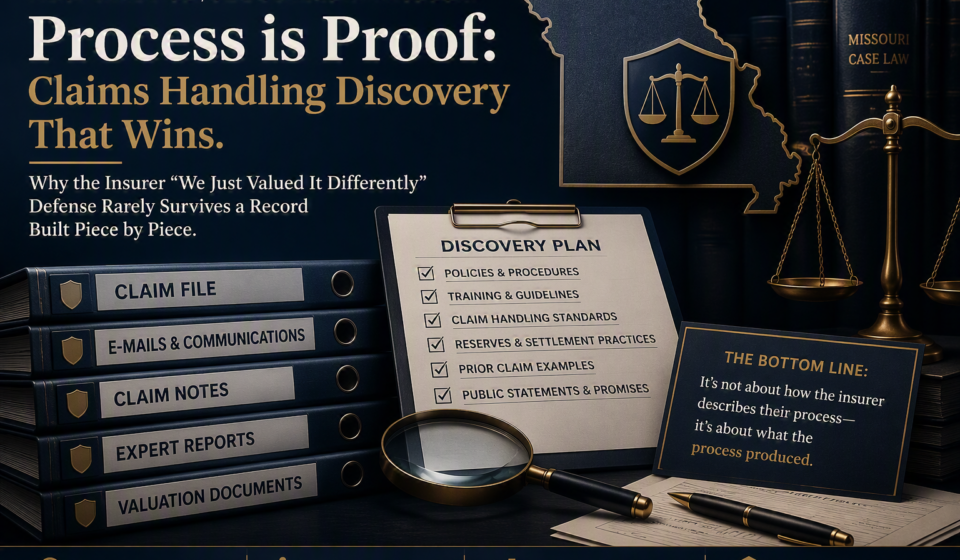
If process is the proof, the discovery plan has to reach the material that documents process, and each of the categories below is relevant to the subject matter of the action under Rule 56.01 — not merely to whichever single element it most obviously touches.
The claim file is the starting point, and in Missouri the most secure. The Supreme Court has analogized the insurer-insured relationship to the attorney-client relationship and held that the claim file belongs to the insured, who is entitled to its contents. Grewell v. State Farm Mut. Auto. Ins. Co., 102 S.W.3d 33, 37 (Mo. banc 2003); see also Grewell v. State Farm Mut. Auto. Ins. Co., 162 S.W.3d 503 (Mo. App. W.D. 2005). The file — its notes, its diary entries, its internal communications, its timeline — is the spine of any process argument.
Claims manuals and guidelines describe how the carrier tells its own people to investigate, evaluate, negotiate, communicate about, and pay the kind of claim at issue. Requests are often most defensible when they are narrowed to the relevant claim type — the UM/UIM guidelines, not the entire enterprise manual — because that both answers the burden objection and sharpens the relevance. But the request should not be narrowed so much that it misses the materials that actually governed the handling of the claim. Some insurers maintain state-specific manuals, general claims-handling manuals, and training materials that are not tied to a single coverage line but still control important parts of the process. Those materials may address negotiation, communications with injured parties or insureds, medical issues, vendor or expert-review procedures, workflow requirements, claim-system valuation tools, documentation standards, authority levels, and supervisory review. They matter because they set the standards the carrier holds its own adjusters to and supply the yardstick against which the handling of the file can be measured. The practical rule is to keep the request reasonable, but not artificially small: ask for the manuals, guidelines, bulletins, and training materials that governed or instructed the investigation, evaluation, negotiation, communication, documentation, supervision, and payment decisions at issue in the claim.
The medical review — who looked, and with what qualifications — is often the center of gravity in an injury case. Consider a composite that recurs in practice: an adjuster whose formal training is a two-year general-studies degree denies the need for a future surgery, having obtained either no medical review at all or a review from an outside vendor whose reviewer was a licensed practical nurse (LPN), while the treating physicians and a retained expert all say the surgery is indicated. Whether the insurer obtained a genuine medical review, and whether the reviewer was qualified to reach the conclusion the insurer adopted, goes directly to whether the investigation was reasonable. This is usually the least contestable category on relevance, because the statute itself requires a reasonable investigation.
Compensation and loss-ratio incentives are the most aggressively resisted category, and the one requiring the most care. Where the plaintiff can make a threshold showing that adjuster or manager compensation is tied to loss ratios or claim-severity reduction — that the people handling the file are rewarded for paying less — courts have compelled production of the incentive structure as relevant to why claims are handled the way they are. A bare allegation usually will not carry it; some evidentiary hook generally must come first.
Two things enlarge or restrict this list. The statutory floor enlarges it: the Unfair Claims Settlement Practices Act (UCSPA), sections 375.1000 to 375.1018, RSMo, and the Department’s regulations require the insurer to conduct a reasonable investigation, to attempt a prompt and fair settlement once liability is reasonably clear, and to affirm or deny coverage within a reasonable time — section 375.1007(4), (6), (7). The Act creates no private cause of action, but it supplies the standard against which handling is measured and makes the adequacy of the investigation squarely relevant. The posture of the case opens the internal door: when a vexatious count is pled, or when the insurer affirmatively alleges that the insured misrepresented or breached, the reasonableness of the insurer’s own process is placed in issue, and the internal, non-public material — manuals, training, compensation — becomes far harder to withhold.
The Insurer’s Own Public Promises
One category needs no door opened at all, and it is underused. Insurers describe their claims practices in public — on their websites, in their brochures, in their marketing. They promise thorough investigation, prompt communication, fair treatment, an explanation of decisions. Those statements are the carrier’s own words about how it performs the very obligation in suit, and they are admissible against it as admissions of a party opponent.
What makes this powerful is that the insured need not ever have read them. Reliance matters only if the theory is estoppel or misrepresentation — that the insured did something because of the statement. It is irrelevant when the document is offered as the party’s own account of its standard of conduct. The move is not that the insured was misled; it is that here is how the defendant tells the public it performs this contract, and here is what it in fact did. The disparity between the two is probative of whether the handling of this claim was reasonable, and it corroborates that the carrier knew the standard well enough to advertise it.
Three cautions keep the argument clean. First, in this context, offer the public statement as an admission of the applicable standard, not as a new term of an unambiguous policy; the moment it is pitched as adding to or rewriting the policy, it invites the parol-evidence and integration objections and loses its footing. That caveat has its own caveat, as so much in the law does: where policy language is genuinely ambiguous, insurer representations, course of dealing, marketing materials, or other extrinsic evidence may bear on how the contract should be understood. The point is not that those materials can never matter to contract meaning. The point is that, when the better use is claims-handling proof, the lawyer should not needlessly convert a strong admission-of-standard argument into a weaker attempt to vary the policy. Second, expect the puffery response — that marketing language is aspirational, exaggerated, or not meant literally — and make the insurer own what that response admits. If the carrier says its public promises about fairness, promptness, communication, or careful claim handling are not really true, then the jury is entitled to ask how an insured is supposed to know which promises are real and which are sales talk. The softer version of the same answer is that these statements describe what the company wants to deliver or strives to achieve, even if it does not always succeed. That answer may sound reasonable, but it opens the next door. How many failures are just isolated failures, and how many make a trend? How does the company measure whether it is living up to the aspiration? Who audits it? What reports are generated? What complaints, market-conduct findings, claim-file reviews, supervisor notes, training records, quality-assurance materials, exception reports, payment trends, reserve changes, communication audits, and corrective-action documents show whether the public promise is true in practice or merely a slogan? Once the corporate witness says the statement is aspirational, the truth or falsity of that testimony depends on whether the company actually has systems to pursue, measure, correct, and enforce the aspiration. That makes the evidence normally fought hardest — audits, trend data, training, supervision, complaints, quality reviews, and corrective action — directly relevant to the witness’s explanation. Often the insurer will say that inquiry is relevant only to the involved employees, but that defense makes company-wide discovery relevant: if the promise is corporate, the systems for measuring, enforcing, and correcting failures are corporate too. If everyone at the company knows the statement is exaggerated, why say it at all? If the promise is only rhetoric, why repeat it to the public? If it is accurate enough to attract customers, why is it not accurate enough to measure the way the claim was handled? That is the limb: either the statement describes the standard the company holds itself out as following, or the company is admitting that it publicly says things about claim handling that it does not actually mean and does not meaningfully measure. Tie that choice back to the concrete regulatory duties the carrier is separately required to meet, and the promise is no longer floating rhetoric; it is either an admission of a legal and operational standard or evidence that the carrier’s public-facing claims message cannot be trusted. Third, this category is independent of the vexatious count and of any fraud defense: because the statements are public, they are the carrier’s admissions whether or not any internal door has been opened. The pled vexatious count and the insurer’s affirmative defense are what pry open the inward-facing reality; the brochure supplies the outward-facing promise for free.
Meeting the Value-Proposition Defense
Return to the defense’s best argument — we simply valued it differently. It succeeds only if the case is tried as a contest of two numbers. Process evidence is what converts it from a difference of opinion into a demonstrated failure of method. The response is not to argue that the insurer’s number was wrong; it is to show that the insurer never did the work that would have entitled it to a number at all — that it missed its own deadlines, adopted a medical conclusion from someone unqualified to reach it, ignored a direct request to explain its position, and offered less than was fair. Each of those facts is admissible on reasonableness, each remains in the record up to the day of trial under Qureshi, and each is a piece the jury needs to answer the only question it truly cares about.
The insurer will always try to make the case as simple as a value proposition, because on that ground it can win. The plaintiff’s task is to show, piece by piece, that the number was the product of a process, and that the process was the problem. Anyone who knows the insurance industry and claims handling knows that insurance is a special business, vital to the public and the economy. For several decades, insurance companies have developed increasingly complex and sophisticated ways to do less risk spreading and more profit building. A large focus of that effort has been reducing claims payments, often covered in corporate speak but motivated simply by profit. Focusing on those processes is the way forward.
[1]See generally International Association of Defense Counsel, 50 State Insurance and Bad Faith Quick Reference Guide (2014), and United Policyholders, 50 State Survey of Bad Faith Laws and Remedies (Jan. 2025) (both collecting first- and third-party authorities). Unlike Missouri — which confines the first-party policyholder to the policy benefit, a capped penalty under sections 375.296 and 375.420, RSMo, and a reasonable attorney’s fee — the substantial majority of states afford broader first-party relief, whether through a common-law tort of insurance bad faith permitting consequential, emotional-distress, and punitive damages, or through statutes authorizing multiplied recoveries and full fee-and-cost shifting. For the common-law tort, see, e.g., Gruenberg v. Aetna Ins. Co., 510 P.2d 1032 (Cal. 1973); Anderson v. Continental Ins. Co., 271 N.W.2d 368 (Wis. 1978); Noble v. Nat’l Am. Life Ins. Co., 624 P.2d 866 (Ariz. 1981); Chavers v. Nat’l Sec. Fire & Cas. Co., 405 So. 2d 1 (Ala. 1981); White v. Unigard Mut. Ins. Co., 730 P.2d 1014 (Idaho 1986); Hoskins v. Aetna Life Ins. Co., 452 N.E.2d 1315 (Ohio 1983); Christian v. Am. Home Assurance Co., 577 P.2d 899 (Okla. 1977); Erie Ins. Co. v. Hickman, 622 N.E.2d 515 (Ind. 1993); Hayseeds, Inc. v. State Farm Fire & Cas. Co., 352 S.E.2d 73 (W. Va. 1986); and Arnold v. Nat’l County Mut. Fire Ins. Co., 725 S.W.2d 165 (Tex. 1987). For statutory remedies exceeding Missouri’s penalty-and-fee model, see, e.g., Fla. Stat. § 624.155; O.C.G.A. § 33-4-6 (penalty up to fifty percent of the insurer’s liability, or $5,000 if greater, plus attorney’s fees); 215 Ill. Comp. Stat. 5/155; Ky. Rev. Stat. § 304.12-230; La. Stat. Ann. §§ 22:1892, 22:1973; Mass. Gen. Laws ch. 93A and ch. 176D (double or treble damages for knowing or willful conduct); Minn. Stat. § 604.18; Mont. Code Ann. § 33-18-242; N.M. Stat. Ann. § 59A-16-30; N.C. Gen. Stat. § 75-1.1 (treble damages); 42 Pa. Cons. Stat. § 8371; R.I. Gen. Laws § 9-1-33; S.C. Code Ann. § 38-59-40; Tex. Ins. Code §§ 541.060, 542.051; Va. Code Ann. § 38.2-209; Wash. Rev. Code § 48.30.015 (Insurance Fair Conduct Act; actual damages, trebling, and fees); Colo. Rev. Stat. §§ 10-3-1115, 10-3-1116 (two times the covered benefit, plus fees and costs); and Conn. Gen. Stat. §§ 38a-815, 42-110g. In all, some forty states afford first-party policyholders remedies broader than Missouri’s, by tort or statute: Alabama, Alaska, Arizona, Arkansas, California, Colorado, Connecticut, Delaware, Florida, Georgia, Hawaii, Idaho, Illinois, Indiana, Iowa, Kentucky, Louisiana, Massachusetts, Minnesota, Mississippi, Montana, Nebraska, Nevada, New Jersey, New Mexico, North Carolina, North Dakota, Ohio, Oklahoma, Pennsylvania, Rhode Island, South Carolina, South Dakota, Texas, Utah, Virginia, Washington, West Virginia, Wisconsin, and Wyoming.
Estimated reading time: 20 minutes