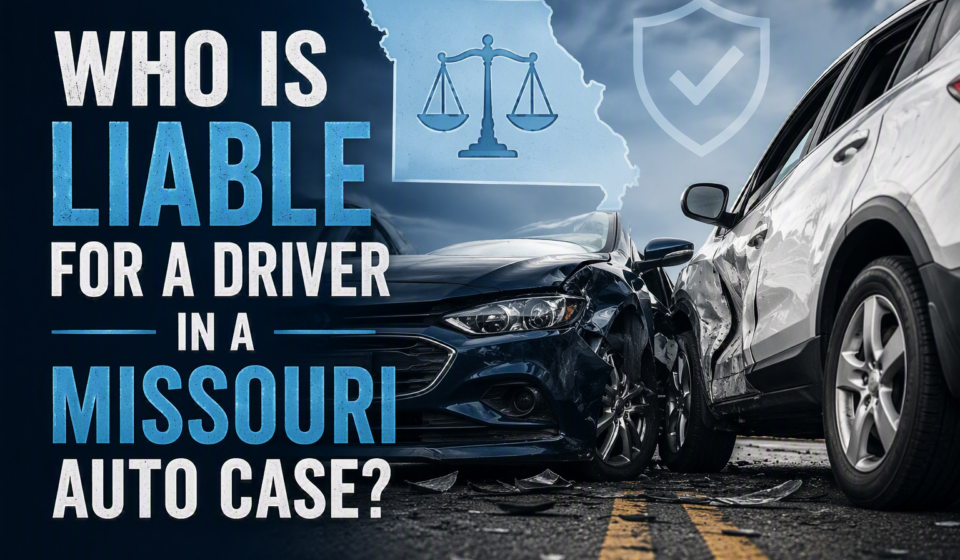
Who Is Liable for a Driver in a Missouri Auto Case?
After a Missouri motor vehicle crash, the first auto liability question is usually whether the driver was negligent. The next question is often harder and more valuable: whether someone else is legally responsible for that driver’s conduct. In cases involving employee drivers, company vehicles, rented or leased vehicles, delivery platforms, owner-operators, freight brokers, permissive users, or negligent entrustors, the answer may turn on respondeat superior, scope of employment, agency, joint venture, negligent entrustment, negligent hiring, negligent retention, negligent training, negligent supervision, insurance coverage, and settlement strategy. Missouri lawyers should treat the issue as a fact-development problem, not a label problem. Contract language, vehicle ownership, tax treatment, rental or lease status, and “independent contractor” terminology matter, but they do not replace the core inquiry into control, permission, foreseeability, and the purpose of the trip.
Respondeat Superior in Missouri Auto Cases
Missouri follows the familiar rule that an employer may be vicariously liable for the negligent acts of an employee committed within the course and scope of employment. State ex rel. McHaffie v. Bunch, 891 S.W.2d 822, 825 (Mo. banc 1995); Burks v. Leap, 413 S.W.2d 258, 266 (Mo. 1967). The Restatement formulation is equally direct: “An employer is subject to liability for torts committed by employees while acting within the scope of their employment.” Restatement (Third) of Agency § 2.04 (Am. L. Inst. 2006). In an auto case, that doctrine matters because the employee-driver may have minimal personal coverage while the employer may have commercial auto coverage, umbrella coverage, or excess coverage. The practical question is not simply whether the driver was negligent. It is whether the driver’s negligence can be attributed to the employer.
The central Missouri practice issue is proof of agency plus proof that the employee was acting in furtherance of the employer’s business when the crash occurred. The test is whether the person sought to be charged as master had the right or power to control and direct the physical conduct of the driver in performing the act. Wilson v. St. Louis Area Council, 845 S.W.2d 568, 570 (Mo. App. E.D. 1992); Carter v. Wright, 949 S.W.2d 157, 158–60 (Mo. App. W.D. 1997). A company logo on the vehicle, a work uniform, a route sheet, dispatch records, job tickets, customer appointments, phone records, mileage reimbursement, or GPS data may all matter. But none of those facts is automatically dispositive. Missouri lawyers should plead and discover the actual relationship, the task being performed, the employer’s control, and the purpose of the trip.
The Restatement also helps sharpen the distinction between agency, employment, and independent-contractor status. Agency exists when a principal manifests assent that another shall act on the principal’s behalf and subject to the principal’s control, and the agent consents so to act. Restatement (Third) of Agency § 1.01 (Am. L. Inst. 2006). But the parties’ label is not controlling: an agency relationship arises only when the legal elements are present, and the characterization used in an agreement or in industry usage does not decide the issue. Restatement (Third) of Agency § 1.02 (Am. L. Inst. 2006). That point is essential in Missouri driver cases because companies often draft around liability by using independent-contractor labels, 1099 payment structures, equipment disclaimers, and contract language denying control.
A related theory worth preserving in the right case is joint venture. Missouri recognizes that a joint venture is a consensual arrangement, that no particular formalities are necessary, and that a joint venture may exist for a single undertaking, including a single truck haul. Johnson v. Pac. Intermountain Express Co., 662 S.W.2d 237, 241–42 (Mo. banc 1983). That theory should not replace the respondeat superior analysis in ordinary employee-driver cases, but it may matter where the facts show a shared commercial undertaking, mutual benefit, and some right of control in the specific transportation or delivery project.
Scope of Employment
Scope of employment is usually the battleground. The plaintiff will frame the trip as serving the employer’s business. The employer will frame it as personal, incidental, unauthorized, outside working hours, or disconnected from assigned duties. Missouri practice requires a fact-specific approach. If reasonable minds could draw different conclusions about the relationship or whether the employee was acting in the course and scope of employment, the issue is generally one for the jury. Johnson v. Bi-State Dev. Agency, 793 S.W.2d 864, 867 (Mo. banc 1990); Smoot v. Marks, 564 S.W.2d 231, 236 (Mo. App. E.D. 1978). The same driver may be inside the scope while driving between customer locations, outside the scope while making a substantial personal detour, and back inside the scope when returning to an assigned route.
Useful discovery includes the employee’s job description, time records, route assignments, dispatch logs, work orders, customer communications, reimbursement records, vehicle-use agreements, fleet policies, and manager communications. In deposition, the cleanest questions usually isolate one fact at a time: where the employee was coming from, where the employee was going, who directed the trip, what work task was being performed, whether the trip was compensated, and whether the employer expected or permitted that kind of travel.
Coming-and-Going Rule Issues
The coming-and-going rule commonly appears when the crash occurs during a commute. Employers generally argue that commuting is personal travel, not work. Plaintiffs respond by looking for facts that make the trip more than ordinary commuting: transporting tools or equipment, driving to a non-routine jobsite, being paid for travel time, responding to a dispatch call, running a work errand, carrying employer materials, or beginning work before reaching the office. The Missouri cases are especially fact-sensitive when the employee is a traveling worker. In Helm v. Wismar, 820 S.W.2d 495 (Mo. banc 1991), the Supreme Court held that a traveling salesman who was away from home on his employer’s business could still be within the scope of employment while driving to dinner, even though he also intended to buy a present for his wife. The Court rejected the idea that the hotel became a “home away from home” that automatically ended the employer’s business. Id. at 496–97.
The analysis should not stop at labels. A company may call the drive a commute while still controlling the timing, destination, route, or purpose of the travel. Conversely, a company car or car allowance does not make every trip work-related. Helm distinguished cases involving employees in their home city where a car allowance alone did not mean the employee was necessarily on the employer’s business whenever driving. 820 S.W.2d at 496. Missouri lawyers should therefore develop the factual record before accepting the employer’s characterization of the trip.
Company Vehicles and Permissive Use
Company-vehicle cases often create a practical presumption in the plaintiff’s favor, but they do not eliminate the need to prove scope. The vehicle’s ownership, signage, maintenance records, assigned-driver records, fuel card records, telematics, and insurance schedules can all help establish the employer’s connection to the trip. Defense counsel will often separate vehicle permission from employment purpose: the employee may have permission to possess or drive the vehicle, but the employer may still argue the trip was personal.
Permissive use also matters for coverage. A driver may qualify as an insured under a commercial auto policy even if the employer disputes vicarious liability. That distinction affects tender strategy, coverage letters, reservation-of-rights issues, and the settlement-demand package. The liability case and the coverage case overlap, but they are not identical.
Delivery Drivers, Sales Representatives, and Service Technicians
Delivery drivers, sales representatives, and service technicians often create strong scope-of-employment facts because driving is not incidental to the job; it is part of the job. The employee’s work day may be built around moving from one location to another. The employer may schedule appointments, assign territory, require customer visits, provide a vehicle, reimburse mileage, track location, monitor productivity, or require phone availability while driving.
For plaintiff’s counsel, the key is to connect the crash to the work system. Was the driver between stops? Was the driver responding to a customer call? Was the driver taking a route the employer expected? Was the employee communicating with dispatch, a supervisor, or a customer? Was the employee under time pressure created by delivery windows, service quotas, or sales appointments? Those facts can convert an ordinary negligence case into a company-liability case.
Bargfrede v. American Income Life Insurance Co., 21 S.W.3d 157 (Mo. App. W.D. 2000), is especially useful in sales-representative and personal-vehicle cases. There, an insurance agent driving to an appointment with a prospective customer caused a fatal crash. The company argued independent-contractor status based on commission pay, use of the agent’s own car, lack of tax withholding, and contract language. The Western District reversed summary judgment because the record contained facts supporting a right of control, including exclusivity, required personal travel, leads and appointment times, training materials, company rules, assigned territory, termination power, and possible benefits. Id. at 160–68. For lawyers handling employee-driver cases, Bargfrede is the answer to the mechanical defense argument that use of a personal car, 1099 treatment, or commission pay ends the inquiry.
Carter v. Wright, 949 S.W.2d 157 (Mo. App. W.D. 1997), supplies the practical Restatement § 220 checklist. The court applied the factors for distinguishing a servant from an independent contractor, including control over details, whether the worker was engaged in a distinct business, skill required, who supplied the instrumentalities, length of employment, method of payment, whether the work was part of the alleged employer’s business, and the parties’ belief about the relationship. Id. at 160. No factor is conclusive; all are viewed to determine whether the alleged principal retained control or the right to control the worker’s physical conduct and details of the work. Id. The decisive point is not whether control was actually exercised at every moment, but whether the right to control existed. Id. at 160–61.
Missouri lawyers should also use J.M. v. Shell Oil Co., 922 S.W.2d 759 (Mo. banc 1996), when the defense relies on contract language disclaiming agency or control. Shell’s agreements stated that the dealer was an independent businessperson and that Shell did not reserve control over the dealer’s business operations. But other provisions imposed detailed standards on hours, appearance, staffing, uniforms, lighting, signs, loitering, training, inspections, and safety materials. The Supreme Court held those competing provisions created a factual issue on Shell’s right to control the relevant work. Id. at 764–65. The lesson carries directly into company-driver and platform-delivery cases: the disclaimer is evidence, but it is not the end of the analysis.
Negligent Entrustment
Negligent entrustment is a direct-liability theory, not a respondeat superior theory. It focuses on the entrustor’s own negligence in supplying, leasing, lending, permitting, or otherwise making a vehicle available to someone the entrustor knew or had reason to know was likely to use it in a manner creating an unreasonable risk of harm. Missouri follows Restatement (Second) of Torts § 390. Evans v. Allen Auto Rental & Truck Leasing, Inc., 555 S.W.2d 325, 326 (Mo. banc 1977); Restatement (Second) of Torts § 390 (Am. L. Inst. 1965).
The Missouri elements are: (1) the entrustee was incompetent by reason of age, inexperience, habitual recklessness, or otherwise; (2) the entrustor knew or had reason to know of the entrustee’s incompetence; (3) there was an entrustment of the chattel; and (4) the entrustor’s negligence concurred with the conduct of the entrustee as a proximate cause of the plaintiff’s harm. Evans, 555 S.W.2d at 326; Trow v. Worley, 40 S.W.3d 417, 423 (Mo. App. S.D. 2001). The instruction must require a finding of incompetence; in Evans, the Supreme Court reversed because the verdict director failed to require a finding that the renter was not competent to drive the truck at the time of the lease. 555 S.W.2d at 326–27.
For Missouri practice, the entrustment element should be pleaded and proved with care. Trow treated a prior insurance-coverage finding that the driver lacked express or implied permission as preclusive on the negligent-entrustment claim because permission was functionally equivalent to entrustment in that factual setting. 40 S.W.3d at 422–25. The opinion is useful in two ways. First, it confirms the Evans elements. Second, it shows that coverage litigation can decide facts—especially permission—that later control the tort case through collateral estoppel if the parties and issues align.
In company-vehicle cases, negligent entrustment usually turns on notice. Evidence may include prior crashes, moving violations, license suspensions, intoxication history, unsafe-driving complaints, failed MVR reviews, telematics alerts, preventable-collision findings, discipline records, or supervisor knowledge of unsafe operation. But counsel should avoid treating every bad driving record as enough. Evans includes a concurrence cautioning that prior accidents, convictions, suspensions, or revocations do not necessarily establish a submissible negligent-entrustment case if the driver was legally entitled to operate the vehicle at the time of the lease. 555 S.W.2d at 327 (Bardgett, J., concurring). The question remains whether the facts known or reasonably knowable to the entrustor made unsafe use foreseeable.
Negligent entrustment also differs from ordinary permissive-use coverage. A driver may be a permissive user for insurance purposes without the entrustor being negligent, and a driver may be outside coverage if use was nonpermissive. Missouri’s Motor Vehicle Financial Responsibility Law requires coverage for persons using the vehicle with the express or implied permission of the named insured, but not for nonpermissive drivers. Trow, 40 S.W.3d at 420–22. Because negligent entrustment depends on permission or its functional equivalent, a declaratory-judgment ruling on permissive use may materially affect both liability and coverage strategy.
The coverage implications can be significant. The negligent-entrustment theory may implicate the vehicle owner’s auto policy, the entrustee’s auto coverage, uninsured or underinsured motorist coverage, and, in some unusual settings, homeowner’s coverage arguments. Missouri authority illustrates that uninsured-motorist issues can arise when the offending automobile is uninsured as to the entrustor even if the negligent driver has separate coverage. Heafner v. Safeco Nat’l Ins. Co. of Am., 613 S.W.2d 478, 479 (Mo. App. E.D. 1981); Hendrickson v. Cumpton, 632 S.W.2d 512 (Mo. App. W.D. 1982). Missouri also has coverage authority involving negligent entrustment of nontraditional vehicles and homeowner-policy exclusions. Killian v. State Farm Fire & Cas. Co., 903 S.W.2d 215 (Mo. App. W.D. 1995). The practical point is that negligent entrustment should trigger early requests for all policies, all coverage positions, and any declaratory-judgment pleadings or rulings that may affect permission, insured status, or issue preclusion.
Rental and leasing cases require one more layer: the federal Graves Amendment. The statute generally preempts state-law vicarious liability against an owner engaged in the business of renting or leasing motor vehicles when liability is asserted merely “by reason of being the owner,” so long as there is no negligence or criminal wrongdoing by the owner or its affiliate. 49 U.S.C. § 30106(a). The carveout matters. The Graves Amendment is not a free pass for a rental or leasing company’s own negligence. It preserves claims based on the owner’s independent negligence, including a properly supported negligent-entrustment theory, and it does not supersede state financial-responsibility or insurance requirements. 49 U.S.C. § 30106(a)–(b). Missouri lawyers handling rental, leased, or fleet vehicles should therefore separate ownership-only liability from direct-negligence theories and should plead the facts showing entrustment, knowledge, incompetence, and causation if the claim is meant to survive Graves Amendment scrutiny.
McHaffie remains the trial-management problem. If an employer admits that the driver was its employee acting within the course and scope of employment, negligent entrustment evidence may become unnecessary and prejudicial because the employer is already liable for the employee’s negligence. State ex rel. McHaffie v. Bunch, 891 S.W.2d 822, 826–27 (Mo. banc 1995). But negligent entrustment should still be pleaded and developed where agency or scope is denied, where the entrustor may not be the employer, where the driver’s use was permissive but outside employment, where coverage turns on ownership or permission, or where punitive-damages facts may support a nonduplicative theory.
Negligent Hiring, Retention, Supervision, and Training
After negligent entrustment, the remaining direct-negligence theories are negligent hiring, negligent retention, negligent supervision, and negligent training. These theories focus on the employer’s own conduct in selecting, keeping, training, monitoring, or failing to control the employee. They are factually related to negligent entrustment, but they are not the same theory and should not be blended together in pleading, discovery, or motion practice.
Negligent Hiring
Negligent hiring asks whether the employer was negligent at the front end—before placing the employee in a position that created the risk. Missouri states the elements as: (1) the employer knew or should have known of the employee’s dangerous proclivities; and (2) the employer’s negligence was the proximate cause of the plaintiff’s injuries. Gibson v. Brewer, 952 S.W.2d 239, 246 (Mo. banc 1997); Dibrill v. Normandy Assocs., Inc., 383 S.W.3d 77, 87–89 (Mo. App. E.D. 2012); Reed v. Kelly, 37 S.W.3d 274, 277 (Mo. App. E.D. 2000). Unlike respondeat superior, negligent hiring does not require that the employee be acting within the course and scope of employment when the injury occurs. The theory is direct negligence by the employer, and the scope question is replaced by notice, foreseeability, and proximate cause.
The pleading and proof problem is nexus. It is not enough that the employee had a bad background or that the employer would not have hired the employee if it had known more. The prior conduct must make the later injury a reasonable and probable consequence of the hiring decision. Reed held that prior angry physical altercations did not, as a matter of law, make a later sexual assault on a stranger foreseeable. 37 S.W.3d at 277–78. Dibrill, by contrast, held that allegations of violent proclivities, failure to perform required background checks, and a sexual assault of a nursing-home resident by an employee were sufficient at the pleading stage. 383 S.W.3d at 87–89. In vehicle cases, the same principle should be translated into driving risk: prior crashes, license problems, intoxication history, unsafe-driving complaints, or known phone-use violations matter only if they connect the hiring decision to the type of driving harm that occurred.
Negligent Retention
Negligent retention is the same basic theory applied after hiring. Missouri treats the elements of negligent retention as the same as negligent hiring: the employer knew or should have known of the employee’s dangerous proclivities, and the employer’s negligence proximately caused the plaintiff’s injury. Gibson, 952 S.W.2d at 246; Reed, 37 S.W.3d at 278; Campbell v. Baxter Int’l, Inc., 697 S.W.3d 36, 42–44 (Mo. App. E.D. 2024). The alleged employee need not be acting inside the scope of employment for the employer to face a negligent-retention claim; the claim rests on the employer’s decision to continue the employment relationship after notice of a relevant risk.
For a driver case, negligent retention asks what the employer learned during employment and what it did with that information. Did the employer receive crash reports, complaints, telematics alerts, MVR updates, license-suspension notices, customer complaints, supervisor observations, discipline records, or preventable-collision findings? Did the employer keep the driver on the road anyway? Reed remains important because notice must be notice of a relevant dangerous proclivity, not merely evidence that the employee was imperfect or difficult. 37 S.W.3d at 278. Campbell adds a modern pleading caution: when the employee’s later wrongdoing occurs outside the scope of employment, Missouri requires more than a general allegation that the employer furnished tools or resources; the employer must have played a sufficient role in bringing the employee into contact with the injured plaintiff. 697 S.W.3d at 43–44.
Negligent Training
Negligent training is often pleaded with hiring, retention, and supervision, but Missouri case law is less developed on a separate set of elements. It should be framed as ordinary negligence: duty, breach, proximate cause, and injury. Thornburg v. Fed. Express Corp., 62 S.W.3d 421, 427 (Mo. App. W.D. 2001); Campbell, 697 S.W.3d at 42–43. The theory is direct negligence by the employer in failing to provide training reasonably required for the job. The employee may be acting within the scope of employment when the crash occurs, but the training claim itself is not vicarious liability; it asks whether the employer’s own failure to train caused or contributed to the injury.
In an employee-driver case, negligent training should be tied to the driving task and the specific risk that produced the crash. Examples include lack of training on following distance, backing, fatigue, phone use, route safety, pre-trip inspections, company vehicle rules, delivery-window pressure, distracted-driving policies, or use of dispatch and navigation systems. Because Missouri requires proximate cause, counsel should plead and prove how the missing training connects to the collision rather than simply alleging that the employer should have trained better. Campbell is useful by analogy: direct-negligence theories fail when the pleaded connection between the employer’s omission and the plaintiff’s injury is too attenuated or speculative. 697 S.W.3d at 43–44.
Negligent Supervision
Negligent supervision deserves separate treatment because Missouri grounds that theory in Restatement (Second) of Torts § 317. Gibson v. Brewer, 952 S.W.2d 239, 246–47 (Mo. banc 1997); Reed v. Kelly, 37 S.W.3d 274, 277–78 (Mo. App. E.D. 2000); Conroy v. City of Ballwin, 723 S.W.2d 476, 479 (Mo. App. E.D. 1986). The cause of action is direct negligence by the employer for failing to control a servant acting outside the scope of employment. Its elements come from § 317: the servant must be on the master’s premises or using the master’s chattel; the master must know or have reason to know it has the ability to control the servant; and the master must know or should know of the necessity and opportunity to exercise that control. Restatement (Second) of Torts § 317 (Am. L. Inst. 1965); Gibson, 952 S.W.2d at 247; Campbell, 697 S.W.3d at 42–43.
Section 317 is not a substitute for respondeat superior. It assumes the servant is acting outside the scope of employment and asks whether the employer nevertheless had a duty to use reasonable care to control the servant. That scope distinction should be stated expressly in pleadings and briefing. If the employee was acting within the scope of employment, the plaintiff usually begins with respondeat superior and then must address McHaffie if the employer admits agency and scope. If the employee was off mission, negligent supervision may fill part of the gap only if the premises-or-chattel nexus, notice, ability to control, and opportunity to intervene are present.
That structure matters in vehicle cases. If the driver was acting within the course and scope of employment, the case usually starts with respondeat superior and then runs into the McHaffie problem if the employer admits agency and scope. If the driver was off mission, negligent supervision may fill part of the gap only if the premises-or-chattel nexus and notice elements are present. A company vehicle, company truck, delivery van, forklift, key card, worksite access, or other employer instrumentality may supply the nexus. A purely personal vehicle on a purely personal errand generally will not.
The battleground is foreseeability plus the ability and opportunity to intervene. The plaintiff must develop facts showing that the employer knew or had reason to know of the risk and knew or had reason to know it could control the employee before the injury occurred. In practice, that means prior complaints, prior crashes, unsafe driving reports, intoxication concerns, phone-use violations, aggressive driving, discipline history, supervisor observations, telematics alerts, customer complaints, or other facts connecting the employee’s risk to the eventual plaintiff or class of persons harmed. Recent Missouri authority has also emphasized the need to connect the employee to the plaintiff for negligent-supervision purposes. Campbell v. Baxter Int’l, Inc., No. ED112259 (Mo. App. E.D. June 25, 2024).
The major Missouri limitation is McHaffie. In State ex rel. McHaffie v. Bunch, 891 S.W.2d 822 (Mo. banc 1995), the Missouri Supreme Court held that once an employer admits the employee was acting within the course and scope of employment, it is generally error to submit additional imputed-liability theories such as negligent hiring or negligent entrustment when the plaintiff’s claim depends on the employee’s negligence. Id. at 826–27. The reason is practical trial management: once respondeat superior is admitted, the employer is strictly liable for fault attributed to the negligent employee, and evidence about the driver’s prior experience, training, logbooks, or employer safety failures may become irrelevant to any contested issue and unfairly prejudicial. Id. at 826–28.
McHaffie does not mean lawyers should ignore direct negligence. It means pleading, discovery, motion practice, and trial strategy must anticipate whether the employer will admit agency and scope. If the employer denies course and scope, direct negligence theories may remain important. If punitive damages are realistically in play, counsel should separately analyze whether the employer’s independent conduct supports a theory that is not merely duplicative of vicarious liability; McHaffie expressly left for another day situations involving independent negligence not dependent on the employee’s negligence, punitive damages against the employer, and contribution disputes between employer and employee. Id. at 826. The pleading plan should preserve the issue where appropriate, then analyze punitive damages as discovery develops and move to amend if the evidence supports the theory.
Collins v. Westlake Hardware Co., 783 S.W.2d 172 (Mo. App. W.D. 1990), is also useful for settlement structure and release drafting. There, the plaintiff settled with and released the employee but expressly reserved claims against the employer. The court held that the release of the employee did not release the employer, even where the employer’s liability was vicarious. Id. at 173–74. For plaintiff’s counsel, the point is straightforward: when settling with a driver or one layer of coverage, the release must expressly reserve claims against the employer, owner, entrustor, commercial carrier, and any other potentially responsible party unless the strategy is to release them.
Employer Phone-Use Policies
Phone-use policies matter because many work-driver crashes involve calls, texts, mapping apps, dispatch apps, delivery apps, customer messages, or supervisor communications. A written policy banning handheld phone use is helpful to the employer only if it is trained, enforced, and consistent with actual work expectations. A policy that says “do not use the phone while driving” may be undermined by evidence that supervisors expected immediate responses from drivers on the road.
Discovery should request the policy, training acknowledgments, discipline history, phone stipends, work-app records, dispatch records, supervisor-driver communications, and any post-crash preservation notices. Counsel should also ask whether the employer audited compliance, whether hands-free use was permitted, whether the employer distinguished personal from work communications, and whether productivity expectations made distracted driving foreseeable.
Fleet Safety Policies
Fleet policies are often the bridge between ordinary crash facts and corporate responsibility. Relevant materials include driver qualification standards, MVR review procedures, crash-review committees, seat-belt rules, backing policies, following-distance policies, fatigue rules, vehicle inspection procedures, maintenance schedules, remedial training, and discipline for preventable collisions.
In Missouri practice, fleet-policy evidence may serve multiple purposes. It may prove notice, foreseeability, breach of internal safety standards, negligent retention, negligent supervision, or punitive exposure. But counsel should expect relevance and prejudice objections if the employer admits vicarious liability. The record should explain why the evidence matters beyond simply showing the driver was bad or the company could have done better.
Telematics and GPS Evidence
Telematics and GPS evidence can be decisive in employer-driver cases. It may show speed, braking, acceleration, route, time at stops, location before impact, post-impact movement, engine data, seat-belt status, phone integration, or harsh-driving events. It may also identify whether the driver was on an assigned route, between customer stops, outside a permitted territory, or making a personal detour.
Preservation is urgent. Company systems may overwrite GPS, dash-camera, electronic logging, route, and app data quickly. The preservation letter should identify the vehicle, driver, date, time, route, telematics provider, dash-camera provider, dispatch platform, mobile device data, electronic work orders, maintenance records, and any crash-review materials. Counsel should also ask who had administrative access to the system and whether any data was downloaded, deleted, overwritten, or exported after notice of the claim.
Insurance Coverage Implications
Employer-liability analysis directly affects coverage. A personal auto case may involve minimum limits. A company-driver case may involve commercial auto coverage, hired-and-non-owned coverage, umbrella coverage, excess coverage, MCS-90 issues in trucking cases, or separate coverage for permissive users. The first demand should not assume the available limits. It should ask for all potentially applicable policies, declarations pages, endorsements, reservations of rights, coverage positions, and any excess or umbrella layers.
Coverage disputes often track the same facts as liability disputes: Was the driver an employee? Was the vehicle scheduled? Was the vehicle owned, hired, borrowed, or non-owned? Was the driver a permissive user? Was the trip business or personal? Was the employee using a personal vehicle for company business? Missouri also recognizes that insurance evidence can sometimes be discoverable or relevant to agency, although admissibility at trial remains tightly controlled. State ex rel. Cummings v. Witthaus, 219 S.W.2d 383, 389 (Mo. banc 1949), allowed discovery of liability insurance where coverage could bear on whether a driver was an independent contractor. Carter, however, affirmed exclusion of lack-of-insurance evidence where its probative value on agency was weak and the usual rule against injecting insurance applied. 949 S.W.2d at 162–63. Those questions should be investigated early because they determine not only who can be sued, but also which insurer must evaluate settlement.
Practice Tip: If the arrangement is being conducted pursuant to contract and there are indemnification provisions, explore whether coverage may be available under an insured contract provision of the parties.
Settlement-Demand Implications When Commercial Limits Apply
Commercial limits change settlement strategy. A Missouri demand involving an employer-driver should identify the driver, employer, vehicle, policy layers, claimed scope-of-employment facts, direct negligence facts, damages evidence, and deadline issues with precision. If the demand is time-limited, counsel must evaluate Missouri’s time-limited demand statute and ensure compliance where applicable. If the demand is not time-limited, counsel should still build the record that the insurer had a fair opportunity to evaluate liability, damages, coverage, and exposure.
In serious injury cases, the employer-liability facts should be integrated into the demand rather than treated as background. The employer and their insurance company need to understand why the company is exposed, why the employee’s conduct was foreseeable, and why a failure to resolve within limits may create later duty-to-settle or bad-faith issues. Depending on the severity of the case, strategy and timing, a demand may include the documents then available that support liability, damages, coverage, and the requested resolution.
Independent Contractor Labels, App-Based Delivery Drivers, Owner-Operators, and Freight Brokers
Modern transportation cases often arrive with independent-contractor agreements, app-based dispatch systems, personal vehicles, owner-operator arrangements, leased tractors or trailers, per-load compensation, and no tax withholding. Those facts matter, but they do not resolve the Missouri agency question. Bargfrede, Carter, and J.M. teach that Missouri courts look beyond labels to the actual right of control, the integration of the work into the company’s business, the method of assigning work, termination or deactivation power, required communications, route or timing expectations, customer relationship, payment structure, and the worker’s ability to operate a genuine independent business.
For app-based delivery, the best Missouri framing is not “the company controlled the steering wheel.” It is that the company controlled or reserved the right to control the delivery work in the ways appropriate to that kind of work. The Restatement recognizes that the principal’s right of control may vary with the relationship and need not mean control over every physical movement. Restatement (Third) of Agency § 1.01 cmt. f (Am. L. Inst. 2006). The proof should focus on app workflow, batch acceptance, delivery windows, item-selection rules, substitution and refund procedures, customer-contact restrictions, GPS tracking, payment processing, ratings, discipline, deactivation, and whether the driver had any transferable route, customer list, goodwill, or ability to delegate the job.
The same analysis applies in commercial-vehicle cases involving owner-operators, leased tractors, leased trailers, motor carriers, dispatch services, logistics companies, and freight brokers. A company may not employ the driver in the ordinary payroll sense, but it may still reserve or exercise control over the transportation project through load assignment, pickup and delivery windows, route instructions, tracking technology, check-call requirements, fuel cards, payment terms, detention rules, safety requirements, equipment standards, insurance requirements, financing arrangements, branding, customer communications, or the power to remove the driver or carrier from future loads. Those facts should be developed before accepting the contractor label.
Freight-broker cases add a federal-law overlay. Brokers such as C.H. Robinson often argue that they merely arrange transportation and do not control the carrier’s driving. That may defeat vicarious liability if the record shows no right to control the manner of performance, but it does not end every theory. The Supreme Court recently held that a negligent-hiring claim against a freight broker is not preempted by the FAAAA because the safety exception preserves state authority over motor-vehicle safety. Montgomery v. Caribe Transp. II, LLC, No. 24-1238, slip op. at 4–8 (U.S. May 14, 2026); 49 U.S.C. § 14501(c)(2)(A). For Missouri lawyers, the practical point is to separate theories: agency or joint venture depends on control and shared undertaking, while negligent selection depends on what the broker knew or should have known about the motor carrier’s safety fitness.
This is also a sensible place to preserve joint-venture facts. A single haul can matter. Missouri recognizes that a joint venture is consensual, does not require formalities, and may exist for one transportation undertaking. Johnson v. Pac. Intermountain Express Co., 662 S.W.2d 237, 241–42 (Mo. banc 1983). In a trucking or brokered-load case, joint venture should not be pleaded as a slogan. Counsel should look for shared commercial purpose, mutual benefit, agreement to participate in the particular undertaking, and some right of control over the transportation project. Evidence may include the shipper-broker agreement, broker-carrier agreement, rate confirmations, load tenders, dispatch communications, routing instructions, tracking data, payment and chargeback terms, fuel-card use, equipment requirements, and indemnity or insurance provisions.
That same evidence also informs negligent entrustment and direct-negligence discovery. If the company claims it is merely a technology platform, ask what it required before allowing a driver to perform vehicle-based delivery work: license status, insurance status, vehicle access, background checks, prior crashes, moving violations, phone-use rules, training, customer complaints, deactivation standards, and any crash-review process. Those facts may support respondeat superior, direct negligence, punitive-damages discovery, or coverage arguments depending on what the record shows.
Discovery should therefore track both branches. For app-based personal-vehicle delivery, focus on the app workflow and worker control. For commercial trucking, focus on the contract stack and operational control: who selected the carrier, who selected or approved the driver, who set the pickup and delivery windows, who monitored location, who communicated with the customer, who had authority to reject or reroute the load, who supplied or financed equipment, who controlled payment, and who had the practical power to stop the unsafe trip before the crash.
Practice Checklist
- Identify the driver’s employment status, job duties, schedule, route, and purpose of travel.
- Request company vehicle records, assignment records, fuel cards, maintenance records, and insurance schedules.
- For negligent entrustment, prove the Evans elements: incompetence, knowledge, entrustment or permission, and concurrent proximate cause.
- Preserve telematics, GPS, dash-camera, app, phone, dispatch, and electronic work-order data immediately.
- Determine whether the employer admits agency and course and scope before relying on direct negligence theories at trial.
- Investigate negligent entrustment, hiring, retention, supervision, training, phone-use, and fleet-safety evidence while anticipating McHaffie objections.
- For negligent supervision, identify the § 317 nexus: outside-scope conduct, employer premises or chattel, notice of danger, ability to control, and opportunity to intervene.
- Analyze commercial auto, hired-and-non-owned, umbrella, excess, and permissive-use coverage.
- Draft settlement demands to connect scope, coverage, damages, and duty-to-settle exposure.
- Use Bargfrede, Carter, J.M., and Restatement § 220-style control evidence to defeat early independent-contractor motions.
Conclusion
Driver-liability cases often require more than proving that the person behind the wheel caused the crash. Missouri lawyers must identify whether another party may answer for the driver’s conduct through respondeat superior, negligent entrustment, direct negligence, agency, joint venture, permissive-use coverage, or other insurance-based theories. That work requires connecting the driver’s conduct to the relevant business, vehicle, permission, control, foreseeability, and coverage facts; preserving electronic, fleet, dispatch, telematics, and app evidence before it disappears; understanding the McHaffie limits on duplicative direct-negligence theories; and building a settlement record that reaches all available coverage. That is why this topic fits naturally after crash reconstruction in the MIIL auto-negligence cluster: reconstruction explains how the collision happened, while driver-liability analysis determines who may have to answer for the loss.