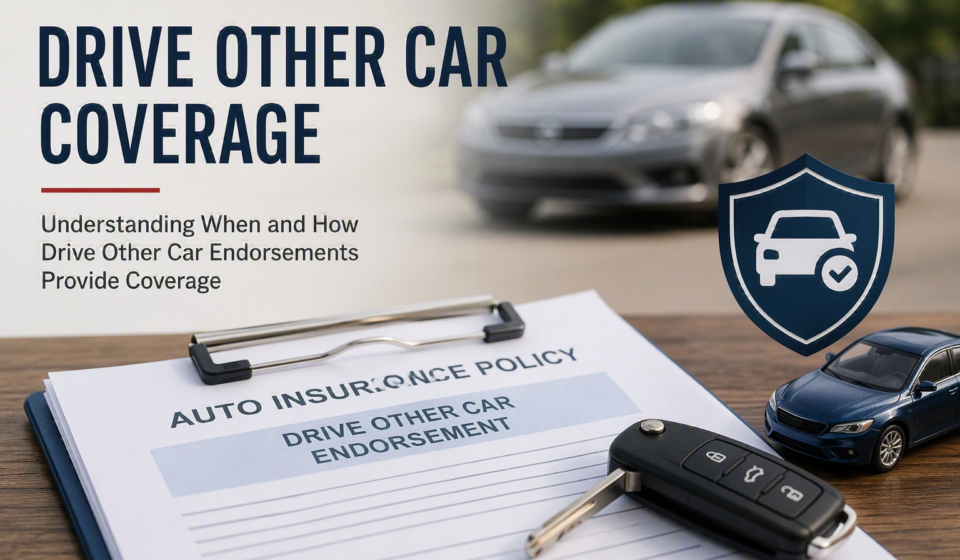
Drive Other Car Coverage
What the DOC Endorsement Is, Why It Exists, and Where It Fits
Key Takeaways
- The Drive Other Car Coverage, or DOC endorsement, is designed to fill coverage gaps for individuals using company-furnished vehicles without personal auto insurance.
- It provides targeted protection for named individuals when they are driving non-owned vehicles, but it only applies under specific conditions.
- Lawyers must carefully review policy declarations, schedules, and coverages to determine if the DOC endorsement applies in claims involving non-owned vehicles.
- Common scenarios include accidents with borrowed or rented vehicles and claims for uninsured/underinsured motorist benefits.
- Understanding the limitations and exclusions of the DOC endorsement is crucial for ensuring adequate protection for individuals relying on business vehicles.
Practice point: The Drive Other Car endorsement is not a routine fleet add-on. It is a targeted fix for a recurring coverage gap: the individual who relies on a company-furnished auto and therefore may not carry a personal auto policy, but still needs personal-type protection when driving, occupying, or being struck by vehicles outside the business fleet.
Introduction
The Drive Other Car endorsement is one of those commercial auto endorsements that many lawyers recognize by name but do not always place correctly in the coverage architecture. It is commonly abbreviated as the DOC endorsement. In ISO usage, the familiar form is CA 99 10, titled Drive Other Car Coverage — Broadened Coverage for Named Individuals. The title matters. This is not a broadening endorsement for every employee, every permissive user, or every household connected to a business automobile. It is scheduled, individual-focused coverage intended to give certain named people protection resembling what they would ordinarily have under a personal auto policy.
That context is the key to understanding the endorsement. Commercial auto policies are built around commercial exposures and covered autos. Personal auto policies are built around individuals, family members, non-owned autos, medical payments, and uninsured or underinsured motorist protection. When a business furnishes an auto to an owner, executive, officer, or key employee, the person may reasonably decide not to buy a personal auto policy. That decision can create a gap when the person is away from the furnished company vehicle. The DOC endorsement exists to narrow that gap.
In coverage litigation, the endorsement often appears after the easy questions are over. Everyone may agree there was a business auto policy. Everyone may agree the policy insured a company vehicle. But the accident may involve a rental car, a borrowed car, a test-driven vehicle, a friend’s vehicle, or a vehicle being used outside the scheduled business fleet. At that point, the lawyer needs to know whether personal-type protection was purchased for a scheduled individual and exactly what coverages were shown on the endorsement schedule.
What the Endorsement Does
At its core, the DOC endorsement modifies a commercial auto policy so that certain non-owned autos become covered autos while being used by the named individual listed in the schedule, or by that person’s resident spouse, subject to the endorsement’s limitations. The ordinary liability concept is straightforward: if the scheduled individual is driving an auto the named insured business does not own, hire, or borrow, the endorsement can treat that auto as a covered auto for liability purposes.
That is why the endorsement is often described as providing non-owned auto protection under a commercial auto policy similar to what a personal auto policy would provide. The comparison is useful, but it should not be overstated. The endorsement does not convert the commercial auto policy into a full personal auto policy. It extends specified coverages, for specified people, in specified situations. The schedule matters. The policy form matters. The coverages for which premium is shown matter.
Practically, the endorsement can address four areas: liability coverage, auto medical payments coverage, uninsured motorist coverage, underinsured motorist coverage, and, where scheduled, physical damage coverage for certain non-owned private passenger type autos in the care, custody, or control of the scheduled person or resident spouse. Those are separate coverage grants. A lawyer should not assume all of them were purchased merely because the endorsement appears in the policy.
Why the Coverage Gap Exists
The gap arises from the mismatch between how people actually use vehicles and how the policy was written. A business auto policy may provide strong protection for the company and for covered autos owned, hired, or borrowed by the business. But the individual who lives with a company-furnished vehicle may lose the ordinary background protection that a personal auto policy would have supplied.
Consider the common example. A business owner drives a company-owned vehicle. The business pays for the vehicle, insures it, maintains it, and allows personal use. The owner does not keep a separate personally owned car. Because there is no personal vehicle, the owner may not maintain a personal auto policy. That arrangement may work adequately while the owner is driving the company vehicle. It may work poorly when the owner rents a car on vacation, borrows a neighbor’s vehicle, test-drives a vehicle, or is injured as a pedestrian or passenger in circumstances where personal auto UM or UIM protection would ordinarily be relevant.
The same problem can arise for a spouse or household member. If the family’s practical automobile protection is built around a business-furnished vehicle, the family may not have the personal auto policy structure that would otherwise follow the household. The DOC endorsement is a commercial auto solution to that personal auto problem.
Who Usually Needs It
The endorsement is most often associated with owners, executive officers, partners, managers, and key employees who are assigned company vehicles for regular use and do not maintain separate personal auto coverage. In a closely held business, the line between business and personal vehicle arrangements may be especially blurred. A corporate vehicle may be used for commuting, errands, family transportation, and personal travel. The fact that the vehicle is commercially insured does not necessarily mean the individual has personal-type coverage when outside that vehicle.
Fleet programs create a similar issue. A company may assign vehicles to certain employees as part of compensation or job duties. If the employee’s only regular automobile is the employer-furnished vehicle, the employee’s personal insurance program may be incomplete. The DOC endorsement is commonly used to schedule the person who needs the additional protection. Some policies schedule named individuals. Others, as seen in practice, may use broader schedule wording for employees to whom owned or leased vehicles are regularly assigned. That wording must be read carefully because the schedule defines who receives the broadened status.
For coverage lawyers, the first factual question is therefore not simply whether the company had a commercial auto policy. It is whether the particular claimant or tort defendant was actually within the category of individuals described in the DOC schedule. If the person is not scheduled or does not fall within the scheduled class, the endorsement may not help.
Policies and ISO Forms Commonly Involved
The DOC endorsement is a commercial auto endorsement. It is commonly attached to the Business Auto Coverage Form. It is also designed for use with other commercial auto programs, including Motor Carrier and Auto Dealers coverage forms. Older editions and policy packages may show the endorsement modifying forms such as Garage, Truckers, or Business Auto Physical Damage forms, depending on the policy era and program structure.
The key ISO form is CA 99 10, Drive Other Car Coverage — Broadened Coverage for Named Individuals. Lawyers will most often see it connected to the Business Auto Coverage Form, commonly CA 00 01, although the endorsement may appear in larger commercial auto programs with additional forms. It should not be confused with other endorsements that address related but different problems, such as employee hired autos, individual named insured language, or broad permissive user provisions. Those forms may matter in the same claim, but they do not do the same thing.
The clean way to analyze the policy is to start with the declarations, identify the underlying commercial auto coverage form, locate the DOC endorsement, and then read the schedule before reading the insuring language. The schedule tells you the name or class of individuals, the coverage limits, the deductibles, and the coverages for which premium was actually charged. The endorsement often changes only those coverages shown in the schedule. That is a critical limitation.
What the Standard Language Is Trying to Accomplish
The liability portion of the endorsement generally treats an auto the named insured business does not own, hire, or borrow as a covered auto while used by the scheduled individual or that person’s resident spouse. That language is designed to reach borrowed or non-owned autos used personally by the scheduled person. It is not designed to insure autos owned by the scheduled person or owned by members of that person’s household. Nor is it designed to cover auto-business risks such as selling, servicing, repairing, or parking automobiles.
The medical payments and UM/UIM portions operate differently because they focus on persons rather than only on the driver’s liability exposure. The endorsement may add the named individual and family members as insureds while occupying, or in some situations as pedestrians struck by, an auto the business does not own. Again, the schedule controls what was purchased. If UM or UIM coverage is not shown, a lawyer should not assume the endorsement supplies it.
The physical damage portion is narrower still. It is typically directed to private passenger type autos the business does not own, hire, or borrow while in the care, custody, or control of the scheduled individual or resident spouse. Physical damage coverage under a DOC endorsement can matter in rental car, borrowed car, or test-drive scenarios, but it is dependent on the scheduled deductible and premium entries.
Limits and Exclusions Lawyers Should Expect
The endorsement is useful precisely because it is targeted. That also means it is limited. The most obvious limitation is the owned-auto problem. If the scheduled individual owns the vehicle involved in the loss, the endorsement generally is not designed to insure that vehicle. The same is true for vehicles owned by household members. This prevents the DOC endorsement from becoming a substitute for insuring personally owned household vehicles.
Another recurring limitation concerns vehicles used in an auto business. If the scheduled person or resident spouse is using the vehicle while working in a business of selling, servicing, repairing, or parking autos, the endorsement ordinarily does not provide the broadened protection. That exclusion tracks the underwriting purpose. The endorsement fills a personal auto gap; it is not intended to underwrite garage or dealer operations through the back door.
A third practical limitation is that the endorsement does not automatically solve every regular-use problem. Coverage disputes may turn on whether a vehicle was truly non-owned and outside the business’s owned, hired, or borrowed auto program, or whether it was regularly available in a way that removes the claim from the expected non-owned auto risk. In litigation, these facts matter: who owned the vehicle, who had keys, who controlled access, how frequently it was used, whether permission was general or specific, and whether the use was personal, business-related, or part of another auto enterprise.
How It Shows Up in Claims
DOC issues often surface in three claim settings. First, a scheduled executive or employee causes an accident while driving a borrowed or rented vehicle and seeks liability defense and indemnity under the company’s commercial auto policy. Second, the scheduled person or a family member seeks UM or UIM benefits after being injured while occupying a non-owned vehicle or as a pedestrian. Third, the scheduled person damages a non-owned private passenger vehicle and claims physical damage protection under the endorsement.
Each setting requires a slightly different analysis. For liability, focus on who was driving, whether the driver was scheduled, whether the vehicle was owned, hired, or borrowed by the business, and whether any exclusion applies. For UM/UIM, focus on who qualifies as an insured under the endorsement and whether that coverage was purchased. For physical damage, focus on the type of vehicle, care-custody-control language, deductibles, and whether physical damage coverage appears on the schedule.
The endorsement also matters in bad-faith and claim-handling disputes because it can be overlooked. Adjusters and lawyers sometimes analyze only the covered auto symbols or the named insured’s business exposure and miss the scheduled individual endorsement. Conversely, claimants sometimes invoke the endorsement as if it were blanket personal auto coverage. Both mistakes can distort the claim. The better practice is to put the endorsement into the coverage map early and decide, coverage by coverage, whether it applies.
Practical Checklist
A practical DOC review should start with these questions:
- Is CA 99 10 or a similar Drive Other Car endorsement attached to the policy?
- Which commercial auto coverage form does it modify?
- Who is listed in the schedule, or what class of individuals is described?
- Does the schedule show liability, medical payments, UM, UIM, or physical damage coverage?
- Was premium charged for the coverage being claimed?
- Was the vehicle owned by the scheduled individual or a household member?
- Was the vehicle owned, hired, or borrowed by the named insured business?
- Was the vehicle being used in an auto business?
- Was the driver the scheduled individual or resident spouse?
- For UM/UIM or medical payments, does the claimant qualify as an insured under the endorsement language?
Conclusion
The Drive Other Car endorsement is a narrow but important bridge between commercial auto insurance and the personal auto protection that an individual may lack because the individual relies on a company-furnished vehicle. Its usefulness depends on the schedule, the coverages purchased, and the facts of the vehicle use. For lawyers handling commercial auto claims, personal auto gaps, UM/UIM claims, or coverage disputes involving company vehicles, CA 99 10 should be part of the initial policy review whenever the loss involves a business-furnished auto arrangement and a person who may not have separate personal auto coverage.
The endorsement is not complicated once placed in context. It asks a practical question: did the policyholder buy personal-type protection for a named individual whose automobile life is otherwise tied to the business fleet? If the answer is yes, the endorsement may be central. If the answer is no, the claim may expose exactly the gap the endorsement was designed to prevent.