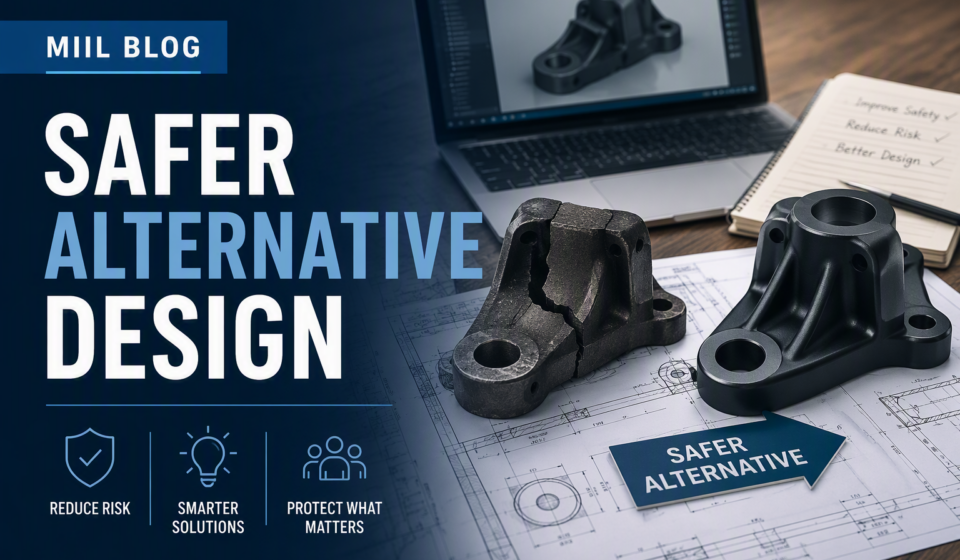
Safer Alternative Design Requirements
The element that isn’t: why Missouri treats a feasible alternative design as evidence, not an element—and why plaintiffs prove it anyway
In many jurisdictions, the plaintiff in a design case must prove that a reasonable, feasible alternative design existed and would have prevented the harm. It is an element: no alternative, no claim. Missouri is not one of those jurisdictions. Here, a safer alternative design is not a required element of a design-defect claim—yet it may be the single most persuasive proof a plaintiff can offer and a common ground on which the case is actually fought. The gap between what Missouri law requires and what a Missouri courtroom rewards is the subject of this article, and misunderstanding it in either direction—treating alternative design as unnecessary because it is not required, or treating it as a hidden element because it is ubiquitous—is a serious error.
I. The Core Rule: No Reasonable-Alternative-Design Element
Missouri imposes no reasonable-alternative-design (RAD) requirement and compels no risk-utility balance, and the reason traces to the same source that governs the whole design inquiry. Because “unreasonably dangerous” is submitted to the jury without a defining instruction, there is no doctrinal slot into which an alternative-design element could be inserted. Nesselrode v. Executive Beechcraft, Inc., 707 S.W.2d 371, 378 (Mo. banc 1986), held that the concept “is presented to the jury as an ultimate issue without further definition,” and that Missouri had adopted neither the consumer-expectation test nor “decided to travel or require plaintiffs to travel the path of risks and utilities.” If neither risk-utility nor consumer expectation is the legal test, then no component of either—including the reasonable-alternative-design inquiry that lives inside risk-utility analysis—can be a required element.
The Supreme Court has said so directly, and more than once. In Rodriguez v. Suzuki Motor Corp., 996 S.W.2d 47, 65 (Mo. banc 1999), the Court, urged to embrace the then-new Restatement (Third), refused: “This Court again declines the invitation to adopt the reasonable alternative design/risk-utility theory. Instead, the concept of ‘unreasonable danger’ is to be treated as an ultimate issue for the jury.” It added the separation-of-powers rationale that hardens the rule against erosion: “By codifying section 402A from the Restatement (Second), unadorned by any definitions, the legislature tacitly adopted the Nesselrode approach.” And the plainest statement is Moore v. Ford Motor Co., 332 S.W.3d 749, 760 (Mo. banc 2011): “Missouri does not require a plaintiff to create an alternative design to prove a design defect claim; it is enough that plaintiff show that the design used was defective and unreasonably dangerous.” That sentence, from the Court en banc, is the field’s controlling word.
II. Federal Confirmation: Sappington v. Skyjack
The Eighth Circuit, applying Missouri law, both endorsed the rule and explained precisely how alternative-design evidence functions without being required. Sappington v. Skyjack, Inc., 512 F.3d 440, 445–46 (8th Cir. 2008), a scissor-lift tip-over, held that “a plaintiff is not . . . required to prove the existence of a reasonable alternative design in order to make a submissible case,” quoting Thompson v. Brown & Williamson Tobacco Corp., 207 S.W.3d 76, 90–91 (Mo. App. W.D. 2006). On the optional character of the evidence, the court quoted Thompson again:
The litigants are certainly entitled to assist the jury in defining the term “unreasonably dangerous” by presenting evidence “that the utility of a design outweighs its risks, or that consumer expectations were violated, or any other theory of unreasonable dangerousness supported by the evidence.” . . . The plaintiffs, however, are not required to present evidence of alternative design.
The significance of Sappington for the federal-diversity practitioner is that it forecloses any argument that an Erie-bound federal court sitting in Missouri may import the Restatement (Third)’s RAD requirement as a de facto element. It may not: alternative-design proof “is not required.” Risk-utility and consumer-expectation evidence are tools the jury may weigh, not tests it must apply.
III. The Contrast: What Missouri Deliberately Rejected
The Missouri rule is easiest to see against the jurisdictions that went the other way. Section 2(b) of the Restatement (Third) of Torts: Products Liability makes RAD an element: a product “is defective in design when the foreseeable risks of harm posed by the product could have been reduced or avoided by the adoption of a reasonable alternative design . . . and the omission of the alternative design renders the product not reasonably safe.” Texas is the paradigm—and statutory—RAD jurisdiction. Texas Civil Practice & Remedies Code § 82.005(a) places the burden on the claimant to prove “there was a safer alternative design” and that “the defect was a producing cause” of the harm, and § 82.005(b) defines “safer alternative design” as one that “in reasonable probability . . . would have prevented or significantly reduced the risk” “without substantially impairing the product’s utility” and “was economically and technologically feasible . . . by the application of existing or reasonably achievable scientific knowledge.” In Texas, the plaintiff who cannot muster a feasible alternative loses as a matter of law.
Missouri rejected exactly this in Rodriguez, 996 S.W.2d at 65. A significant bloc of states conditions design liability on a reasonable or safer alternative (or on a risk-utility test that in practice demands one)—among them, with variations, Louisiana by statute, Ohio by statute, and a number of others; categorizations differ by commentator and should be checked against the specific state before relying on them. The doctrinal upshot is a rule of thumb worth stating plainly to a client or a court: the same record that is dismissible on summary judgment in Texas for want of a safer alternative can be submitted to a Missouri jury on the bare, undefined question of unreasonable danger. Moore, 332 S.W.3d at 760; Sappington, 512 F.3d at 445–46.
IV. How Alternative-Design Evidence Functions in Missouri
Not required is a long way from irrelevant. Alternative-design, feasibility, and risk-utility evidence are fully admissible, and both sides use them. The legislature signaled its neutrality in the state-of-the-art statute: section 537.764 RSMo, after defining the state-of-the-art defense for warning claims, provides that the section “shall not be construed to permit or prohibit evidence of feasibility in products liability claims.” Feasibility evidence is thus neither foreclosed nor compelled; it is governed by ordinary relevance rules, consistent with the Nesselrode–Sappington framework of permitted-but-not-required proof.
The archetype of the plaintiff’s affirmative use is Blevins v. Cushman Motors, 551 S.W.2d 602 (Mo. banc 1977), the three-wheeled golf-cart rollover, where the Court held feasible-alternative evidence sufficient to submit the case: “the stability of the cart could be improved by widening the wheel base, by use of four wheels, by lowering the center of gravity, by increasing its minimum turning radius, and by decreasing its maximum speed. On the basis of the evidence adduced, we believe plaintiffs made a submissible case.” Id. at 608. Blevins also imported the Phillips v. Kimwood Machine Co. reasonable-manufacturer rationale—the bridge that lets risk-utility thinking inform the analysis without becoming the test—by framing strict liability as concerned with “the condition (dangerousness) of an article which is designed in a particular way,” as against negligence’s focus on “the reasonableness of the manufacturer’s actions.” Id. at 607–08. Plaintiffs deploy alternative design affirmatively; defendants deploy utility, state-of-the-art, and infeasibility in response. Under Nesselrode and Rodriguez, all of it is legitimate argument to define “unreasonably dangerous,” none of it a legal element.
V. Why Plaintiffs Prove It Anyway
Given that the law does not require it, why do experienced Missouri plaintiff’s lawyers almost always put on a safer alternative design? Four reasons converge, and they are worth stating because they explain the gap between doctrine and practice.
Persuasion. An undefined standard is a vacuum the jury fills with, in Nesselrode’s words, its “collective intelligence and experience.” Nothing fills it more powerfully than a demonstrated, buildable, comparably priced safer design the manufacturer chose not to adopt. It converts an abstract question—was this “unreasonably dangerous”?—into a concrete engineering comparison the jury can feel.
Submissibility and causation insurance. Missouri permits circumstantial proof of defect and causation, but the inference must be reasonable and, on causation, the evidence must make the defect the probable cause and “tend to exclude” other reasonable causes. A feasible alternative that would have prevented this injury both supports the inference of defect and ties the defect to the harm, insulating the case against a directed verdict.
Surviving Daubert. Since August 28, 2017, section 490.065.2 RSMo has applied a Daubert-style standard requiring that expert opinion rest on sufficient facts or data, reliable principles and methods, and a reliable application to the facts. A design opinion grounded in a tested, quantified, feasible alternative—drawings, prototypes, testing, cost data, industry practice—is far more defensible than a bare ipse dixit that a product is “unreasonably dangerous.” The alternative design is frequently what supplies the methodology that makes the opinion admissible.
Appellate durability. A verdict resting on concrete alternative-design evidence is markedly harder to overturn for insufficiency than one resting on conclusory danger testimony, because the appellate court can point to specific record facts supporting the jury’s exercise of its undefined discretion—the very posture the Court approved in Blevins and Sappington.
The caution. There is a real gap between “not an element” and “not needed to win.” A plaintiff who offers no alternative and no other cogent theory of unreasonable danger risks a Daubert exclusion of a conclusory expert and a directed verdict for failure to generate a submissible inference—not because RAD is an element, but because the plaintiff has failed the ordinary submissibility test. The rule protects the plaintiff doctrinally; it does not excuse an evidentiary vacuum.
VI. The Other Edge: A Safer Design Does Not Create Liability Either
The corollary of “no RAD element” is that the mere existence of a safer possible design does not establish liability. The leading statement is Linegar v. Armour of America, Inc., 909 F.2d 1150 (8th Cir. 1990), where a Missouri trooper was killed when a round entered the unprotected side gap of a contour ballistic vest that had stopped five other rounds. The Eighth Circuit reversed the plaintiff’s verdict, holding the vest not unreasonably dangerous because it performed as designed and its coverage limits were obvious, and delivering the line every defense brief cites: “A manufacturer is not obliged to market only one version of a product, that being the very safest design possible.” 909 F.2d at 1154. A fuller-coverage vest plainly existed, yet the decision to offer a lighter, more comfortable, obviously limited model was not actionable. The symmetry is the point: in Missouri, the presence of a safer alternative does not create liability any more than its absence defeats it. Both cut only as evidence bearing on the ultimate, undefined question of unreasonable danger, and utility, obviousness, and consumer choice can outweigh a demonstrated safer option.
VII. Strategy and Analytical Tensions
Has any Missouri court drifted toward requiring RAD? The controlling authority runs emphatically the other way—Thompson, Sappington, and Moore foreclose it—and attempts to smuggle section 2(b) in have failed since Rodriguez. The realistic pressure is not doctrinal but evidentiary. Post-2017, defendants reframe a section 490.065 reliability attack as a de facto alternative-design requirement: if the plaintiff’s only proof of unreasonable danger is an expert’s naked conclusion, the reliability gate can exclude it and take submissibility with it. The correct response is that reliability of methodology is not the same as a substantive alternative-design element (Moore; Sappington), and that a plaintiff may prove unreasonable danger through failure-mode analysis, standards violations, comparative field data, or consumer-expectation evidence without a full alternative-design build. But as risk management, a plaintiff who brings no alternative is betting the case on the undefined standard surviving both a directed-verdict motion and a Daubert challenge. The unifying insight for the practitioner is this: in Missouri the reasonable-alternative-design inquiry migrates from the elements of the claim—where Texas and the Restatement (Third) put it—to the evidentiary and rhetorical center of the trial, where it is not required but is nearly always decisive.
Related in the Products Liability Series
- Missouri Product Liability Law: The Complete Guide
- Design Defect Claims Under Missouri Law — the undefined “unreasonably dangerous” standard and how design cases are submitted.
- Manufacturing Defect Claims Under Missouri Law — proving departure from design by circumstantial inference and expert proof.
- Failure-to-Warn Claims Under Missouri Law — the two causation prongs and the read-and-heed presumption.
- Product Recall Evidence in Civil Litigation — the Pollard framework and the limits on recall admissibility.
- The Learned Intermediary Doctrine in Missouri Products Cases — the physician as the object of the duty to warn, and the preemption overlay.
- Investigating the Products Case: Preservation, Spoliation, and Cost.