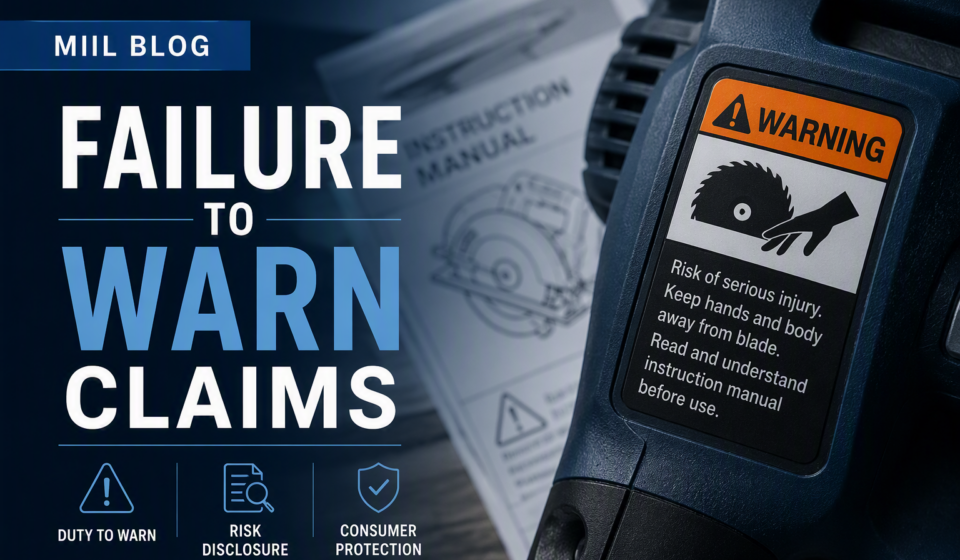
Failure-to-Warn Claims Under Missouri Law
Two causation prongs, a read-and-heed presumption that is only a submissibility device, and the one defense the legislature made complete
A failure-to-warn claim concedes, for argument’s sake, that the product is soundly designed and correctly built. Its premise is narrower and, in a sense, more unsettling: that a non-defective product can still be unreasonably dangerous because it was sold without an adequate warning of a characteristic the user did not know. The defect is the silence. Missouri treats the warning claim as a theory wholly distinct from design and manufacturing defect, with its own statutory home, its own verdict director, and—most consequentially—its own two-part causation structure and a rebuttable presumption that operates differently than most practitioners assume. It is also the single context in which the legislature granted manufacturers a complete affirmative defense. This article works through the elements, the causation architecture, the presumption, the strict-versus-negligent divide, the adequacy inquiry, and the defenses, then turns to how these cases are tried.
I. Statutory Basis and the Five Elements
The warning theory is codified at section 537.760(3)(b) RSMo—not (2)(b), a miscitation worth avoiding—which reaches a product “then unreasonably dangerous when put to a reasonably anticipated use without knowledge of its characteristics,” where “the plaintiff was damaged as a direct result of the product being sold without an adequate warning.” Missouri courts consistently recite five elements, stated verbatim by the Supreme Court in Tune v. Synergy Gas Corp., 883 S.W.2d 10, 13 (Mo. banc 1994), and by the Court of Appeals in Cole v. Goodyear Tire & Rubber Co., 967 S.W.2d 176, 184 (Mo. App. E.D. 1998):
(1) defendant sold the product in question in the course of his business; (2) the product was unreasonably dangerous at the time of sale when used as reasonably anticipated without knowledge of its characteristics; (3) defendant did not give adequate warning of the danger; (4) the product was used in a reasonably anticipated manner; and (5) plaintiff was damaged as a direct result of the product being sold without an adequate warning.
Nesselrode v. Executive Beechcraft, Inc., 707 S.W.2d 371, 384 (Mo. banc 1986), states the same five elements and ties them to MAI 25.05. As throughout Missouri products law, the phrase “unreasonably dangerous” is submitted to the jury as an ultimate issue without definition (Nesselrode, 707 S.W.2d at 383). The elements to watch are the second and fifth, which import the two operative concepts—danger “without knowledge of its characteristics” and damage “as a direct result of the product being sold without an adequate warning”—and which map directly onto the two causation prongs discussed next.
II. The Two Causation Prongs: Arnold v. Ingersoll-Rand
The defining feature of the Missouri warning claim is that causation is not one question but two. Arnold v. Ingersoll-Rand Co., 834 S.W.2d 192 (Mo. banc 1992)—a unanimous opinion, not a fractured one—arose from an explosion at an auto-repair shop where an air compressor’s sparking pressure switch was alleged to have ignited gasoline vapors. The Court held that a failure-to-warn plaintiff must prove two distinct causal links. “First, the plaintiffs’ injuries must be caused by the product from which the warning is missing”—product causation. “Second, plaintiffs must show that a warning would have altered the behavior of the individuals involved in the accident”—warning causation. 834 S.W.2d at 194.
The second prong is where warning cases are won and lost, because a plaintiff can prove the product caused the injury and still lose. Arnold tied warning causation to the plaintiff’s knowledge: before the causation presumption can apply, there must be “a legitimate jury question whether the plaintiff did not already know the danger,” and “the burden is on plaintiffs to show that lack of knowledge.” Id. The plaintiffs lost the warning submission precisely because everyone involved—the mechanics, the owner, the supplier—already knew of the fume-ignition danger, so a warning would have conveyed nothing new and could not have altered anyone’s behavior. That analysis makes the plaintiff’s lack of knowledge the gateway to the entire warning theory.
III. The Read-and-Heed Presumption—and What It Actually Is
Missouri lightens the second causation burden with a rebuttable presumption that an adequate warning, had it been given, would have been read and heeded. The presumption originates not in Restatement comment j, as treatises often assume, but in Duke v. Gulf & Western Manufacturing Co., 660 S.W.2d 404, 419 (Mo. App. 1983), which adopted the reasoning of the Indiana Craven decision that “a rebuttable presumption must arise that a warning would be heeded.” Grady v. American Optical Corp., 702 S.W.2d 911, 918 (Mo. App. 1985), restated it as arising “as a matter of law,” such that “in the absence of compelling evidence establishing that the absence of a warning did not cause the injury the causation question becomes one for the jury,” and that “[c]ertainty that the existence of the warning would have prevented injury is not required.”
The crucial refinement—and the point most often misused—comes from Tune, which characterized the device precisely: “If there is sufficient evidence from which a jury could find that the plaintiff did not already know the danger, there is a presumption that a warning will be heeded,” and, critically, “the term ‘presumption’ is used to mean ‘makes a prima facie case,’ i.e., creates a submissible case that the warning would have been heeded.” 883 S.W.2d at 14. In other words, the heeding presumption is a submissibility device, not a burden-shifting instruction the jury is told to apply. It carries the plaintiff past a directed verdict on the second prong; it does not command the jury to presume heeding. Counsel who over-claim it at the instruction conference invite reversible error, and defense counsel should hold the plaintiff to Tune’s framing. The presumption never attaches where the danger was already known or obvious (Arnold), and it is rebuttable by compelling evidence that the missing warning did not cause the injury (Grady).
IV. Moore v. Ford: The Warning Theory Stands Alone
Moore v. Ford Motor Co., 332 S.W.3d 749 (Mo. banc 2011), is the modern anchor and supplies two propositions a warning lawyer must own. A driver of roughly six feet and three hundred pounds was paralyzed when her seatback collapsed rearward in a low-speed rear-end collision; she alleged Ford failed to warn that the seat could collapse for a larger occupant, and testified she would not have bought the vehicle had she been warned. The trial court directed a verdict for Ford; the Supreme Court reversed. First, the Court held that a product not shown to be defective in design can nonetheless be unreasonably dangerous for want of an adequate warning—the warning theory is genuinely independent of the defect theory, so a design defense verdict does not dispose of the warning claim. Second, the Court applied the heeding presumption and held that the plaintiff’s own testimony that she would have avoided the vehicle supplied the behavioral-causation prong. Moore thus confirms both the independence of the (3)(b) branch and the continuing vitality of the presumption after tort reform.
V. Strict Liability Versus Negligent Failure to Warn
Missouri recognizes both a strict-liability and a negligent failure-to-warn theory, and the distinction is real. Strict liability focuses on the condition of the product—was it unreasonably dangerous without an adequate warning?—with no element of the manufacturer’s knowledge. The Eastern District underscored the point recently in Durnell v. Monsanto Co. (Mo. App. E.D. Feb. 11, 2025), affirming a $1.25 million Roundup verdict and holding that Missouri’s strict warning standard requires only that a defendant “did not give adequate warning of the danger,” with “no element requiring proof of the defendant’s knowledge or intent”—the analysis that let the state claim escape FIFRA preemption. Negligent failure to warn, by contrast, focuses on the manufacturer’s conduct—whether it knew or, by using ordinary care, should have known of the danger and unreasonably failed to warn—and is submitted on a negligence director rather than MAI 25.05.
Because the theories allocate the knowledge question in opposite directions, they may be pleaded together and their verdicts may diverge without inconsistency; a jury may find for the manufacturer on strict liability yet against it on negligence, or the reverse. Palmer v. Hobart Corp., 849 S.W.2d 135 (Mo. App. 1993), and Rinker v. Ford Motor Co., 567 S.W.2d 655 (Mo. App. 1978), treat them as separate submissions. The practical consequence: strict liability spares the plaintiff the knew-or-should-have-known proof, while the negligence theory can open the door to the manufacturer’s internal knowledge—testing, adverse-event data, prior claims—that a jury often finds more damning than the product’s bare condition. Prudent plaintiffs plead both.
VI. Adequacy of the Warning
Whether a warning is “adequate” is ordinarily a jury question, and Missouri’s leading treatment is Grady v. American Optical. Three dimensions recur. Content must signal the specific danger: a lens tag reading “impact resistant but . . . not unbreakable” was inadequate because it “did not warn a wearer that the lenses would shatter and thereby cause injury to the wearer’s eyes,” 702 S.W.2d at 917. Prominence and placement matter: adequacy turns on “placement or location, the language used and how it may or may not impress the average user,” and a tag positioned so it had to be removed before the glasses could be worn was inadequate as a fact question, id. at 914, 917. And the warning must reach the user—the manufacturer cannot delegate the duty to the employer, id. at 917. Nesselrode adds a content principle of its own: a warning must signal danger, so that installation instructions and part numbers are not warnings, 707 S.W.2d at 387. And Tune shows the point can run to the product’s own safety feature—there, a failure to warn that the odorant meant to reveal a propane leak might itself fail.
Two no-duty doctrines cabin the claim. There is no duty to warn of dangers that are open, obvious, or commonly known; Grady states the rule, 702 S.W.2d at 915, though whether a danger is obvious is usually itself a fact question (the court refused to hold as a matter of law that “safety glass” is commonly known to shatter into fragments). The related sophisticated-user defense discharges or reduces the duty where the user or an intermediary already possesses the relevant knowledge by training or expertise; the Eighth Circuit applied it under Missouri law in Donahue v. Phillips Petroleum Co., 866 F.2d 1008 (8th Cir. 1989). Both doctrines do their work through Arnold causation: a plaintiff who already knew the danger cannot show a warning would have altered behavior, and the heeding presumption never arises.
VII. The State-of-the-Art Defense—Section 537.764
The warning claim is the one setting in which state of the art is a complete statutory defense. Section 537.764 RSMo defines “state of the art” to mean that “the dangerous nature of the product was not known and could not reasonably be discovered at the time the product was placed into the stream of commerce,” and makes it “a complete defense and relevant evidence only in an action based upon strict liability for failure to warn,” to be “pleaded as an affirmative defense” with “the burden of proof” on the defendant. The design of the defense is deliberate. Strict liability otherwise charges a manufacturer with knowledge of its product’s dangers regardless of actual knowledge; section 537.764 gives the defendant a single, burden-bearing route to reintroduce what was genuinely unknowable at sale. Three consequences follow for practice. The defense is unavailable in design cases and, by subsection 3, does not touch a negligence claim—so a plaintiff who fears it should plead negligent failure to warn alongside strict liability. The defendant must actually prove unknowability, which a plaintiff blunts with evidence that the risk was reasonably discoverable (internal studies, literature, adverse-event reports). And subsection 4—“this section shall not be construed to permit or prohibit evidence of feasibility in products liability claims”—keeps feasibility evidence governed by ordinary relevance rules rather than by the statute.
VIII. Comparative Fault and the “Already Knew” Fulcrum
Section 537.765 RSMo applies pure comparative fault to warning claims, and two of its enumerated categories—use “with knowledge of a danger . . . and the voluntary and unreasonable exposure to said danger,” and “unreasonable failure to appreciate the danger”—are the warning defense’s fulcrum. They let a defendant convert the plaintiff’s own knowledge into apportionable fault even where that knowledge does not defeat causation outright. The result is a layered defense: the plaintiff’s knowledge of the danger can (a) negate the duty to warn (open and obvious), (b) defeat warning causation and strip the heeding presumption (Arnold), or, failing those, (c) reduce the recovery as comparative fault under section 537.765(3). Framing the plaintiff’s knowledge to capture whichever of these the evidence will support is the core of warning-defense strategy.
IX. The Learned Intermediary Overlay
In prescription-drug and medical-device cases, the duty to warn is reshaped by the learned intermediary doctrine: the manufacturer’s duty runs to the prescribing physician rather than the patient, and an adequate warning to the physician discharges it. That doctrine changes the causation inquiry—requiring proof that an adequate warning would have altered the prescriber’s decision—and it carries a federal-preemption overlay that can dispose of the claim before the merits. It is treated in full in the companion article, The Learned Intermediary Doctrine in Missouri Products Cases.
X. Trying the Warning Case
Plaintiff—proving both prongs. Establish product causation through the injury-mechanism experts, then build the second prong deliberately: first show the plaintiff’s lack of knowledge of the specific danger to trigger the presumption (Arnold; Tune), distinguishing general familiarity from knowledge of the operative hazard—as in Tune, where the user knew the smell of propane but not that the odorant could fade. Offer affirmative “I would have heeded / would not have used it” testimony as belt-and-suspenders (Moore), and propose a specific warning that would have conveyed new information. Plead negligent failure to warn to reach the manufacturer’s knowledge and to sidestep the section 537.764 defense.
Defense—defeating the second prong. Aim at warning causation, which is the claim’s soft tissue. Prove the danger was already known, obvious, or commonly known—simultaneously negating duty (Grady), defeating causation (Arnold), and supplying comparative fault. Frame obviousness in causation terms at directed verdict, not merely as a duty argument. Marshal “compelling evidence” that the missing warning would not have changed the outcome (Grady)—a plaintiff who ignored existing warnings or removed guards. Hold the plaintiff to Tune’s submissibility-only framing of the presumption, and, where the hazard was not reasonably discoverable at sale, plead and prove the section 537.764 state-of-the-art defense. Expect Daubert fights under section 490.065 over human-factors and warning-efficacy opinions on both sides.
XI. Analytical Tensions
Three tensions reward attention. The first is the near-circularity between the presumption and its precondition: the plaintiff must first raise a jury question that she did not know the danger before the heeding presumption can aid her (Arnold), so the presumption never rescues the plaintiff who cannot clear the knowledge threshold in the first place. The second is the presumption’s character after rebuttal. Tune’s “makes a prima facie case” language suggests a bursting-bubble presumption that drops out once the defendant offers contrary evidence, leaving behavioral causation to be proved conventionally and without a heeding instruction—yet Duke and Grady speak of a presumption that keeps the causation question for the jury absent compelling rebuttal. The reconciliation—submissibility device, not jury charge—is defensible but under-theorized, and it is live at every instruction conference. The third is whether section 537.764 has quietly “negligence-ized” strict warning liability: strict liability imputes knowledge, but the state-of-the-art defense lets the defendant disprove knowability, collapsing much of the practical distance between the strict and negligent theories. For the practitioner, the through-line is that warning cases are causation cases, that the plaintiff’s knowledge is the hinge on which duty, causation, the presumption, and comparative fault all turn, and that mastery of Arnold and Tune is worth more than any other pair of authorities in the field.
Related in the Products Liability Series
- Missouri Product Liability Law: The Complete Guide
- Design Defect Claims Under Missouri Law — the undefined “unreasonably dangerous” standard and how design cases are submitted.
- Manufacturing Defect Claims Under Missouri Law — proving departure from design by circumstantial inference and expert proof.
- Safer Alternative Design Requirements — why Missouri treats alternative design as evidence, not an element.
- Product Recall Evidence in Civil Litigation — the Pollard framework and the limits on recall admissibility.
- The Learned Intermediary Doctrine in Missouri Products Cases — the physician as the object of the duty to warn, and the preemption overlay.
- Investigating the Products Case: Preservation, Spoliation, and Cost.