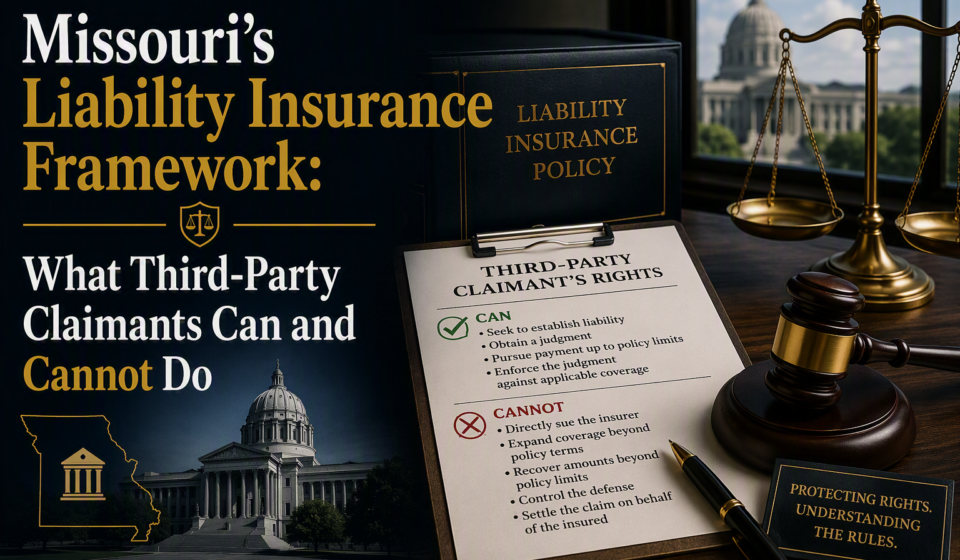
Missouri’s Liability Insurance Framework: What Third-Party Claimants Can and Cannot Do
Understanding direct action limitations and the judgment creditor’s rights under Missouri law
Missouri Injury & Insurance Law | missouriinjuryandinsurancelaw.com
Introduction
One of the recurring questions in Missouri personal injury practice is can an injured claimant bring a direct action against a tortfeasor’s liability insurer. The answer under Missouri law is generally no—but understanding the exceptions, the procedural pathways that exist, and the rights that vest upon judgment is essential to effective representation of injured clients. This post examines the direct action limitation, the assignment of bad faith claims, and the mechanics of proceeding against a liability carrier as a judgment creditor.
The Direct Action Bar in Missouri
Missouri follows the traditional rule that a third-party claimant has no direct right of action against a liability insurer until a judgment has been obtained against the insured. This principle flows from the nature of the liability insurance contract, which runs between the insurer and the insured, not between the insurer and injured third parties. The injured claimant is not a party to the contract and generally cannot enforce its terms directly.
Missouri has not enacted a general direct action statute of the type found in some other jurisdictions, such as Louisiana. Accordingly, plaintiffs’ counsel must proceed against the tortfeasor, obtain a judgment, and then proceed against the insurer. This sequencing has important strategic implications for how cases are structured and settled.
Exceptions and Practical Workarounds
Several important exceptions exist. First, Missouri’s uninsured motorist statute, Mo. Rev. Stat. § 379.203 (2023), and underinsured motorist provisions create direct contractual rights for the insured against their own carrier, not the tortfeasor’s carrier. These are first-party claims governed by different rules.
Second, in cases involving insurer insolvency, Missouri’s guaranty association statutes, Mo. Rev. Stat. §§ 375.771–375.799 (2023), provide a mechanism for claimants to seek recovery from the Missouri Life and Health Insurance Guaranty Association or the Missouri Insurance Guaranty Association, depending on the line of insurance involved.
Third, interpleader proceedings under Mo. R. Civ. P. 52.07 sometimes permit an insurer to pay disputed policy proceeds into court and seek discharge, which can accelerate resolution in multi-claimant scenarios.
Rights of Judgment Creditors
Once a judgment is obtained against the insured, the judgment creditor steps into the insured’s shoes with respect to the policy. At this point, the judgment creditor may pursue the insurer directly if the insurer refuses to pay the judgment within the policy limits. Mo. Rev. Stat. § 379.200 (2023) provides that every liability policy issued in Missouri must contain a provision making it directly enforceable by judgment creditors.
The judgment creditor is entitled to receive the full benefit of the insured’s rights under the policy, including the right to pursue vexatious refusal under Mo. Rev. Stat. § 375.420 (2023) and any common law bad faith claims that have accrued. Practitioners should ensure that any settlement or consent judgment with the insured includes an explicit assignment of all insurance-related claims to preserve these rights.
Assignment of Bad Faith Claims
One of the most important tools in Missouri excess judgment practice is the assignment of the insured’s bad faith claim against its own carrier. When an insurer fails to settle within policy limits and an excess judgment results, the insured may assign its bad faith claim to the injured plaintiff in exchange for a covenant not to execute on the excess judgment. This arrangement—sometimes called a Ganaway assignment after patterns established in Missouri case law—can transform a judgment that is otherwise uncollectable into a significant recovery.
Practitioners pursuing assigned bad faith claims should be aware that Missouri courts scrutinize the adequacy of the underlying settlement demand and the insurer’s investigation process. The demand must have been within policy limits, reasonable in light of the facts known at the time, and accompanied by sufficient information to allow the insurer to evaluate its exposure. Documentation of these elements from the moment of first contact with the insurer is essential.
Conclusion
Missouri’s framework for third-party liability insurance claims rewards practitioners who understand the procedural sequencing and who begin building the record for a potential bad faith or vexatious refusal claim from the earliest stages of representation. The direct action limitation is not a barrier—it is simply a sequencing requirement that disciplined practitioners can navigate effectively.