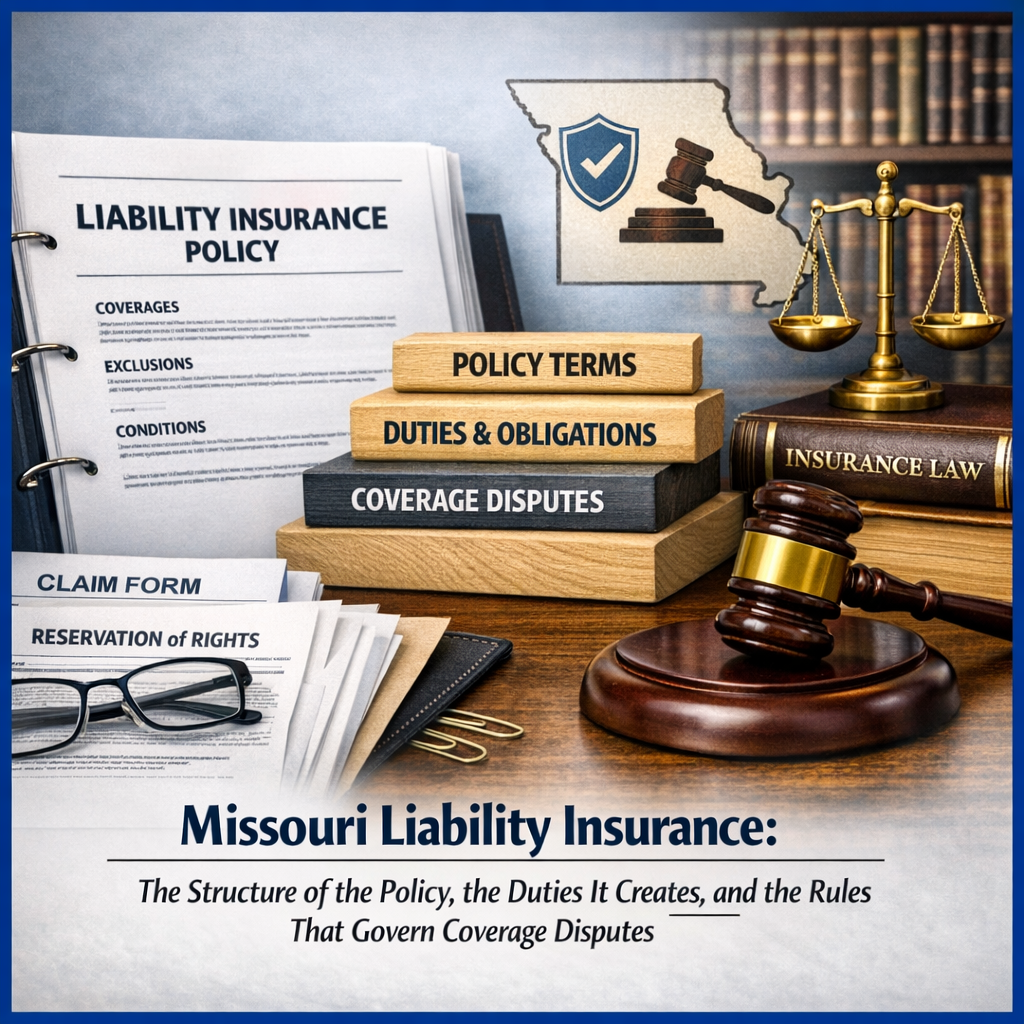
Missouri Liability Insurance: The Structure of the Policy, the Duties It Creates, and the Rules That Govern Coverage Disputes
A foundational overview for practitioners and sophisticated readers
Missouri Injury & Insurance Law | missouriinjuryandinsurancelaw.com
Introduction
Every liability insurance dispute in Missouri rests on the same foundation: a contract of adhesion drafted exclusively by the insurer, purchased by the insured for protection, and interpreted under a well-developed body of Missouri law that governs how policies are read, what obligations they create, and what happens when the insurer fails to honor those obligations.
This post provides a foundational overview of that framework. It covers the nature of the insurance contract itself, the two core duties every liability policy creates, the rules Missouri courts apply when interpreting policy language, the mechanics of a reservation of rights, and the consequences of a wrongful refusal to defend. Each topic is treated here at the level necessary to understand how the pieces fit together. For deeper treatment of individual subjects, see the dedicated posts in this series noted throughout.
I. The Nature of the Insurance Contract
A liability insurance policy is not a negotiated agreement between parties of equal sophistication and bargaining power. It is a standardized, mass-produced contract drafted in its entirety by the insurer and offered to the insured on a take-it-or-leave-it basis. The insured typically has no meaningful ability to negotiate its terms, no access to the drafting history, and no practical alternative but to accept the language as written.
That reality carries legal consequences. Because the insurer alone controls the language of the policy, it bears responsibility for its own drafting failures. Where the insurer’s language is ambiguous, vague, or susceptible to more than one reasonable interpretation, the insured receives the benefit of that doubt. This is not a pro-insured judicial preference—it is the logical and well-settled result of who wrote the contract and for what purpose it was purchased.
At the same time, Missouri enforces clear and unambiguous policy language as written, provided the provision does not violate a statute or strong public policy. Weathers v. Royal Indem. Co., 577 S.W.2d 623, 626 (Mo. banc 1979). Where a provision is plain on its face, courts apply it according to its terms. The ambiguity rule operates only at the margin: when the insurer’s own drafting leaves genuine room for doubt, that doubt resolves in favor of the insured. Where the language is clear, it is enforced as written.
For a full treatment of how Missouri courts interpret insurance policy language—the ambiguity canon, exclusion construction, and the statutory and public policy limits on enforcement—see: “Reading the Policy: How Missouri Courts Interpret Insurance Contracts”
II. The Two Core Duties—and the Right to Control
Every liability insurance policy creates two fundamental obligations. Understanding the distinction between them is essential to understanding every coverage dispute that follows.
A. The Right and Duty to Defend
The first and most immediate obligation is the right and duty to defend the insured against claims that are potentially within the scope of coverage. This obligation arises at the threshold of potential coverage—not after coverage is confirmed—and it is broader than the duty to indemnify.
The duty to defend is triggered whenever a claim is potentially or arguably within coverage. Luyties Pharmacal Co. v. Frederic Co., 716 S.W.2d 831 (Mo. App. E.D. 1986). Missouri courts construe the underlying petition liberally, resolve all doubts in the insured’s favor, and also consider facts known or reasonably knowable to the insurer beyond the four corners of the petition. Truck Ins. Exch. v. Prairie Framing, LLC, 162 S.W.3d 64, 79 (Mo. App. W.D. 2005); Allen v. Continental W. Ins. Co., 436 S.W.3d 548, 553 (Mo. banc 2014). The duty exists as long as at least one potentially covered claim is pleaded, even if other claims are clearly outside coverage.
For a full treatment of the duty to defend—the potentially-within-coverage standard, the three-option framework, wrongful refusal consequences, and the declaratory judgment action—see: “Missouri’s Duty to Defend: Scope, Breach, and the Consequences of Wrongful Refusal”
B. The Duty to Indemnify
The second obligation is the duty to indemnify—to pay any judgment entered against the insured, or any settlement reached, within policy limits, for claims that fall within coverage. The duty to indemnify is narrower than the duty to defend: it requires actual coverage, not merely potential coverage. An insurer may owe a defense it ultimately has no obligation to indemnify, because the defense obligation attaches earlier and on a lower threshold.
C. The Right to Control the Defense and Settlement
Accompanying the right to defend is the insurer’s contractual right to control the defense and to direct or approve any settlement of the covered claim. This right is not incidental to the policy—it is central to how the insurer manages its exposure under the policy limits it has accepted.
But the right to control carries a corresponding obligation. When the insurer retains exclusive control over the litigation and settlement, Missouri law imposes a fiduciary relationship and requires the insurer to act with the utmost good faith toward the insured—giving equal, and in some circumstances paramount, consideration to the insured’s interests when evaluating settlement opportunities.
Zumwalt v. Utils. Ins. Co., 228 S.W.2d 750 (Mo. 1950); W. Cas. & Sur. Co. v. Herman, 405 F.2d 121 (8th Cir. 1968). An insurer that places its own financial interests ahead of the insured’s exposure—particularly when a reasonable settlement within policy limits is available—breaches that fiduciary obligation and opens the door to contract and extra-contractual liability.
III. When Coverage Is in Question: The Three-Option Framework
When a liability claim is presented and coverage is disputed, Missouri recognizes three available courses of action for the insurer. State ex rel. Rimco, Inc. v. Dowd, 858 S.W.2d 307, 308 (Mo. App. E.D. 1993):
- Defend unconditionally, accepting the defense without qualification.
- Defend under a reservation of rights, preserving coverage defenses in writing while providing the defense.
- Refuse to defend, accepting the risk that the refusal is wrongful.
A wrongful refusal exposes the insurer to policy-limit liability plus attorney’s fees, defense costs, and other consequential damages. A defense under a reservation of rights preserves coverage defenses but triggers significant conflict-of-interest concerns and gives the insured the right to refuse the tendered defense.
A. What a Proper Reservation Letter Requires
A reservation of rights letter must be more than a boilerplate recitation of policy language. It should specifically identify the provisions and exclusions at issue, tie those provisions to the specific allegations in the petition, explain the coverage position in detail, describe the proposed defense arrangement, advise the insured of any right to independent counsel where a genuine conflict exists, identify actual or potential conflicts of interest, and use the words “reservation of rights” explicitly. Western Heritage Ins. Co. v. Love, No. 4:13-CV-0034-DGK, slip op. at 7-8 (W.D. Mo. Jan. 13, 2014).
B. The Conflict a Reservation Creates—and the Insured’s Right to Refuse
Missouri recognizes that a reservation of rights may chill a zealous defense. An insurer defending under a reservation has potential incentives to develop facts supporting noncoverage rather than defeat liability on the merits—an interest directly at odds with the insured’s.
Carrier practices vary: some tender defense counsel simultaneously with the reservation letter; others condition the provision of counsel on the insured’s written acceptance, pressuring the insured to accept the arrangement to obtain representation at all. The timing and mechanics matter both practically and legally.
When the insurer files a declaratory judgment action to resolve coverage while simultaneously defending the underlying case, the insurer and insured become formal adversaries on the coverage question. In that posture, defense counsel must remain independent of the insurer and may not share defense strategy, facts, or legal theories with the carrier to the extent necessary to protect the insured’s defense. II Mo. Ins. Prac. § 13.68 (Mo. Bar 5th ed. 2004). The insured also has the right to refuse a defense tendered under a reservation of rights. Safeco Ins. Co. of Am. v. Rogers, 968 S.W.2d 256, 258 (Mo. App. W.D. 1998).
reservation of rights mechanics, the conflict-of-interest analysis, appointed counsel obligations, and strategic implications for plaintiff’s counsel—see: “Reservation of Rights in Missouri: Appointed Counsel, Conflicts of Interest, and the Insured’s Right to Refuse” .
IV. Wrongful Refusal to Defend: Consequences
An insurer that wrongfully refuses to defend breaches its contract. Sprint Lumber, Inc. v. Union Ins. Co., 627 S.W.3d 96, 119 (Mo. App. 2021). The consequences are significant: the insurer may be liable for the full policy limits, plus attorney’s fees the insured incurred in the defense, and other consequential damages. Pets Alone Sanctuary of Lincoln Cnty. v. Midwest Family Mut. Ins. Co., 2022 U.S. Dist. LEXIS 203262 (citing Allen v. Bryers, 512 S.W.3d 17, 38 (Mo. banc 2016)).
A wrongful refusal also forfeits the insurer’s ability to control the defense and manage its litigation exposure. Having declined to defend, the insurer cannot later complain about how the case was litigated, what admissions were made, or what settlement was reached without its involvement. The insurer that refuses to defend gambles not only on whether it was right about coverage, but on the entire trajectory of the underlying case.
V. How the Pieces Fit Together
Missouri’s liability insurance framework is coherent and, once understood, predictable. The policy is an adhesion contract: clear language is enforced as written, ambiguous language is construed in favor of coverage, and exclusions are read narrowly with the burden on the insurer. Those interpretive rules set the stage for every coverage dispute.
When a claim arrives, the insurer evaluates the petition and known facts. If there is any reasonable possibility of coverage, the duty to defend attaches. The insurer may defend outright, defend under a reservation of rights with all the conflict implications that entails, or refuse to defend at its peril. If it controls the defense, it does so as a fiduciary—required to act with utmost good faith and to give the insured’s interests equal consideration, particularly when evaluating settlement.
Each of these topics is addressed in depth in dedicated posts in this series. This post provides the map; the individual posts provide the terrain.