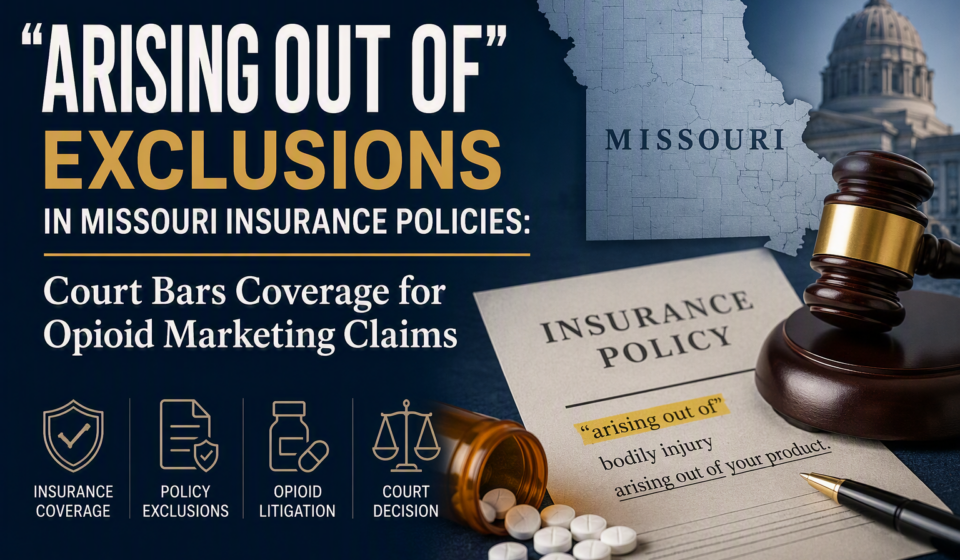
“Arising Out Of” Exclusions in Missouri Insurance Policies: Court Bars Coverage for Opioid Marketing Claims
In Opioid Master Disbursement Trust II a/k/a Opioid MDT II v. ACE American Insurance, et al., ED113635 (Mo. App. E.D. July 21, 2026), the Missouri Court of Appeals addressed an important coverage issue arising out of the opioid litigation wave: whether bodily injury claims allegedly resulting from deceptive, unbranded opioid marketing fall within a products-completed operations hazard exclusion (“PCOH exclusion”) contained in liability insurance policies. The court held that they do.
The decision provides significant guidance regarding two recurring insurance-coverage issues:
- How broadly Missouri courts interpret the phrase“arising out of”; and
- Whether allegations based on marketing representations can constitute claims arising from the insured’s product for purposes of a product-liability exclusion.
Background
Mallinckrodt and related entities manufactured, marketed, and distributed opioid products. Following thousands of lawsuits alleging harm from opioid use, the companies entered bankruptcy. As part of the bankruptcy process, the Opioid Master Disbursement Trust II was created and received the debtors’ insurance rights, allowing it to pursue coverage for opioid-related liabilities.
The underlying lawsuits alleged that the debtors engaged in a widespread unbranded marketing campaign designed to understate addiction risks, promote opioid use for chronic pain, and increase overall opioid sales. Claims included governmental actions, wrongful death suits, and neonatal abstinence syndrome cases.
The Trust sought coverage under multiple primary, umbrella, and excess liability policies. Insurers argued that coverage was barred by policy language excluding bodily injuries arising out of the insured’s products and by claims-made reporting requirements.
The Policies at Issue
The primary policies contained a PCOH exclusion barring coverage for bodily injury occurring away from the insured’s premises and “arising out of” the insured’s product. Arising out of exclusions have been treated broadly in Missouri. The policy definition of “your product” extended beyond physical products and expressly included:
- Warranties and representations concerning the product; and
- Failures to provide warnings or instructions.
The umbrella and excess policies contained endorsements that restored certain product-related coverage only when claims were both made and reported during the applicable policy period. The Trust acknowledged that the underlying opioid claims were not made and reported within the required periods.
The Trust’s Argument
The Trust argued that the underlying injuries did not arise from the debtors’ products because many claimants allegedly suffered harm through products manufactured by others or through illicit opioids such as heroin. According to the Trust, the injuries stemmed from broader market conditions and third-party conduct rather than the debtors’ specific products.
The Trust further contended that applying the exclusion to unbranded marketing created ambiguity because the marketing was not tied to a particular branded product. Under traditional Missouri insurance-law principles, ambiguities would be resolved in favor of coverage.
The Court’s Analysis
The court rejected those arguments.
“Arising Out Of” Remains Broad in Missouri
The opinion reiterates Missouri’s long-standing approach that “arising out of” is an extremely broad phrase. Missouri courts interpret it to mean:
- originating from;
- growing out of;
- flowing from; or
- having origins in.
Importantly, the court emphasized that the phrase requires only a causal connection—not direct or proximate causation. The opinion relied on Missouri precedent holding that “arising out of” requires merely a simple causal relationship between the injury and the excluded conduct.
That principle proved outcome-determinative.
Unbranded Marketing Was Still Part of the Insureds’ Product
The court concluded that the policies’ definition of “your product” plainly included representations and warranties concerning opioid products. Because the underlying lawsuits alleged that the debtors disseminated misleading information about opioid safety, addiction risks, and treatment uses in order to increase opioid sales, the alleged bodily injuries flowed from those representations.
According to the court, it did not matter that the marketing campaign was “unbranded.” The allegations asserted that the campaign was intended to increase the sale of the debtors’ opioid products and active pharmaceutical ingredients. Those allegations established the requisite causal connection between the injuries and the debtors’ products.
Reliance on Actavis and Dundon
Because the precise issue presented a matter of first impression in Missouri, the court relied heavily on two opioid-coverage decisions from other jurisdictions:
- The Travelers Property Casualty Company of America v. Actavis, Inc., a California appellate decision; and
- Dundon v. ACE Property & Casualty Insurance Co., a federal decision involving another opioid manufacturer.
Both cases concluded that substantially similar product-liability exclusions barred coverage for claims arising from allegedly deceptive opioid marketing campaigns. Missouri’s Eastern District found their reasoning persuasive and adopted it.
Claims-Made Requirements Provided an Independent Basis for Denial
Even if the PCOH exclusion had not applied, the court held that coverage remained unavailable under the umbrella and excess policies because the policies required claims to be both made and reported during the policy period. The underlying opioid lawsuits were filed years after the relevant policy periods ended, and no claims were reported during those periods. As a result, the claims-made endorsements independently barred coverage.
Why Coverage Lawyers Should Care
This case reinforces several important Missouri coverage principles.
First, Missouri courts continue to interpret “arising out of” broadly. Policyholders will face an uphill battle when attempting to sever indirect injuries from the conduct identified in a coverage exclusion.
Second, courts may look beyond the physical product itself and focus on contractual definitions that include representations, warranties, and warnings. Where policies define “your product” broadly, marketing conduct may be treated as part of the product for coverage purposes.
Third, the opinion serves as a reminder that claims-made-and-reported requirements remain potent coverage defenses. Courts continue to enforce those requirements according to their plain language, even in mass-tort settings involving substantial liabilities.
Takeaway
The Eastern District’s decision represents a significant Missouri coverage ruling arising from the opioid litigation landscape. By holding that injuries allegedly resulting from deceptive unbranded opioid marketing still “arose out of” the insureds’ products, the court applied a broad reading of product-related exclusions and aligned Missouri with other jurisdictions addressing similar opioid coverage disputes. The court also reaffirmed that claims-made reporting requirements will be enforced as written, providing insurers with an independent basis to deny coverage when reporting prerequisites are not satisfied.
Related links:
Reading a Missouri Liability Policy: Declarations, Insuring Agreements, Exclusions, and Conditions
Using AI to Parse the Grammar and Syntax of Insurance Policy Language