Qureshi v. American Family: Building a Missouri Vexatious Refusal Case
How an inadequate claims investigation, a lowball settlement offer, and an insurer’s strategic refusal to answer deposition questions combined to sustain a jury verdict for vexatious refusal under § 375.420 RSMo
Missouri Injury & Insurance Law | missouriinjuryandinsurancelaw.com
I. Introduction
Every insurance coverage practitioner in Missouri knows that § 375.420 RSMo authorizes a statutory penalty and attorney’s fees when an insurer refuses to pay a loss “without reasonable cause or excuse.” The statute is powerful. But the power is in the execution—in how you build the record during the claims process, how you take the depositions, what evidence you get in front of the jury, and how you frame the insurer’s conduct as a coherent story of unreasonableness.
Qureshi v. American Family Mutual Insurance Co., 2020 Mo. App. LEXIS 395 (Mo. App. E.D. Apr. 7, 2020), is one of the most instructive vexatious refusal opinions in recent Missouri case law—not because the legal principles are novel, but because the Eastern District’s opinion walks through the evidentiary and trial-practice mechanics of the vexatious case in a way that few decisions do. The court addressed five points on appeal—sufficiency of the evidence, admissibility of deposition testimony, settlement offers, policy limits, and expert testimony on vexatiousness—and in doing so provided a practical roadmap for building the § 375.420 claim from the ground up.
This post breaks down each holding and identifies the lessons I take from it for my own practice.
II. The Facts: A Hit-and-Run, a Closed File, and a $20,000 Offer on a $75,000 Claim
Farzad Qureshi was rear-ended by a hit-and-run driver on I-270 in Ferguson, Missouri, on June 26, 2011. He reported the claim to American Family the following day. The adjuster, Stephanie Osbourne, attempted to locate the hit-and-run driver using the plate number Qureshi provided. When she could not identify the driver, she closed the file on August 11, 2011. She did not advise Qureshi that a hit-and-run driver constitutes an uninsured motorist under Missouri law—which would have triggered his right to UM benefits under his own policies. That omission is the kind of claims-handling failure that, in my experience, is far more common than it should be, and it is the seed from which the entire vexatious case grew.
Qureshi persisted. Over the next two years, he contacted American Family with updates on his worsening symptoms—neck and back pain, diagnostic testing, and eventually an MRI revealing herniated discs at three cervical levels. His orthopedic surgeon concluded the injuries were a direct result of the collision and recommended a multi-level cervical fusion. A second surgeon concurred on causation and recommended a multi-level disc replacement surgery estimated at over $200,000.
Qureshi’s counsel demanded the $75,000 UM policy limits. American Family’s sole response was a single offer of $20,000. When the $75,000 demand was reasserted with a detailed letter documenting the surgical recommendation and estimated cost, American Family did not respond at all. At trial, the jury awarded $75,000 on the UM claim, $18,000 in vexatious refusal damages, and $96,828 in attorney’s fees. The Eastern District affirmed on all points and awarded an additional $26,458 in appellate fees.
III. The Three-Part Test and the “General Survey” Standard
The court restated the elements of a vexatious refusal claim under § 375.420, citing Dhyne v. State Farm Fire & Casualty Co., 188 S.W.3d 454, 457 (Mo. banc 2006): (1) the insured had a policy with the insurer; (2) the insurer refused to pay losses; and (3) the refusal was without reasonable cause or excuse. The first two were undisputed. The case turned entirely on the third.
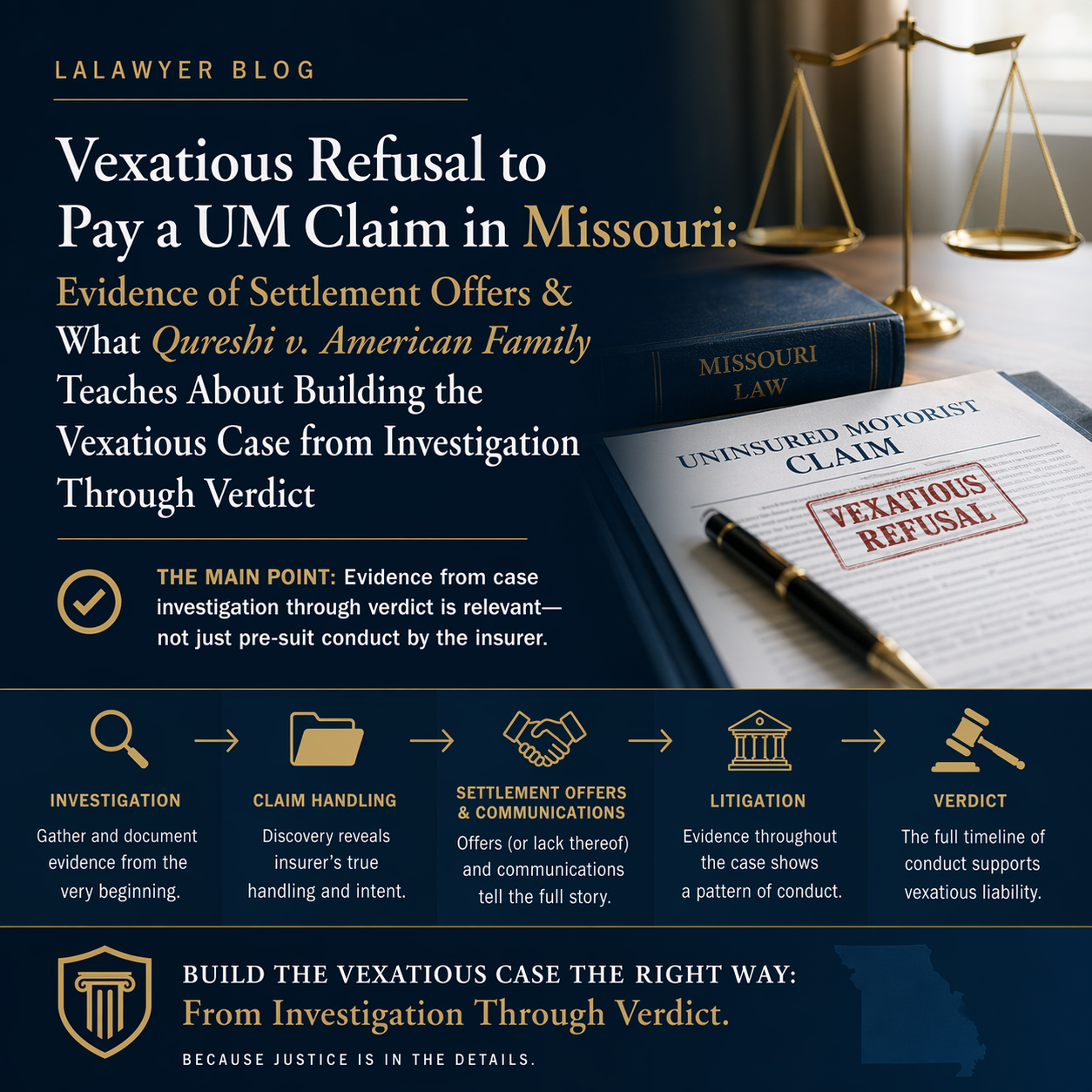
What makes Qureshi particularly useful is the court’s emphasis on how the jury evaluates reasonableness. Direct and specific evidence of vexatious refusal is not required. The jury may find vexatious refusal “upon a general survey and consideration of the whole testimony and all the facts and circumstances in connection with the case.” Dhyne, 188 S.W.3d at 457 (quoting DeWitt v. American Family Mutual Insurance Co., 667 S.W.2d 700, 710 (Mo. banc 1984)). And critically, the jury is not limited to the insurer’s pre-suit conduct—it may consider any facts developed prior to trial, including the insurer’s conduct during the litigation itself. Hopkins v. American Economy Insurance Co., 896 S.W.2d 933 (Mo. App. W.D. 1995).
I cannot overstate the importance of this principle. Insurers routinely argue that the vexatious inquiry should be limited to what happened before the lawsuit was filed. Qureshi expressly rejects that limitation. The jury evaluates the entire course of conduct—from the date of the claim through the date of trial. That includes how the insurer handled discovery, what its corporate representative said (or refused to say) in deposition, and whether it ever meaningfully reassessed its position as the evidence developed.
IV. The Insurer’s Investigation as Evidence of Vexatiousness
American Family argued that testimony about its investigation of the claim was irrelevant to vexatious refusal. The court disagreed, citing Tauvar v. American Family Mutual Insurance Co., 269 S.W.3d 436, 439 (Mo. App. W.D. 2008): evidence of the insurer’s investigation is relevant to the jury’s determination of vexatiousness, and “an insurer’s refusal to pay based on an inadequate investigation is key exemplary evidence of an insurer’s vexatiousness.”
The facts here illustrate why this matters. Osbourne closed the file without telling Qureshi he had UM coverage. She received signed authorizations for medical and employment records but never requested them. When American Family’s corporate representatives were deposed, counsel instructed them not to answer questions about what the company knew about Qureshi’s injuries or how it handled the claim after suit was filed—invoking attorney-client privilege and work product. The court found this strategic silence was itself evidence of vexatiousness. These witnesses could have explained the company’s reasoning. Instead, American Family chose “the legally unsupported path that anything that occurred after suit was filed was irrelevant.”
The deposition excerpts were independently admissible under Missouri Supreme Court Rule 57.07(a)(2), which provides that depositions may be used in court “for any purpose.”
Practice Tip: In every vexatious refusal case, the insurer’s claims file is the battlefield. Depose the adjuster and the corporate representative. Ask what records they requested, when, what they reviewed, and what they did not. Ask what analysis supported their valuation. If they are instructed not to answer, that blank record comes in at trial under Rule 57.07(a)(2)—and the silence speaks volumes.
V. Settlement Offers as Evidence of Unreasonableness
American Family argued its $20,000 offer and Qureshi’s $75,000 demand were inadmissible under the general rule against using settlement offers to prove liability. The court acknowledged the general rule but applied the vexatious-refusal exception: settlement offers and demands are admissible when relevant to the reasonableness of the insurer’s conduct. Hopkins, 896 S.W.2d at 944–45.
The court’s language is worth internalizing: it found it “difficult to imagine any evidence more relevant to the reasonableness element in a vexatious refusal to pay case than whether a defendant insurance company made a settlement offer and, if so, for how much.” To exclude this evidence would force the jury to assess the insurer’s conduct “in a vacuum.”
This is consistent with my experience trying these cases. The gap between the insurer’s offer and the policy limits—viewed against the medical evidence sitting in the insurer’s own file—tells the reasonableness story more effectively than any expert. Here, American Family offered $20,000 on a $75,000-limit policy where the medical records documented herniated discs at three cervical levels and a recommended surgery costing over $200,000. That number speaks for itself.
Practice Tip: Document every settlement demand and every response—or non-response—from the carrier. Under Qureshi, the entire negotiation history is a trial exhibit. A detailed demand letter that attaches medical records, identifies policy limits, and requests a specific amount—followed by silence or a fraction of the demand—is among the most powerful evidence you will put in front of the jury.
VI. Policy Limits in the Vexatious Context
American Family challenged the admission of its UM policy limits. The court acknowledged that limits might be irrelevant in a pure breach-of-contract case, but held that in a case also involving vexatious refusal, the limits are directly relevant because “the paramount issue was whether the insurance company’s conduct was reasonable.” The $75,000 policy limits put American Family’s $20,000 offer into devastating context—barely more than a quarter of its own coverage on a claim supported by extensive medical documentation.
VII. Expert Testimony on Vexatious Conduct
American Family challenged the qualification of the plaintiff’s expert—an attorney who opined that American Family’s handling of the claim was vexatious. The court found the expert properly qualified based on practical experience: he had been licensed since 1994, started at an insurance defense firm handling UM claims for insurers, and had since litigated nearly one hundred UM and UIM cases representing insureds, including vexatious refusal claims. Under § 490.065 RSMo, an expert may be qualified by “skill, knowledge, experience, training, or education,” and any weakness in the factual underpinnings goes to weight, not admissibility. Matter of Brown v. State, 519 S.W.3d 848, 861 (Mo. App. W.D. 2017).
Practice Tip: Retain a vexatious refusal expert—ideally an attorney with experience on both sides of the claims relationship. Someone who has handled UM claims for insurers and then represented insureds against them can walk the jury through what a reasonable carrier should have done with this file. Qureshi confirms that practical litigation experience is a sufficient basis for qualification. The insurer’s challenge goes to weight. The jury decides weight.
VIII. Attorney’s Fees on Appeal
The court awarded an additional $26,458 in appellate attorney’s fees at the same hourly rate the jury found reasonable at trial. The entitlement to appellate fees stands on the same ground as the trial-level award. Merseal v. Farm Bureau Town & Country Insurance Co. of Missouri, 396 S.W.3d 467, 475 (Mo. App. E.D. 2013). When the insurer appeals a vexatious refusal verdict and loses, the statutory penalty continues to compound. That is a consideration the insurer’s appellate counsel should weigh carefully—and one the plaintiff’s attorney should raise in any post-trial settlement discussion.
IX. What I Take from This Case
Qureshi is fundamentally a case about the record you build. Every holding traces back to evidence that was created or preserved during the claims process and litigation. The lessons are practical:
The vexatious case starts the day the claim is reported—not the day you file suit. Document every communication with the carrier. Send every demand by a method that creates a written record. When the insurer fails to respond, preserve the silence.
The insurer’s investigation is the centerpiece. A carrier that closes a file without advising the insured of available coverage, fails to request medical records despite having authorizations, and makes a single lowball offer without any documented valuation analysis is building the plaintiff’s case for you.
Depose the claims handlers aggressively. If counsel instructs them not to answer, the blank transcript is a trial exhibit. If they do answer, their testimony about what they knew, when they knew it, and what they did about it is the heart of the case.
The settlement history is evidence. The gap between the offer and the limits—viewed against the medical documentation in the carrier’s own file—is the single most effective way to show the jury that the refusal was without reasonable cause.
And when the carrier appeals and loses, the fees compound. That is the design of § 375.420. The statute is meant to deter unreasonable refusals, and the ongoing accumulation of attorney’s fees through appeal is part of that deterrence.
For further reading check out: