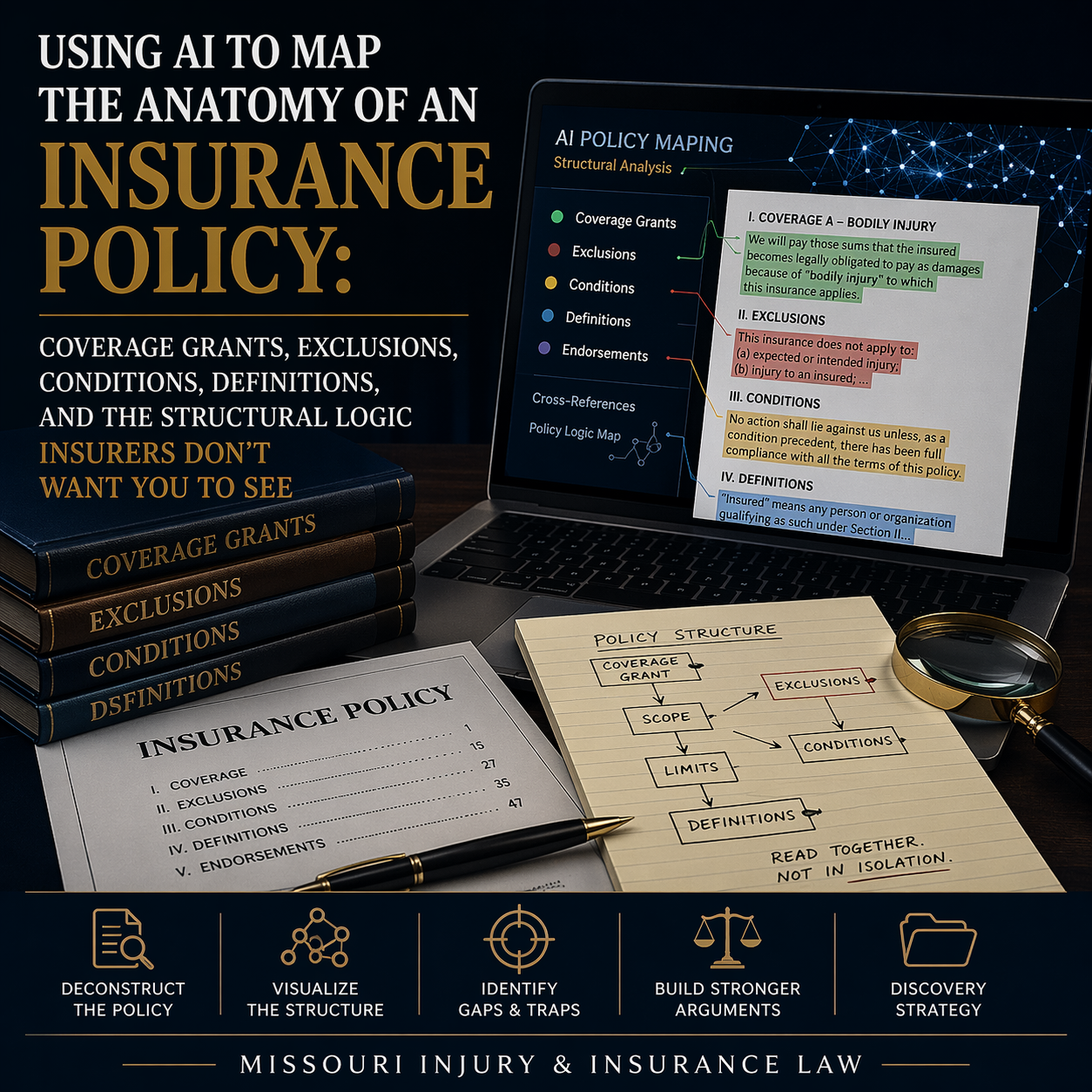
Using AI to Map the Anatomy of an Insurance Policy: Coverage Grants, Exclusions, Conditions, Definitions, and the Structural Logic Insurers Don’t Want You to See
How to use AI to deconstruct an insurance policy into its functional components — and why understanding the architecture of the contract is the single most important skill in coverage litigation
Introduction
Every insurance policy, regardless of its line of coverage, is built on the same structural architecture. There is a coverage grant — the insurer’s core promise to pay. There are definitions that control the meaning of the terms used throughout the contract. There are exclusions that carve back the grant. There are conditions that impose obligations on the insured as prerequisites to recovery. And there are endorsements that modify, expand, or restrict any of the foregoing. These components interact with each other, and the interaction is where coverage disputes live.
Most policyholders — and, candidly, many attorneys — read a policy linearly, front to back, as though it were a narrative. It is not. An insurance policy is a machine. Each component performs a specific function, and the components operate in a specific sequence. The coverage grant opens the door. The definitions determine how wide the door opens. The exclusions close it partially. The exceptions to exclusions reopen it. The conditions impose prerequisites that must be satisfied before the insured can walk through. Reading a policy without understanding this architecture is like reading a circuit diagram as prose.
AI is exceptionally well-suited to this kind of structural analysis. A large language model can ingest an entire policy, identify each functional component, classify it, and produce a structured map of how the components interact. This post explains how to use AI to perform that analysis and what to look for at each stage.
I. The Coverage Grant
The coverage grant is the core promise the insurance company makes in the policy. It is the paragraph — usually at the top of each coverage section — where the insurer defines what it will pay for and under what circumstances. Everything else in the policy either narrows or qualifies that promise. The coverage grant is where every coverage analysis must begin, because if the claim does not fall within the grant, nothing else in the policy matters.
When you upload a policy to an AI tool, the first instruction should be: “Identify every coverage grant in this policy. For each grant, state the insuring agreement verbatim, identify the triggering event or condition, identify the type of loss or damage covered, and identify who qualifies as an insured under that grant.” The AI will locate each insuring agreement and extract its operative components. In a commercial general liability policy, for example, it will separately identify Coverage A (bodily injury and property damage liability), Coverage B (personal and advertising injury liability), and Coverage C (medical payments), along with the distinct triggering conditions for each.
Practice Tip: Always ask the AI to identify the coverage trigger explicitly. Occurrence-based policies and claims-made policies impose fundamentally different triggering requirements, and the distinction controls when coverage attaches. If the AI cannot identify the trigger clearly from the grant language, the policy may be ambiguous on the point — and that ambiguity favors the insured.
II. Definitions
The definitions section is the most underappreciated part of any insurance policy. Definitions do not merely explain terms; they control scope. A policy that covers “bodily injury” means one thing if “bodily injury” is defined to include emotional distress and something quite different if it is limited to physical harm to the body. A policy that covers “your work” means one thing if “your work” includes the work of subcontractors and something else entirely if it does not.
Ask the AI to build a definitions inventory: “Identify every defined term in this policy. For each defined term, state the definition and identify every provision in the policy — coverage grants, exclusions, conditions, and endorsements — where that term appears. Flag any defined term that is used inconsistently or that appears to have a different operational meaning in different sections of the policy.”
This cross-referencing is something AI does far more reliably than a human reader. A single policy may use a defined term dozens of times across multiple sections, and a subtle shift in context can change its practical effect. The AI will map every instance and flag inconsistencies that a linear reader would almost certainly miss.
Practice Tip: Pay particular attention to defined terms that incorporate other defined terms. Nested definitions are a favorite drafting technique, and they can create circular or internally contradictory language. Ask the AI to “unpack” each nested definition by substituting the underlying definitions into the parent term so you can read the fully expanded meaning in a single sentence.
III. Exclusions and Exceptions to Exclusions
Exclusions are the provisions that carve back the coverage grant. They identify categories of loss, types of conduct, or specific circumstances that the insurer will not cover even though the loss would otherwise fall within the insuring agreement. In Missouri, the insurer bears the burden of proving that an exclusion applies, and exclusions are construed narrowly against the insurer. These principles are foundational, but they do not help the practitioner unless the practitioner first understands exactly what each exclusion says and how it interacts with the grant.
Prompt the AI: “Identify every exclusion in this policy. For each exclusion, state the excluded category of loss or conduct, identify the defined terms used within the exclusion, and explain the relationship between the exclusion and the coverage grant it modifies. Then identify every exception to an exclusion — every provision that restores coverage for a subset of what the exclusion would otherwise eliminate.”
The exception-to-exclusion analysis is where AI earns its keep. Many practitioners stop at the exclusion and never look for the exception that gives coverage back. The classic example is the CGL policy’s pollution exclusion, which in many forms contains an exception for pollution events that are “sudden and accidental.” The exclusion appears to bar coverage; the exception reopens it for a specific subset of pollution claims. If you do not identify the exception, you concede coverage that may exist.
Practice Tip: Ask the AI to produce an exclusion map that pairs each exclusion with its exceptions and then cross-references both against the relevant coverage grant. The output should show the coverage flow: grant → exclusion → exception. This visual logic chain is invaluable at summary judgment and in coverage opinions.
IV. Conditions and Conditions Precedent
Conditions are the obligations the policy imposes on the insured as prerequisites to the insurer’s duty to perform. They are distinct from exclusions. An exclusion says the insurer will not pay for a particular type of loss. A condition says the insurer will not pay at all — for any loss — unless the insured has satisfied a specific obligation. The most common conditions include timely notice of the occurrence, cooperation with the insurer’s investigation, submission of a sworn proof of loss, consent to examination under oath, and compliance with the suit-limitation provision.
The distinction between a “condition” and a “condition precedent” matters. A condition precedent must be satisfied before the insurer’s obligation to pay is triggered. A breach of a condition precedent is a complete defense to the claim. Other conditions may be characterized as covenants, the breach of which gives rise to a defense only if the insurer can demonstrate prejudice. Missouri law has addressed this distinction in the notice context, and the characterization of a particular policy provision as a condition precedent versus a covenant can be outcome-determinative.
Prompt the AI: “Identify every condition imposed on the insured in this policy. For each condition, state the obligation, identify whether the policy characterizes it as a condition precedent, and identify the consequence the policy specifies for noncompliance. If the policy is silent on whether a condition is precedent, flag it.” The AI will produce a comprehensive inventory that allows you to assess your client’s compliance posture across every condition in the policy before the insurer raises the issue.
Practice Tip: When a policy uses the phrase “in the event of” or “the insured shall” or “as a condition of coverage,” the drafter is almost certainly attempting to create a condition precedent. Ask the AI to flag every instance of this language and classify it. If the policy fails to use condition-precedent language consistently, the inconsistency may support an argument that a particular provision is a covenant rather than a true condition precedent.
V. Duties: The Insurer’s and the Insured’s
Closely related to conditions are duties — obligations that run in both directions. The insured has duties (notice, cooperation, proof of loss), and the insurer has duties (the duty to defend, the duty to indemnify, the duty to investigate, and in some contexts the duty to settle within policy limits). The policy will typically spell out the insured’s duties explicitly. The insurer’s duties, by contrast, are often implied by statute, regulation, or case law rather than stated in the policy itself.
Ask the AI to separate the two: “Identify every duty this policy imposes on the insured and every duty it imposes on the insurer. For the insured’s duties, state each obligation and identify the section of the policy that creates it. For the insurer’s duties, identify any duties stated in the policy and flag areas where the policy is silent on duties that may be imposed by applicable law.” This dual inventory is particularly useful in bad-faith litigation, where the insured’s theory often depends on establishing that the insurer breached a duty the insurer either understated or omitted from the policy altogether.
VI. Endorsements and Policy Modifications
Endorsements are the provisions that modify the base policy form. They may broaden coverage, narrow it, add new exclusions, impose additional conditions, or change definitions. In many commercial policies, the endorsement package is longer than the base form, and the cumulative effect of the endorsements can transform the coverage in ways that are not apparent from the base form alone.
AI handles endorsement analysis well because the task is inherently comparative: the AI must identify what the endorsement changes relative to the base form. Prompt: “For each endorsement in this policy, identify the provision of the base form it modifies, state the nature of the modification (broadening, narrowing, replacing, or adding), and explain how the endorsement changes the coverage, exclusion, condition, or definition it addresses. If two endorsements modify the same base-form provision, flag the potential conflict.”
Endorsement conflicts are more common than most practitioners realize. When an insurer attaches a broadening endorsement and a narrowing endorsement to the same base-form provision, the resulting coverage depends on which endorsement controls — and the policy may not say. AI will identify these conflicts systematically across the entire endorsement package.
Practice Tip: Manuscript endorsements — endorsements drafted specifically for the policyholder rather than pulled from the insurer’s standard library — are particularly important to flag. They often reflect negotiated terms, and their language may depart from the standard forms in ways that favor the insured. Ask the AI to identify any endorsement whose language does not appear to follow the formatting or drafting conventions of the standard-form endorsements in the same policy.
VII. Other Insurance and Priority-of-Coverage Provisions
When multiple policies may apply to the same loss, the “other insurance” clause in each policy determines how the policies interact. These clauses come in three varieties: pro-rata clauses that apportion the loss among all applicable policies, excess clauses that make the policy excess over any other available coverage, and escape clauses that attempt to eliminate the insurer’s obligation entirely when other insurance exists. When two policies contain conflicting other-insurance clauses — both claiming to be excess, for example — the conflict must be resolved by the court.
Ask the AI: “Identify every other-insurance provision in this policy. Classify each one as pro-rata, excess, or escape. Identify the conditions under which the provision is triggered and explain how it interacts with the coverage grant.” If you are analyzing multiple policies in the same matter, upload all of them and ask the AI to identify the conflicts between their respective other-insurance clauses.
VIII. Assembling the Complete Policy Map
Once you have worked through each component individually, the final step is to ask the AI to produce a unified structural map of the entire policy. The prompt: “Now produce a comprehensive policy map. Organize it by coverage section. For each section, list the coverage grant, the applicable definitions, the exclusions (with their exceptions), the conditions and conditions precedent, the insured’s duties, the insurer’s duties, the applicable endorsements and their effects, and the other-insurance provisions. Identify any internal inconsistencies, ambiguities, or gaps across the entire policy.”
The output is a working blueprint of the contract. It does not replace the attorney’s judgment — no tool does. But it provides something that is extraordinarily difficult to produce manually under the time constraints of practice: a complete, cross-referenced inventory of every operative provision in the policy and a map of how they interact. That map is the foundation for every coverage opinion, every reservation-of-rights letter, every declaratory judgment action, and every bad-faith claim. Building it used to take days. AI can produce the first draft in minutes.
The practitioner’s job remains what it has always been: to read the language, understand the architecture, apply Missouri law, and advocate for the client. AI does not change the job. It changes the speed at which the job’s most labor-intensive preliminary step — taking the policy apart — can be accomplished.
For an in-depth treatment of how AI systems work and the professional rules regrading the use of AI see this foundational blog in the AI series: AI Systems for Missouri Lawyers: How They Work, What They Risk, and How to Use Them Responsibly
Additional links to consider: