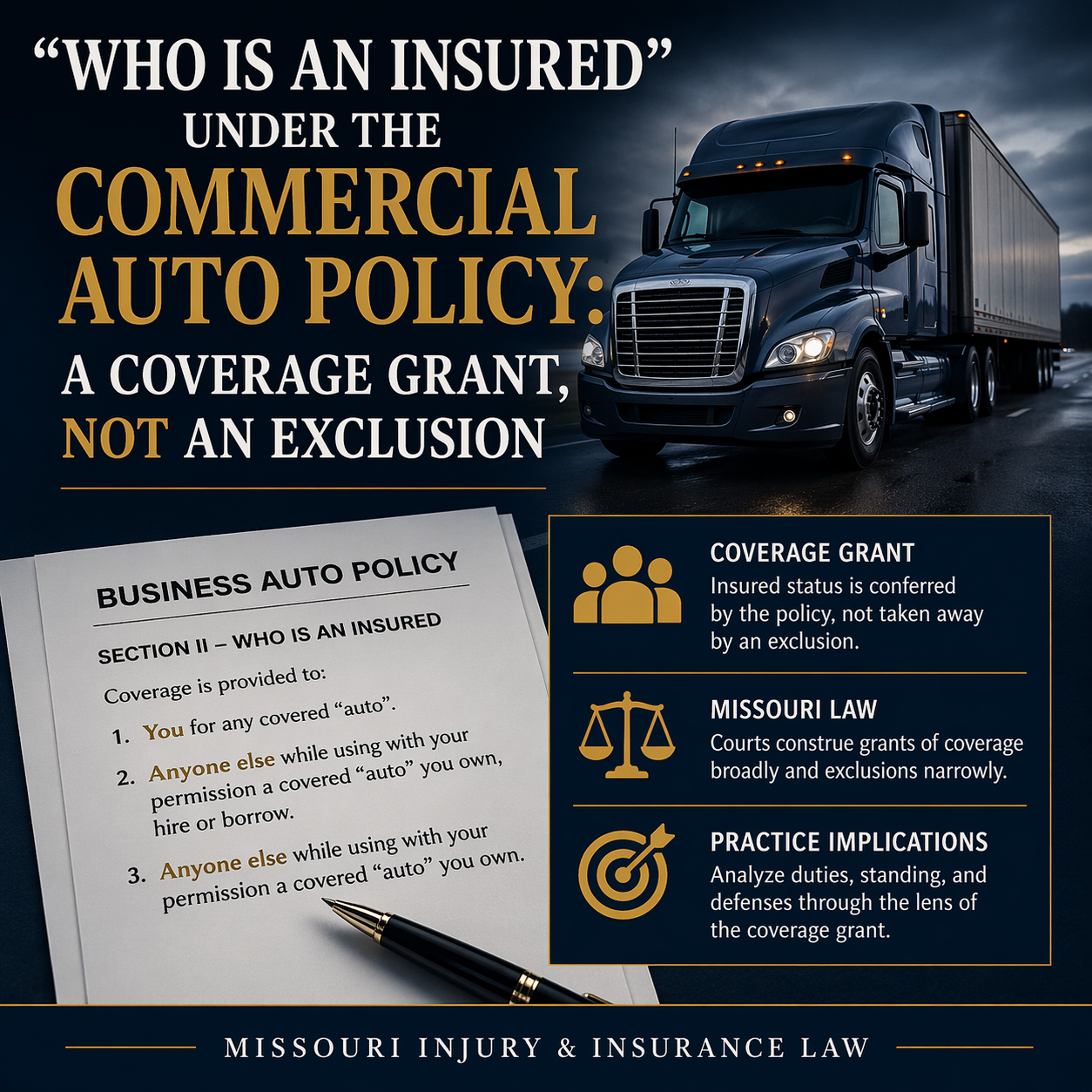
“Who Is an Insured” Under the Commercial Auto Policy: A Coverage Grant, Not an Exclusion
How Missouri courts interpret the ISO CA 00 01 insured-status tiers — and why getting the characterization right is the foundation of every commercial auto coverage case for the insured and the injured
Missouri Injury & Insurance Law | missouriinjuryandinsurancelaw.com
I. Why Insured Status Is a Coverage-Defining Issue Under Missouri Law
Coverage disputes under commercial automobile policies frequently arrive framed as exclusion cases. The insurer’s denial letter identifies a driver, a vehicle, or a use it contends falls outside the policy and declines the tender. What those letters rarely acknowledge — and what too many coverage opinions get analytically backward — is that the threshold question in these disputes is not whether an exclusion applies. It is whether the person seeking coverage qualifies as an insured in the first instance.
This distinction matters enormously for anyone representing an insured or an injured party. Insured-status is a coverage grant question. Exclusions are a separate analytical tier entirely. The rules of construction, the burden of proof, and the direction ambiguity resolves are different for each. An insurer that frames an insured-status denial as though it were an exclusion argument is, whether deliberately or carelessly, mischaracterizing the analysis in its own favor. Recognizing and correcting that mischaracterization is the first task of counsel for the insured.
A. Burden of Proof
Missouri’s allocation of the burden of proof in coverage disputes tracks the structure of the policy. The insured bears the initial burden of demonstrating that the claim falls within the policy’s coverage grant. Once the insured makes that threshold showing, the burden shifts to the insurer to establish that a specific exclusion clearly and unambiguously applies. The insurer does not get to treat the absence of insured status as an exclusion and then impose the burden of proof on the insured to disprove the denial.
Where the dispute is whether a driver falls within the “Who Is An Insured” provision, the insured bears the initial burden of showing the grant reaches them — but that burden is met by showing any reasonable reading of the grant language extends coverage. Because the “Who Is An Insured” provision is a coverage grant, it is construed broadly in the insured’s favor, and any ambiguity in the grant language is resolved against the insurer. The insurer drafted the policy. If the grant language is susceptible to a reasonable reading that extends coverage to this driver, that reading governs.
This is not a technical nicety. It is the practical difference between the insurer having to prove coverage is clearly excluded and the insured having to prove coverage is clearly required. Missouri law demands the former. An insured’s counsel who allows the analysis to proceed as though the insurer needs only point to the absence of an explicit coverage grant has conceded the most favorable terrain in the dispute.
B. The Duty to Defend
The duty to defend implications of the insured-status question are equally consequential for the insured and for the injured party. The ISO CA 00 01 (11/20 edition) insuring agreement provides, in relevant part:
| We have the right and duty to defend any ‘insured’ against a ‘suit’ asking for such damages or a ‘covered pollution cost or expense’. However, we have no duty to defend any ‘insured’ against a ‘suit’ seeking damages for ‘bodily injury’ or ‘property damage’ or a ‘covered pollution cost or expense’ to which this insurance does not apply. ISO CA 00 01 11 20, Section II.A. |
The insurer that denies insured status to a driver is simultaneously denying that driver a defense in the underlying tort action. Under Missouri law, the duty to defend is triggered whenever the petition states a claim potentially within the policy’s coverage, including based on facts the insurer knows or that are reasonably apparent at the outset of the case. Allen v. Continental Western Insurance Co., 436 S.W.3d 548, 553 (Mo. 2014). An insurer that denies insured status prematurely — before the facts bearing on permission or employment scope have been developed — makes a premature coverage decision with severe consequences if wrong.
Under Allen v. Bryers, 512 S.W.3d 17 (Mo. 2016), an insurer that wrongfully refuses to defend its insured is liable for the entire resulting judgment, the insured’s defense costs, and potential bad faith exposure. The fact that the insurer framed its refusal as an insured-status denial rather than a coverage exclusion provides no additional protection. A wrongful denial is a wrongful denial.
For the injured party in the tort case, the duty to defend question is equally significant. If the driver who caused the accident is an insured and should have been defended, the insurer that refused to defend cannot relitigate the facts necessarily established in the underlying litigation. Allen v. Bryers, 512 S.W.3d at 33. A wrongful insured-status denial locks in the insurer’s exposure on the underlying judgment.
C. The Correct Analytical Sequence
The correct analytical sequence in any commercial auto coverage dispute begins with the coverage grant, not with the exclusion. Before asking whether anything excludes coverage, counsel should establish:
Step 1: Does the party seeking coverage fall within any tier of the “Who Is An Insured” provision on a reasonable reading of the grant language?
Step 2: If the grant language is susceptible to more than one reasonable reading, which reading does Missouri law require?
Step 3: Does the mandatory minimum of § 303.190.2(2) R.S.Mo. independently require coverage regardless of the policy’s express terms?
Step 4: Only after coverage attaches at steps 1–3 does the exclusion analysis begin.
| An insurer that denies coverage based on insured status is not relying on an exclusion — it is arguing that the coverage grant never attached. That argument is subject to broad construction of the grant language and requires the insurer, as the drafter, to bear the consequences of any ambiguity it created. |
II. How the Commercial Auto Policy Structures Insured Status
The ISO Business Auto Coverage Form CA 00 01 (11/20 edition) defines “Who Is An Insured” for liability coverage purposes in Section II.A.1. The full text of the provision, reproduced verbatim from the form, is:
| Who Is An Insured The following are “insureds”: a. You for any covered “auto”. b. Anyone else while using with your permission a covered “auto” you own, hire or borrow except: (1) The owner or anyone else from whom you hire or borrow a covered “auto”. This exception does not apply if the covered “auto” is a “trailer” connected to a covered “auto” you own. (2) Your “employee” if the covered “auto” is owned by that “employee” or a member of his or her household. (3) Someone using a covered “auto” while he or she is working in a business of selling, servicing, repairing, parking or storing “autos” unless that business is yours. (4) Anyone other than your “employees”, partners (if you are a partnership), members (if you are a limited liability company) or a lessee or borrower or any of their “employees”, while moving property to or from a covered “auto”. (5) A partner (if you are a partnership) or a member (if you are a limited liability company) for a covered “auto” owned by him or her or a member of his or her household. c. Anyone liable for the conduct of an “insured” described above but only to the extent of that liability. ISO CA 00 01 11 20, Section II.A.1. © Insurance Services Office, Inc., 2019. |
This three-tiered structure creates distinct coverage questions with distinct analytical frameworks. Each tier is a coverage grant that is construed broadly in the insured’s favor.
A. Tier One: “You” — The Named Insured
The first tier covers the named insured — the entity or person identified on the declarations page — for any covered auto. The CA 00 01 defines “you” and “your” as the named insured shown in the declarations. Named insured is not separately defined in the form, which means it encompasses only the entities actually listed. Related entities — subsidiaries, parent companies, affiliates operating under trade names — that are not listed on the declarations are not “you” under Tier One.
For the insured’s counsel, the named insured identity question is often where coverage analysis should start. An insurer that denies coverage to a related entity by arguing the named insured designation does not include it must confront Missouri’s rule that an insured may be covered under any name as long as there is no fraud and the policy was obtained for the benefit of the entity seeking coverage. Where there is any ambiguity about whether the named insured designation was intended to include the entity asserting coverage — because of trade name usage, overlapping organizational structures, or the reasonable expectations of the parties at contracting — that ambiguity is resolved in favor of coverage. Jones v. Mid-Century Insurance Co., 287 S.W.3d 687, 689 (Mo. banc 2009).
B. Tier Two: Permissive Users — “Anyone Else While Using With Your Permission”
The second tier is the most frequently litigated and the most practically significant for both insureds and injured parties. It extends coverage to “anyone else while using with your permission a covered ‘auto’ you own, hire or borrow” — subject to five enumerated exceptions.
The grant language is deliberately broad: “anyone else.” Not any employee. Not any authorized driver. Anyone. The only textual requirements are that the person be “using” the vehicle and that the use be “with your permission.” The five exceptions narrow the grant at the margins for specific situations. But the starting point is broad coverage, and the exceptions are construed narrowly because they limit a coverage grant.
B.1. The Statutory Floor: § 303.190.2(2) R.S.Mo.
Before analyzing the policy’s permissive use tier, every commercial auto coverage dispute in Missouri must account for the statutory mandate that operates independently of whatever the policy says. Section 303.190.2(2) R.S.Mo. requires that every motor vehicle liability policy issued in Missouri shall insure:
| the person named therein and any other person, as insured, using any such motor vehicle or motor vehicles with the express or implied permission of such named insured, against loss from the liability imposed by law for damages arising out of the ownership, maintenance or use of such motor vehicle. |
This is not a suggestion or a default rule the parties can contract around. It is a public policy mandate. Any policy term that purports to restrict coverage for permissive users below what the statute requires is void. State Farm Mutual Automobile Insurance Co. v. Monday, 847 S.W.2d 468, 470 (Mo. App. W.D. 1993). The Missouri Supreme Court confirmed in Griffitts v. Old Republic Insurance Co., SC96740 (Mo. banc July 3, 2018):
| It is the public policy of Missouri to assure financial remuneration for damages sustained through the negligent operation of motor vehicles on the public highways of this state not only by the owners of such automobiles but also by all persons using such vehicles with the owner’s permission, express or implied. |
For the insured’s counsel, § 303.190.2(2) is a sword, not just a shield. When the insurer’s coverage denial depends on policy language that narrows permissive user coverage below what the statute requires — whether through behavioral restrictions, scope limitations, or enumerated exceptions that go beyond those in the form — the statutory argument is available and is often dispositive.
B.2. The Permission Requirement: “Use” Versus “Operation”
The term “permission” is not defined in the CA 00 01. Under Missouri law, undefined terms in an insurance policy receive their ordinary meaning as understood by a layperson. Mendenhall v. Property & Casualty Insurance Co. of Hartford, 375 S.W.3d 90, 92 (Mo. banc 2012). For the insured’s counsel, this means the permission question is evaluated from the perspective of the driver’s reasonable understanding of what was authorized — not from the perspective of the employer’s narrowest possible characterization of what was permitted.
The most important Missouri authority on the permission question is Griffitts v. Old Republic Insurance Co., SC96740 (Mo. banc 2018). James Campbell, an employee of BNSF Railway, had been given a company vehicle to use while working out of town. On the night of the accident he drove the vehicle while intoxicated. BNSF and its insurer Old Republic denied coverage, arguing that Campbell violated company rules prohibiting alcohol use and therefore lacked “permission” to operate the vehicle in that condition.
The Missouri Supreme Court reversed unanimously. In doing so, the Court drew a critical distinction between two types of company rules:
Use restrictions — rules that define the purposes for which the vehicle may be used at all. A restriction limiting use to travel between specific locations, or prohibiting personal use entirely, is a use restriction. Violation of a true use restriction can potentially place the driver outside the scope of permission.
Operating restrictions — rules governing how the vehicle is driven within an authorized use. Rules requiring seatbelts, prohibiting speeding, limiting driving hours, and prohibiting intoxicated driving all govern conduct during an authorized use. The Court held that violation of an operating restriction does not retroactively withdraw the permission that authorized the underlying use.
The Court stated: “the issue is whether Campbell’s use (as distinct from operation) of the vehicle was within the scope of permission given by BNSF and, therefore, covered under the omnibus insurance clause. This Court holds it was.” The decision reaffirmed a line of authority going back to Weathers v. Royal Indemnity Co., 577 S.W.2d 623 (Mo. banc 1979), and United Fire & Casualty Co. v. Tharp, 46 S.W.3d 99 (Mo. App. 2001).
The practical consequence of Griffitts for the insured’s counsel is powerful. When an insurer’s coverage denial rests on an employee’s violation of company safety rules — driving while intoxicated, exceeding driving hours, violating load restrictions, using a cell phone — the denial is almost certainly attacking an operating restriction, not a use restriction. Under Griffitts and Tharp, that denial fails. The insurer cannot draft itself out of the statutory mandate for permissive user coverage by recasting behavioral rules as use definitions.
| Watch for this: insurers sometimes reframe operating restriction denials as “scope of permission” arguments, arguing that the employee’s conduct was so far outside company policy that the permission effectively lapsed. Griffitts forecloses this reframing. The question is always whether the underlying use — the purpose for which the vehicle was employed — was authorized. If it was, behavioral violations during that use do not defeat coverage. |
B.3. The Five Exceptions in Tier Two
The five exceptions carved out of Tier Two’s broad permissive user grant are limitations on a coverage provision. Under Missouri’s rules, they are construed narrowly against the insurer. An insurer relying on any of the five exceptions to deny coverage bears the burden of establishing that the exception clearly and unambiguously applies to the specific facts.
Exception (1) excludes the owner or bailor of a vehicle that the named insured has hired or borrowed. This prevents the vehicle’s owner from claiming insured status under the borrower’s policy. For the insured’s counsel, the relevant question is whether the entity asserting coverage is the actual owner of the vehicle in the legal sense, or whether an ownership-like characterization is being argued to deny coverage to someone who is functionally an authorized user.
Exception (2) excludes an employee from Tier Two coverage for a vehicle the employee personally owns or that belongs to a household member. Coverage for employee-owned vehicles must be sought through the non-owned auto symbol rather than through Tier Two. This exception is narrowly drawn to the employee’s own vehicle; it does not affect coverage for the employee driving a company-owned or company-leased vehicle.
Exceptions (3), (4), and (5) address auto service workers using the vehicle, non-employees moving property to or from the vehicle, and partners or members driving vehicles they personally own. Each is fact-specific and each is construed narrowly. An insurer relying on any of these exceptions must establish it applies to the actual facts, not to a general characterization of the driver’s role.
C. Tier Three: Vicarious Liability — “Anyone Liable for the Conduct of an Insured”
Tier Three extends insured status to “anyone liable for the conduct of an ‘insured’ described above but only to the extent of that liability.” This provision covers entities that face vicarious liability for the acts of a Tier One or Tier Two insured — most commonly employers facing respondeat superior exposure for employees who are themselves named insureds or permissive users.
The “only to the extent of that liability” language limits Tier Three coverage to the entity’s vicarious exposure. An entity that faces independent direct liability for its own negligence — negligent hiring, negligent entrustment, negligent supervision — cannot find coverage for those independent claims in Tier Three. Tier Three covers vicarious exposure only; it does not independently insure the third party’s own negligence.
For the injured party pursuing both vicarious and direct liability claims, this distinction matters: the employer’s direct liability claims may require a separate coverage analysis under the CGL policy rather than the commercial auto policy. In cases involving both auto liability and premises or operations liability, coordinating coverage across both policies is essential.
III. Missouri Case Law Principles Governing Insured-Status Disputes
A. Liberal Construction in Favor of Coverage
Missouri’s interpretive rules for insurance policies apply in full force to insured-status disputes. Coverage grants are construed broadly and ambiguities are resolved against the insurer. Weathers v. Royal Indemnity Co., 577 S.W.2d 623, 626 (Mo. banc 1979). This is not a mechanical rule favoring insureds in all cases; it is the logical consequence of who drafted the language and who had the opportunity to make it clear.
At the duty to defend stage, where the question is whether coverage is potentially — not definitely — established, any reasonable reading of the “Who Is An Insured” provision that reaches the driver triggers the defense obligation. An insurer that identifies an arguable basis for denying insured status and denies both coverage and defense on that basis, without investigating the actual facts bearing on the question, has accepted the risk that the argument fails.
Missouri courts recognize that insured-status facts are often undeveloped at the time of the coverage decision. Whether an employee had permission, whether a driver was acting within the scope of employment, whether a temporary worker qualifies under the policy’s employee definition — these are factual questions the petition alone rarely resolves. The insurer that denies the defense without investigating those facts is making a premature coverage decision that Missouri law treats as a wrongful refusal to defend if the investigation would have revealed coverage.
B. The Griffitts Line: Permissive Use Is Construed Broadly
Griffitts v. Old Republic, SC96740 (Mo. banc 2018), and the line of authority it affirms — Weathers (1979), Tharp (2001) — establish that Missouri’s permissive use jurisprudence is deliberately and emphatically insured-favorable. The public policy underlying § 303.190.2(2) is to ensure that persons injured on Missouri highways by negligently operated vehicles have access to the insurance coverage that makes compensation possible. Courts interpret the permission requirement in light of that policy, which means they interpret it broadly.
Insurers read these cases and sometimes respond by drafting increasingly granular use definitions and company policies intended to narrow the scope of permission they are extending. Griffitts holds that this strategy fails when the restriction operates on how the vehicle is driven rather than what the vehicle may be used for. Behavioral restrictions on driving conduct cannot defeat the statutory mandate. This is a robust and well-settled rule in Missouri.
C. Fact-Intensive Inquiries on Permission and Scope
Both the permission inquiry and the scope-of-employment inquiry — where relevant to Tier Two coverage for an employee using a company vehicle — are intensely fact-specific. Missouri courts do not resolve them on bright-line rules. The inquiry focuses on what authority was actually extended, whether that authority was general or specific, and whether the driver had a reasonable basis to understand permission extended to the particular use at issue.
A critical point: the CA 00 01’s coverage grant for employees using company vehicles with permission is broader than the respondeat superior standard in tort law. Respondeat superior determines whether the employer is vicariously liable for the employee’s tort. Insured status determines whether the policy covers the employee’s liability. An employee on a personal errand may still be a Tier Two permissive user if the named insured’s general permission to use the vehicle extended to personal use, even though that personal errand would not create respondeat superior liability for the employer.
An insurer that argues against coverage for an employee by pointing to the absence of respondeat superior liability is conflating two different legal questions. Insured-status counsel for the insured should identify and correct this conflation directly.
IV. Practical Litigation Consequences When Insurers Deny Based on Insured Status
A. The Wrongful Refusal to Defend Framework
An insurer that wrongfully denies insured status and refuses to defend the driver faces the full range of consequences Missouri law imposes for wrongful refusal to defend. Allen v. Bryers, 512 S.W.3d 17 (Mo. 2016) establishes that the insurer is liable for the entire resulting judgment including any amount above policy limits, for the insured’s defense costs, and for potential bad faith exposure. The insurer is also bound by facts necessarily determined in the underlying litigation it chose not to defend. Allen v. Bryers, 512 S.W.3d at 33.
For the insured driver who was denied coverage and forced to retain independent counsel, Allen v. Bryers means the insurer’s gamble on the insured-status denial may ultimately cost far more than defending the underlying case would have. This is not an accidental feature of Missouri law. It is a deliberate deterrent against premature and unfounded coverage denials.
B. The Reservation of Rights
Where the insured-status question is genuinely uncertain — the permission issue is disputed, the scope-of-employment question turns on undeveloped facts — the insurer’s proper course is a reservation of rights, not an outright denial. The insurer accepts the defense while reserving the right to contest insured status when the facts are more fully developed. Brooner & Associates Construction, Inc. v. Western Casualty & Surety Co., 760 S.W.2d 445 (Mo. App. W.D. 1988).
For the insured, a reservation of rights creates the structural conflict of interest addressed in State ex rel. Rimco, Inc. v. Dowd, 858 S.W.2d 307, 308 (Mo. App. E.D. 1993). The insurer is defending the insured while simultaneously investigating whether the driver was an insured at all — and the insurer’s appointed defense counsel may be positioned to develop facts that help the insurer’s coverage argument at the insured’s expense. Missouri is among a minority of states that allow the insured to refuse a reservation of rights defense. State Farm Mutual Automobile Insurance Co. v. Ballmer, 899 S.W.2d 523, 527 (Mo. banc 1995).
When a reservation of rights is issued based on insured-status grounds, the insured’s counsel should evaluate immediately: Does the insurer’s appointed defense counsel have a structural incentive to develop facts that defeat insured status? If so, the insured has grounds to demand independent counsel at the insurer’s expense. Howard v. Russell Stover Candies, Inc., 649 F.2d 620, 625 (8th Cir. 1981) (applying Missouri law).
C. The Declaratory Judgment Action and the Stay Question
When coverage is genuinely disputed, insurers frequently file declaratory judgment actions to resolve the coverage question and seek to stay the underlying tort case pending that resolution. The insurer frames this as orderly case management. For the injured plaintiff and the insured defendant, a stay of the tort case is something entirely different: it is an insurer that denied coverage, often wrongfully, successfully preventing the injured person from pursuing their day in court until the insurer’s coverage litigation resolves on the insurer’s timeline. One threshold point must be understood clearly: a federal court cannot stay a state court proceeding. The Anti-Injunction Act, 28 U.S.C. § 2283, prohibits federal courts from enjoining state court proceedings except in three narrow statutory exceptions — expressly authorized by Act of Congress, necessary in aid of the federal court’s own jurisdiction, or to protect or effectuate a prior federal judgment. None of those exceptions applies to an insurer’s coverage declaratory action. The stay motion, if an insurer pursues one, must be directed to the state court hearing the tort case — not to any federal court where the insurer filed its declaratory action. These are two separate procedural arenas with different tools available to insured’s counsel in each.
Missouri courts were historically resistant to granting stays of underlying tort actions at the insurer’s request. For decades, Missouri appellate decisions refused to allow insurers to intervene in tort cases and seek stays, reflecting a well-founded recognition that the injured party and the insured have independent rights to proceed with their litigation that do not depend on the insurer’s coverage position. The insurer who denied coverage forfeited its right to control the pace of the litigation.
The Missouri Supreme Court’s December 2024 decision in McCrackin v. Mullen, SC100578 (Mo. 2024), significantly changed this landscape. The Court held that an insurer with good faith coverage questions has the right to intervene in the underlying tort action and seek a stay of those proceedings pending resolution of a simultaneously filed declaratory judgment action. The Court advised that such declaratory actions should be filed in the same court as the underlying tort action “whenever possible” to prevent unnecessary delay.
McCrackin is a significant victory for insurers in coverage disputes and a meaningful setback for injured parties and insureds. An insurer that denies coverage, files a declaratory action simultaneously with the tort case, and successfully obtains a stay has effectively weaponized the coverage dispute to delay the injured person’s access to the court that actually matters to them. The insurer goes first. The injured person waits.
| From the insured’s perspective: there is nothing equitable about a system that allows an insurer that denied its own insured a defense to then intervene in the tort case and halt it in its tracks while the insurer litigates its way out of the very coverage the insured paid for. McCrackin requires “good faith” coverage questions. That requirement must be enforced. An insured-status denial that mischaracterizes the analysis, ignores the Griffitts line, or relies on operating restrictions rather than true use restrictions is not a good faith coverage question — and an intervention and stay based on such a denial should not be granted. |
D. Practice Tip: Arguing Against the Stay
Counsel for the insured and for the injured plaintiff should resist any motion to stay the tort action by the intervening insurer. The following arguments, grounded in McCrackin itself and in the governing legal framework, should be developed in every case where a stay is sought:
1. The insurer lacks a good faith coverage question. McCrackin’s endorsement of the stay procedure is expressly conditioned on the insurer having “good faith coverage questions.” McCrackin, SC100578, at 10. If the insured-status denial rests on an operating restriction that Griffitts clearly forecloses, or on a policy term that the statutory mandate of § 303.190.2(2) overrides, or on a grant interpretation that the contra proferentem rule rejects, the insurer has no good faith coverage question to litigate. Without a good faith basis, the intervention and stay procedure is not available.
2. The coverage and liability issues are not separable. Courts are generally unwilling to stay a tort action while a declaratory judgment action proceeds when the issues in both actions are essentially identical. The permission question — did the driver have authority to use this vehicle for this purpose — may be the same question as the liability question in the underlying tort. If so, the declaratory action adds no efficiency; it merely delays the resolution of the same questions the tort case will resolve.
3. The injured plaintiff’s independent right to proceed. The injured plaintiff in the tort case has an independent constitutional and statutory right to a prompt hearing on their claim. The insurer’s coverage dispute is not the plaintiff’s dispute. The plaintiff did not choose to have this defendant as their tortfeasor, and the plaintiff should not bear the delay caused by the insurer’s coverage litigation. A stay imposes real harm on an injured person — witnesses become unavailable, memories fade, evidence is lost, and the plaintiff may face financial hardship while waiting.
4. The insurer forfeited its position by denying coverage. An insurer that denied coverage and left its insured without a defense has already demonstrated that it is not aligned with the insured’s interests. The intervention-and-stay procedure was designed for insurers with genuine, good-faith coverage questions who are actively defending under a reservation of rights, not for insurers that have already walked away from their obligation. An insurer that denied coverage and seeks a stay has the equities running squarely against it.
5. When the declaratory action is filed in federal court, move to dismiss or stay under Wilton/Brillhart. Remember: a federal court cannot stay a state court proceeding — the Anti-Injunction Act, 28 U.S.C. § 2283, prohibits it. The stay motion, if pursued, goes to the state court after the insurer intervenes under McCrackin — not to any federal court. Insured’s counsel therefore operates on two fronts simultaneously. In the state court: resist the motion to stay using the arguments in tips 1 through 4 and 6 through 7. In the federal court: move to dismiss or stay the insurer’s federal declaratory action under the Wilton/Brillhart abstention doctrine. Under Wilton v. Seven Falls Co., 515 U.S. 277 (1995), and Brillhart v. Excess Insurance Co. of America, 316 U.S. 491 (1942), federal courts have broad discretion to decline jurisdiction over insurance declaratory judgment actions when a parallel state proceeding will adequately resolve the same issues. Key Wilton/Brillhart factors include: whether the state court can adequately resolve the coverage questions; whether the federal action will produce piecemeal litigation; whether the insurer chose federal court for forum advantage rather than any legitimate jurisdictional reason; and whether coverage and liability issues are so intertwined that they are better resolved together in the state forum. McCrackin advised that insurers file declaratory actions in the same court as the tort case “whenever possible” to prevent unnecessary delay. McCrackin, SC100578, at fn.11. An insurer that deliberately chose federal court contrary to that guidance has handed insured’s counsel a Wilton/Brillhart argument to return the coverage question to the state forum where both cases can be resolved together. However, federal courts are not bound to follow this footnote from the Supreme Court.
6. The insured was denied a defense, not offered one. The strongest argument against the stay, in cases where the insurer has denied the defense entirely, is that the insurer cannot have it both ways. The insurer that said “we have no obligation to defend this person” cannot then invoke the intervention-and-stay procedure to halt the tort case on the grounds that the coverage question needs to be litigated first. The insured who was left to defend themselves is entitled to their day in court without further interference from the insurer that abandoned them.
7. Prejudice to the tort parties from delay. Missouri courts retain discretion on whether to grant a stay even where intervention is proper. Arguing specific, concrete prejudice — witness availability, statutes of limitations on related claims, the plaintiff’s financial circumstances, the insured’s personal exposure during the stay period — is essential. A stay is not automatic even under McCrackin. The Court expressly left the stay question to the trial court’s discretion.
E. The § 537.065 Alternative
When the insurer denies coverage — whether by denying insured status outright or by refusing to withdraw a reservation of rights — the insured and the injured party are in position to enter a § 537.065 agreement limiting recovery to insurance proceeds. Under § 537.065.1 R.S.Mo., one of the two triggering conditions is that the insurer has “refused to withdraw a reservation of rights or declined coverage.” A flat denial of insured status is a declination of coverage and satisfies this condition.
Once the § 537.065 framework is invoked, the insurer’s intervention rights under the 2021 version of the statute are triggered and the notice requirements must be followed. But the point stands: an insured-status denial is not merely a coverage defense. It is the act that opens the door to the full § 537.065 framework, the bad faith claim, and the excess judgment exposure that follows. An insurer that denies insured status to avoid a defense creates precisely the conditions that produce the most adverse possible legal outcomes.
V. Conclusion
The “Who Is An Insured” section of the ISO CA 00 01 is a coverage grant. It is construed broadly. Ambiguities in its language are resolved against the insurer. Missouri’s statutory permissive user mandate under § 303.190.2(2) establishes a floor that no policy term can reduce, and the Griffitts-Tharp-Weathers line of authority makes clear that operating restrictions on how a vehicle is driven cannot defeat the coverage the statute requires.
For counsel representing insureds or injured parties, the insured-status question must always be properly characterized at the outset of the coverage analysis. It is a coverage grant dispute, not an exclusion dispute, and it is approached with tools that favor coverage: broad construction, ambiguity against the drafter, and the statutory mandate. An insurer that turns this into an exclusion argument, or that denies both insured status and the defense without fully investigating the permission and scope questions, has made a premature decision with potentially enormous consequences.
And when the insurer follows its coverage denial with an intervention and motion for a stay — seeking to put its coverage litigation ahead of the injured person’s tort case — the insured’s counsel has arguments on two separate fronts. In the state court where the insurer seeks the stay: McCrackin requires good faith coverage questions as the price of entry to the intervention-and-stay procedure; McCrackin left the stay to the trial court’s discretion; and it advised to file declaratory actions in the same court as the tort. A query whether the denial was in good faith is appropriate. In the federal court where the insurer filed its declaratory action: the Anti-Injunction Act, 28 U.S.C. § 2283, means the federal court cannot stay the state tort proceedings — and the Wilton/Brillhart abstention doctrine gives insured’s counsel a strong basis to move the federal court to decline jurisdiction and send the coverage question back to the state forum where the tort case is pending. Keeping these two tracks distinct, and pursuing both simultaneously, gives counsel the full toolkit.
The insured paid for this coverage. The injured person has a right to their day in court. The insurer’s litigation strategy should not be permitted to substitute for the coverage obligation it is designed to avoid.