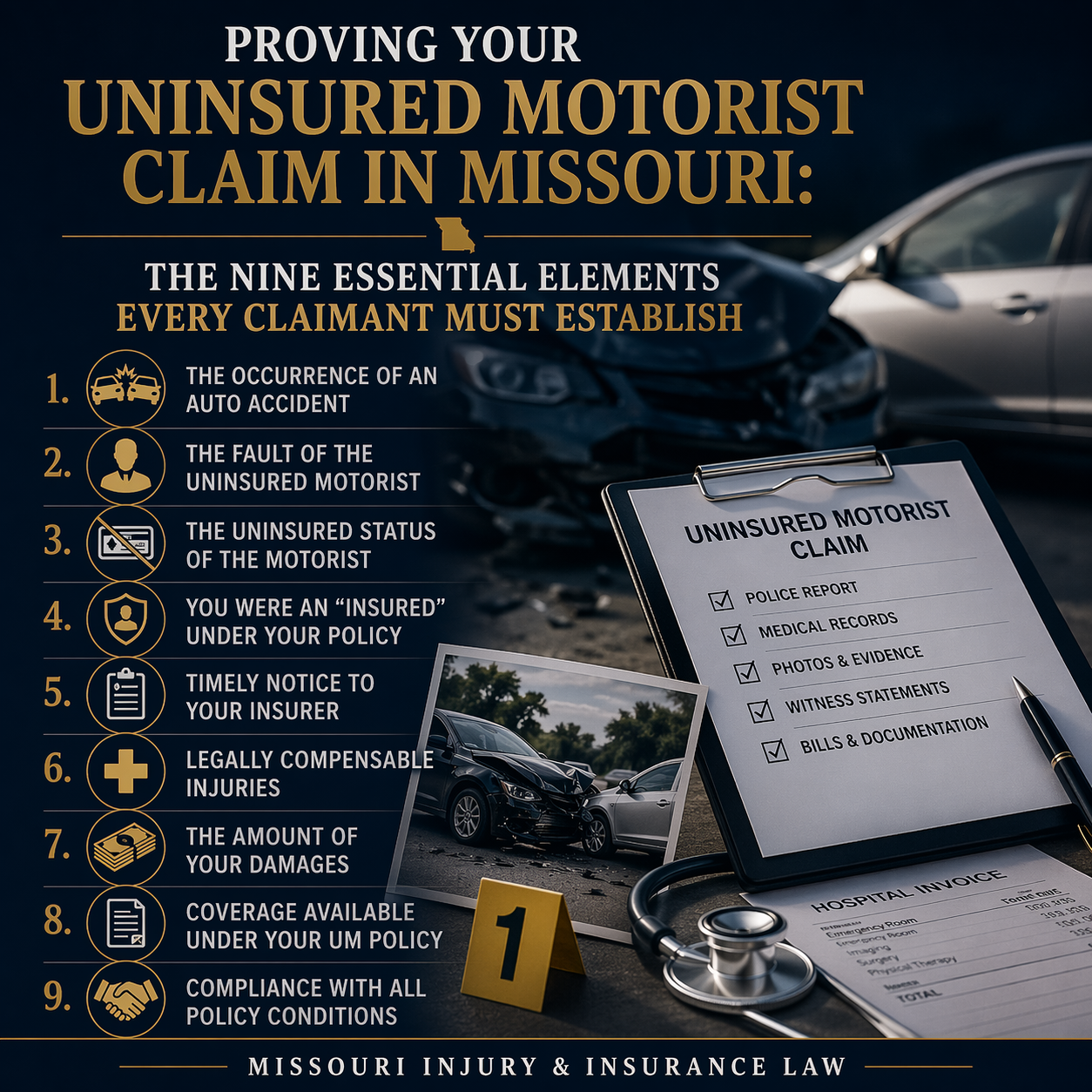
Proving Your Uninsured Motorist Claim in Missouri: The Nine Essential Elements Every Claimant Must Establish
A practitioner’s guide to the elements of proof required to recover under Missouri’s uninsured motorist statute, § 379.203 RSMo
Missouri Injury & Insurance Law | missouriinjuryandinsurancelaw.com
Introduction
When a Missouri motorist is injured by a driver who carries no liability insurance—or whose insurer is insolvent—the injured party’s own uninsured motorist (“UM”) coverage becomes the primary avenue for compensation. Missouri’s UM statute, § 379.203 RSMo, mandates that every automobile liability policy issued in the state include UM coverage unless the named insured affirmatively rejects it. The statute is remedial in nature, and Missouri courts have long interpreted it liberally in favor of coverage.
Yet the road from incident to recovery is anything but automatic. A UM claim is a direct action against the insurer—not against the uninsured tortfeasor. Shepherd v. American States Insurance Co., 671 S.W.2d 777 (Mo. 1984). The claimant must satisfy a structured series of proof elements before the carrier’s obligation to pay is triggered. This post identifies those nine essential elements, traces the controlling authority for each, and offers practical guidance for the plaintiff’s attorney assembling a UM case for litigation.
I. The Nine Elements of Proof
The Missouri Supreme Court in Shepherd v. American States Insurance Co., 671 S.W.2d 777 (Mo. 1984), established the foundational framework for UM claims. As refined by subsequent authority and the Missouri Practice Series, the essential elements of the cause of action are:
A. An Automobile Liability Policy Providing UM Coverage Was in Force
The threshold inquiry is the simplest: the claimant must establish that an automobile liability insurance policy providing uninsured motorist coverage was in effect at the time the cause of action accrued. This is ordinarily proved through the declarations page, the policy jacket, and, where necessary, testimony from the insurer’s underwriting department. Counsel should obtain a certified copy of the complete policy—including all endorsements—at the earliest opportunity, because the scope of coverage frequently turns on endorsement language that modifies the base policy.
B. The Claimant Was an Insured Under the Policy or by Virtue of § 379.203
The claimant must prove either that the policy’s terms define the claimant as an “insured” or that coverage attaches by operation of § 379.203 RSMo. Statutory insured status is broader than most insurers acknowledge; § 379.203 extends UM protection to any person legally entitled to recover damages because of bodily injury arising from ownership, maintenance, or use of the uninsured motor vehicle. Where the claimant asserts a derivative cause of action—such as a wrongful death or loss-of-consortium claim—the claimant must plead and prove facts establishing that the decedent, spouse, or minor child through whom the claim derives was an insured, unless the policy’s own terms independently establish the derivative claimant’s insured status. Lambert by Cobb v. State Farm Mutual Automobile Insurance Co., 820 S.W.2d 602 (Mo. Ct. App. S.D. 1991).
Practice Tip: Identify all potentially applicable policies early. A claimant may qualify as an insured under a spouse’s policy, a household member’s policy, or even the policy of the vehicle’s owner if the claimant was an occupant. Each policy is a potential independent source of UM recovery, subject to “other insurance” provisions.
C. Bodily Injury, Sickness, or Disease by Reason of Ownership, Maintenance, or Use of a Motor Vehicle
This element requires proof that the insured sustained bodily injury, sickness, or disease causally connected to the ownership, maintenance, or use of a motor vehicle by a tortfeasor. In a landmark en banc decision, the Missouri Supreme Court in Derousse v. State Farm Mutual Automobile Insurance Co., 298 S.W.3d 891, 895 (Mo. 2009) (en banc), held that § 379.203.1 covers sickness and disease—including emotional distress—even when unrelated to a physical injury. Derousse substantially expanded the scope of compensable harm under UM coverage and remains essential authority for any claim that involves psychological or emotional injury absent a contemporaneous physical impact.
The causal nexus—“by reason of the ownership, maintenance, or use”—must be established independently. Missouri courts apply a substantial-factor test to determine whether the motor vehicle’s involvement was more than incidental to the injury.
D. The Tortfeasor Is Legally Liable for Such Bodily Injury, Sickness, or Disease
The UM claimant must prove the uninsured motorist’s negligence—or other basis of legal liability—just as the claimant would in a direct tort action against the tortfeasor. The insurer stands in the shoes of the uninsured motorist and may assert any defense the tortfeasor could have raised, including comparative fault. Derousse, 298 S.W.3d at 895. As a practical matter, this means the plaintiff must present the same quality of evidence on liability as in any negligence case: duty, breach, causation, and damages.
E. The Motor Vehicle Was Uninsured
The claimant must prove that the motor vehicle causing the injury was “uninsured” as defined by the policy and § 379.203. Most policies define an “uninsured motor vehicle” to include a vehicle for which no liability policy exists, a hit-and-run or phantom vehicle, and a vehicle whose insurer has become insolvent. For claims involving an unidentified (phantom) vehicle, the Eastern District in Preston v. American Family Mutual Insurance Co., 325 S.W.3d 485, 486 (Mo. Ct. App. E.D. 2010), distilled the elements to three: that the unidentified motorist was uninsured, causation, and amount of damages.
Practice Tip: For phantom-vehicle claims, most policies require corroborating evidence of the hit-and-run—often an independent witness or physical evidence of contact. Preserve all physical evidence and take photographs at the scene immediately. Without corroboration, the carrier will challenge this element aggressively.
F. All Conditions Precedent to the Insurer’s Liability Have Been Met
The insured must demonstrate compliance with all policy conditions precedent, which commonly include timely notice of the accident, cooperation with the insurer’s investigation, and submission to an examination under oath or independent medical examination when requested. Kesterson v. Wallut, 157 S.W.3d 675, 684 (Mo. Ct. App. W.D. 2004). In some policies, the insurer may demand that the insured join the tortfeasor as a party defendant; failure to comply when the policy so requires can jeopardize the claim. Phipps v. Shelter Mutual Insurance Co., 715 S.W.2d 930, 931 (Mo. Ct. App. S.D. 1986).
G. The Insured Is Legally Entitled to Collect from the Tortfeasor
This element overlaps with but is conceptually distinct from element (D). The insured must prove that, but for the tortfeasor’s lack of insurance, the insured would be legally entitled to recover damages. Where the tortfeasor possesses an affirmative defense—such as workers’ compensation immunity—the insured’s legal entitlement may be defeated entirely. Kesterson, 157 S.W.3d at 686 (involving immunity under Missouri’s workers’ compensation law). This element underscores that UM coverage is not a no-fault benefit; it is predicated on the tortfeasor’s legal liability.
H. Demand for Payment, the Date Thereof, and Refusal to Pay
The claimant must prove that a demand was made upon the insurer for payment, the date on which the demand was tendered, and the insurer’s refusal to pay. This is both a substantive element of the cause of action and a condition precedent to suit. From a practical standpoint, the demand letter should be precise: it should identify the policy number, the date of loss, the claimed coverage, the amount demanded, and the factual and legal bases for the claim. A well-constructed demand also lays the groundwork for the ninth element.
I. Vexatious Refusal to Pay and Attorney’s Fees
Where appropriate, the claimant may assert that the insurer’s refusal to pay constituted a vexatious refusal within the meaning of § 375.420 RSMo, entitling the claimant to a statutory penalty and attorney’s fees. The vexatious-refusal claim is not an independent cause of action but is ancillary to the UM claim itself. The prayer for relief should include the principal sum, prejudgment interest if sought, and all sums due by reason of vexatious refusal, including attorney’s fees accrued to date.
Practice Tip: Build the vexatious-refusal record from the outset. Document every communication with the carrier. Send demands by certified mail with return receipt. Where the insurer’s refusal lacks a reasonable basis, a well-documented demand and claims history will support the statutory penalty at trial.
For a more information about vexatious refusal–see Understanding Missouri’s Vexatious RefusalStatute: A Practitioner’s Guide to § 375.420.
II. Affirmative Defenses: The Insurer’s Burden
If an insurer seeks to interpose an affirmative defense to the claim—whether based upon the coverage (such as a breach of condition or an exclusion) or upon the legal liability of the uninsured motorist (such as comparative fault)—the insurer bears the burden of pleading and proving the defense. This allocation of burden is significant. The plaintiff’s counsel should resist any attempt by the carrier to shift the burden of proof on coverage defenses to the claimant, and should file appropriate motions in limine to ensure that the jury is properly instructed on burden.
III. Multiple Defendants and Comparative Fault
Where a UM claim arises in a multi-defendant action governed by the comparative-fault doctrine of Gustafson v. Benda, 661 S.W.2d 11 (Mo. 1983), the insured is entitled to collect the entirety of a favorable judgment from any defendant against whom any degree of fault has been assessed. If such a defendant is an uninsured motorist, and the UM carrier is bound by the result, the insured may collect the whole of the judgment from the applicable UM coverage. Hollis v. Blevins, 927 S.W.2d 558 (Mo. Ct. App. S.D. 1996). This rule applies whether the UM carrier has been substituted as a party defendant in lieu of the uninsured motorist or the driver of a phantom vehicle. The same result follows under the joint judgment statute, § 537.067.1 RSMo.
The practical implication for plaintiffs’ counsel is clear: in a multi-defendant case where one defendant is uninsured, the UM carrier’s exposure is not limited to its proportionate share of fault. The insured may recover the full judgment from the UM coverage, subject only to the policy limits.
IV. Conclusion
Missouri’s UM framework places a structured but manageable burden on the claimant. Each of the nine elements identified in Shepherd and its progeny must be addressed in the pleadings and supported by proof at trial. Counsel who master these elements—and who understand the interplay between statutory coverage, policy language, and Missouri’s comparative-fault regime—will be well-positioned to maximize recovery for clients injured by uninsured motorists.
The critical takeaway is that a UM claim, while structurally a contract action against the insurer, demands the same rigor on liability and damages as any tort case. The insurer has every incentive to contest each element, and the claimant’s attorney must be prepared to prove each one with precision.