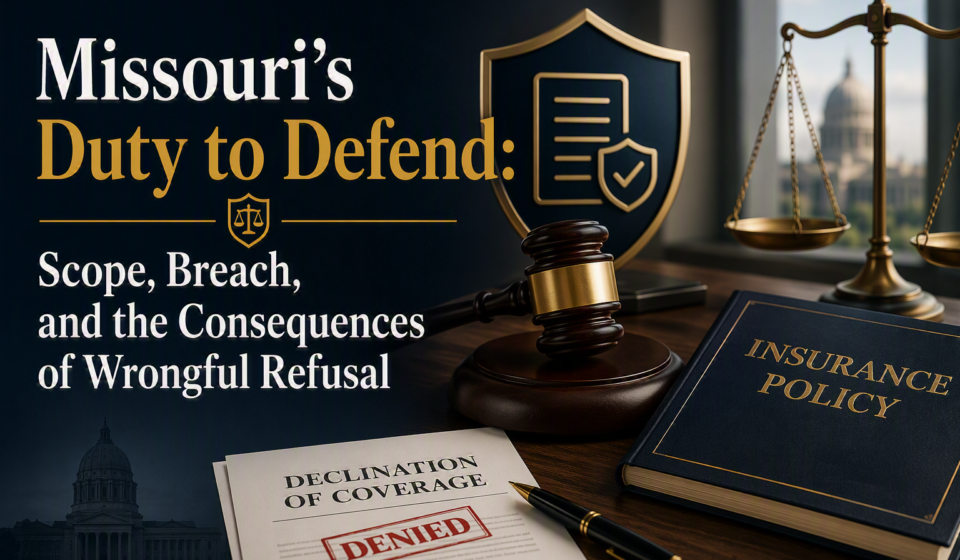
Missouri’s Duty to Defend: Scope, Breach, and the Consequences of Wrongful Refusal
What triggers the duty, what happens when it is breached, and how to hold the insurer accountable
Missouri Injury & Insurance Law | missouriinjuryandinsurancelaw.com
Introduction
The duty to defend is one of the most expansive and frequently litigated obligations in insurance law. In Missouri, the duty to defend is broader than the duty to indemnify, and its breach carries significant consequences for the insurer. Understanding the precise scope of the duty, the standard for triggering it, and the remedies available when it is breached is fundamental to effective representation of insured defendants and injured plaintiffs alike. This post examines Missouri’s duty to defend framework, the potentially-within-coverage standard, the consequences of wrongful refusal, and the strategic implications for practitioners on both sides of coverage disputes.
The Potentially-Within-Coverage Standard
Missouri follows the well-established rule that the duty to defend arises whenever the claim is potentially or arguably within the coverage provided by the policy. The controlling principle, applied consistently by Missouri courts, is that if there is any reasonable possibility that coverage exists, the insurer must defend. Luyties Pharmacal Co. v. Frederic Co., 716 S.W.2d 831 (Mo. App. E.D. 1986); Ranger Ins. Co. v. Mercantile Trust Co., 363 F. Supp. 795 (E.D. Mo. 1973).
“If the claim is potentially or arguably within the coverage provided, the duty to defend exists.” Luyties Pharmacal Co. v. Frederic Co., 716 S.W.2d 831, 833 (Mo. App. E.D. 1986).
The duty to defend is determined by comparing the allegations of the petition against the terms of the insurance policy. If the petition alleges facts that, if proven, would be covered by the policy, the duty to defend is triggered regardless of whether those facts are ultimately proven or whether the insured is ultimately found liable. The duty is not contingent on the insured’s actual culpability—it is contingent on the possibility that the claim falls within the policy’s scope.
Importantly, the potentially-within-coverage standard means that an insurer cannot wait for a definitive coverage determination before assuming the defense. An insurer that refuses to defend on the ground that coverage is uncertain assumes the risk that its coverage analysis will be proven wrong. If the coverage question is close, the burden of that uncertainty falls on the insurer, not the insured. This allocation of risk is consistent with the basic principle that insurance policies are construed in favor of coverage when ambiguous.
The Three Options When Coverage Is Disputed
When a liability insurer receives a claim against its insured and a question of coverage exists, Missouri law recognizes three options available to the insurer. As stated by the Eastern District of Missouri, the insurer may: (1) defend the claim; (2) defend under a reservation of rights; or (3) refuse to defend altogether. State ex rel. Rimco, Inc. v. Dowd, 858 S.W.2d 307, 308 (Mo. App. E.D. 1993). Each option carries distinct legal consequences, and practitioners should understand those consequences precisely.
The first option—defending without reservation—preserves the insurer’s ability to contest coverage in subsequent proceedings but risks waiver and estoppel if the defense conduct is inconsistent with the coverage defense. The second option—defending under a reservation of rights—preserves the coverage defense but triggers the conflict of interest analysis discussed in Post 13 of this series. The third option—outright refusal—exposes the insurer to the full consequences of a wrongful refusal if the coverage analysis ultimately proves incorrect.
Wrongful Refusal to Defend: The Legal Consequences
The consequences of a wrongful refusal to defend in Missouri are severe. The Missouri Court of Appeals has stated the rule plainly: ‘An insurer’s wrongful failure to defend constitutes a breach of contract.’ Sprint Lumber, Inc. v. Union Ins. Co., 627 S.W.3d 96, 119 (Mo. App. 2021). The measure of damages for that breach is equally clear: ‘If an insurer wrongfully refuses to defend, it is liable to the limits of its policy plus attorney fees, expenses and other damages.’ Pets Alone Sanctuary of Lincoln Cnty. v. Midwest Family Mut. Ins. Co., 2022 U.S. Dist. LEXIS 203262, *5-6 (citing Bryers v. Seymour, 512 S.W.3d 38 (Mo. App. 2017)).
The policy limits exposure arises because an insurer that wrongfully refuses to defend forfeits its ability to manage the defense and influence the outcome. Having abandoned its insured, the insurer cannot later complain that the resulting judgment—obtained without its participation—was excessive or the product of inadequate defense. The insured who is forced to retain independent counsel, negotiate a settlement without the insurer’s participation, or face a default judgment has been harmed by the insurer’s breach, and the damages reflect that harm.
Attorney fees are recoverable in addition to policy limits because the wrongful refusal to defend forced the insured to incur legal expenses that the policy was supposed to cover. Mo. Rev. Stat. § 375.420 (2023) provides the statutory vehicle for fee recovery in appropriate cases, and practitioners should plead vexatious refusal alongside breach of contract when the insurer’s refusal to defend was without reasonable cause or excuse.
Building the Wrongful Refusal Case
Practitioners pursuing wrongful refusal to defend claims should structure their cases around three central inquiries. First, what did the petition allege at the time the insurer refused to defend? The coverage analysis is anchored to the allegations as they existed when the refusal occurred, not as they may have evolved through subsequent amendments. Practitioners should obtain and preserve the complaint or petition as it existed at the time of the refusal and compare it carefully against the policy’s insuring agreement.
Second, was there any reasonable possibility that the allegations fell within coverage? Because the standard is ‘potentially or arguably within coverage,’ the insured needs only demonstrate that the claim was colorably within the policy’s scope—not that it was definitively covered. Under Luyties Pharmacal, this is a low threshold that most well-pleaded claims will clear.
Third, what damages resulted from the refusal? The insured’s actual attorney fees, costs of defense, and any judgment or settlement entered without the insurer’s participation are all recoverable. In addition, the statutory penalties and fee-shifting provisions of Mo. Rev. Stat. § 375.420 (2023) may apply if the refusal was vexatious. Comprehensive damages documentation from the moment the insurer refuses to defend is essential.
Declaratory Judgment Actions and the Duty to Defend
Insurers frequently respond to disputes about the duty to defend by filing declaratory judgment actions under Mo. Rev. Stat. § 527.010 (2023) seeking a judicial determination that no coverage exists. While this is a legitimate procedural option, it does not suspend the insurer’s obligation to defend in the interim. An insurer that refuses to defend while its declaratory judgment action is pending assumes the risk that the court will find coverage and that its interim refusal will have resulted in compensable harm to the insured.
Practitioners representing insureds in this situation should consider seeking a mandatory injunction requiring the insurer to assume the defense pending resolution of the coverage dispute. Missouri courts have jurisdiction to grant such relief, and the threat of an injunction—combined with the damages exposure for wrongful refusal—provides meaningful leverage to compel the insurer to fulfill its defense obligation while coverage is litigated.
Conclusion
Missouri’s duty to defend is broad, and its breach is consequential. The potentially-within-coverage standard provides robust protection for insureds facing liability claims, and the damages available for wrongful refusal—policy limits, attorney fees, and additional damages—reflect the seriousness with which Missouri courts view an insurer’s failure to honor its defense obligation. Practitioners who understand the contours of this duty and who document the insurer’s conduct carefully will be well-positioned to hold wrongfully-refusing insurers fully accountable.