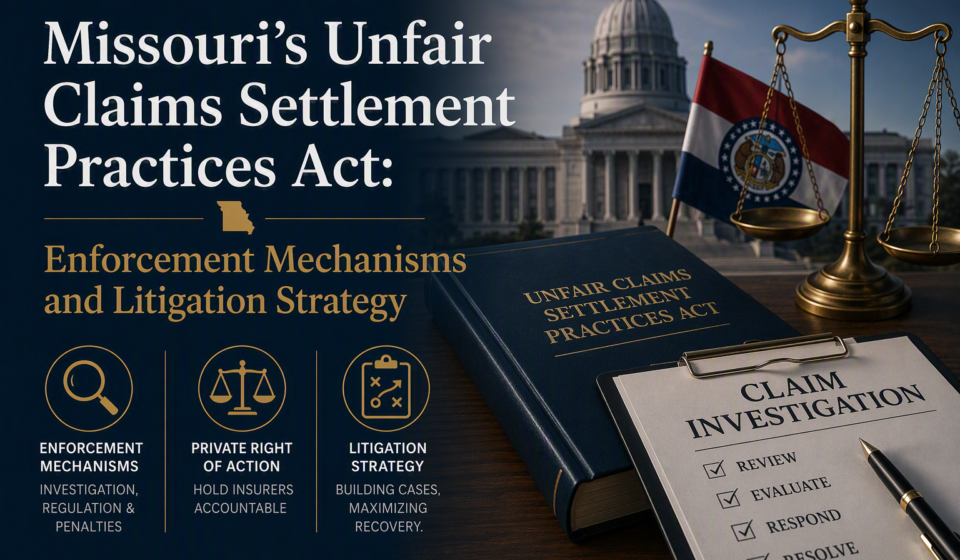
Missouri’s Unfair Claims Settlement Practices Act: Enforcement Mechanisms and Litigation Strategy
How § 375.1000 shapes insurer conduct and what it means for case.
Missouri Injury & Insurance Law | missouriinjuryandinsurancelaw.com
Introduction
Missouri’s Unfair Claims Settlement Practices Act (UCSPA), codified at Mo. Rev. Stat. §§ 375.1000–375.1018 (2023), establishes a comprehensive framework of prohibited insurer conduct in the claims adjustment process. While the Act is primarily enforced by the Missouri Department of Insurance through administrative proceedings, its provisions are highly relevant to civil litigation—both as evidence of an insurer’s bad faith conduct and as a framework for identifying the specific practices that constitute unreasonable claims handling. This post examines the Act’s key prohibitions, its enforcement structure, and the ways in which practitioners can leverage its provisions in coverage disputes.
Overview of Prohibited Practices
Section 375.1000 identifies numerous specific acts that constitute unfair claims settlement practices when committed knowingly or as a general business practice. The most frequently litigated prohibitions include: misrepresenting pertinent facts or insurance policy provisions relating to coverages at issue; failing to acknowledge and act reasonably promptly upon communications with respect to claims; failing to adopt and implement reasonable standards for the prompt investigation of claims; refusing to pay claims without conducting a reasonable investigation; failing to affirm or deny coverage within a reasonable time after proof of loss; not attempting in good faith to effectuate prompt, fair, and equitable settlements of claims in which liability has become reasonably clear; compelling insureds to institute litigation to recover amounts due under an insurance policy; and delaying the investigation or payment of claims by requiring both a formal and informal proof of loss, or requiring unnecessarily burdensome documentary evidence.
The ‘General Business Practice’ Requirement
One of the most important aspects of the UCSPA is that administrative enforcement under the Act typically requires a showing that the prohibited conduct constitutes a ‘general business practice’ rather than an isolated occurrence. Mo. Rev. Stat. § 375.1000(1) (2023). This requirement does not eliminate the statute’s relevance in individual cases, but practitioners should be aware of it when arguing that UCSPA violations independently establish bad faith.
In civil litigation, Missouri courts have addressed the question of whether a private right of action exists under the UCSPA. Practitioners should carefully research the current state of Missouri case law on this question and should not assume that a UCSPA violation automatically creates a separate actionable claim. The more reliable approach is to use UCSPA violations as evidence supporting a common law bad faith claim or a vexatious refusal claim under Mo. Rev. Stat. § 375.420 (2023).
Using UCSPA Violations as Evidence in Litigation
Even where a private right of action may be limited, evidence that an insurer violated UCSPA standards is admissible and highly persuasive in bad faith litigation. Practitioners should conduct discovery specifically targeted at establishing UCSPA violations, including: requests for the insurer’s claims handling guidelines and manuals; deposition of the claims adjuster regarding compliance with investigation standards; requests for information about how similar claims were handled by the same insurer; and records of regulatory actions taken against the insurer by the Missouri Department of Insurance.
Expert testimony on industry standard claims practices is also valuable in this context. A qualified insurance industry expert can opine on whether the insurer’s conduct conformed to or deviated from UCSPA standards and industry norms, providing the jury with a framework for evaluating the insurer’s conduct.
The Prompt Payment Provisions
Missouri’s prompt payment requirements under Mo. Rev. Stat. § 375.1007 (2023) establish specific timeframes within which insurers must acknowledge claims, begin investigations, and render coverage decisions. Violations of these timeframes, while not automatically establishing bad faith, are powerful evidence of unreasonable claims handling. Practitioners should document the dates of all key claim events—first notice, acknowledgment, investigation initiation, coverage decision—and compare them against the statutory and regulatory timelines.
Department of Insurance Resources
The Missouri Department of Insurance maintains records of market conduct examinations and regulatory actions against licensed insurers. Practitioners handling significant bad faith cases should consider filing a public records request with the Department for examination reports, consent orders, and enforcement actions involving the insurer at issue. A pattern of regulatory violations can powerfully corroborate a bad faith claim in individual litigation.
Conclusion
The UCSPA is an underutilized resource in Missouri coverage litigation. Practitioners who understand its provisions, use them to structure discovery, and present UCSPA violations as part of a coherent narrative of bad faith conduct will find that the Act significantly enhances their ability to hold insurers accountable for unreasonable claims handling.