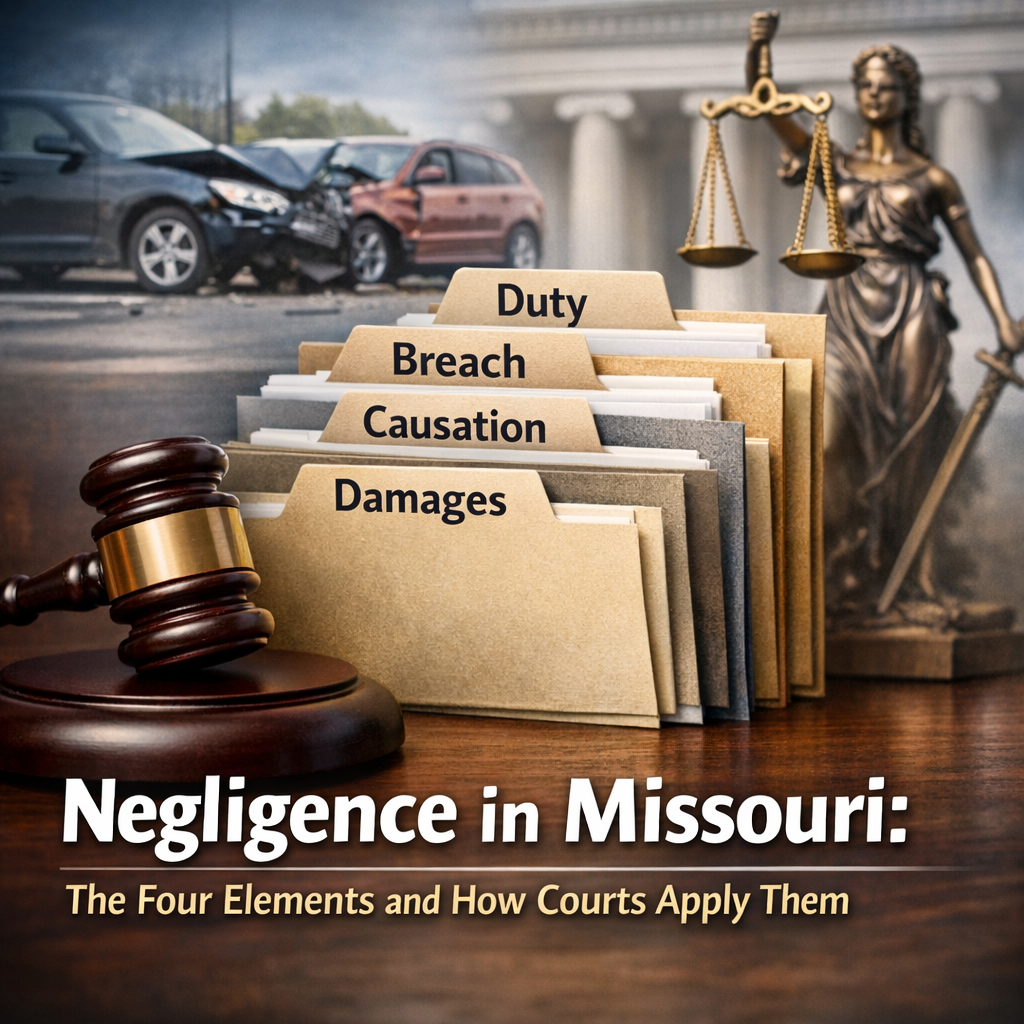
Negligence in Missouri: The Four Elements and How Courts Apply Them
A complete framework for understanding the foundation of every personal injury case in Missouri
Missouri Injury & Insurance Law | missouriinjuryandinsurancelaw.com
Introduction
Every personal injury case in Missouri rests on the same four-element foundation. Whether the claim arises from a car crash, a slip on a wet floor, a defective product, or a truck that ran a red light, the plaintiff must prove the same essential elements of negligence to recover. Understanding how Missouri courts define and apply each element is not just academic — it is the analytical framework that shapes every aspect of a case from the initial evaluation through verdict.
This post provides a complete treatment of negligence doctrine in Missouri: what each element requires, how courts apply it, where plaintiffs most commonly run into difficulty, and what the case law says. It is intended as a reference that practitioners can return to whenever they need to ground-check their analysis or explain the framework to a client or co-counsel.
The Four Elements of Negligence in Missouri
To establish negligence under Missouri law, a plaintiff must prove four elements by a preponderance of the evidence:
| ELEMENT 1: DUTYThe defendant owed a legal duty of care to the plaintiff. |
| ELEMENT 2: BREACHThe defendant breached that duty by failing to act as a reasonably careful person would have acted under the same or similar circumstances. |
| ELEMENT 3: CAUSATIONThe defendant’s breach was the direct and proximate cause of the plaintiff’s injury. |
| ELEMENT 4: DAMAGESThe plaintiff suffered actual damages as a result. |
These four elements are derived from the Missouri Approved Instructions (MAI) and are the standard by which Missouri juries evaluate negligence claims. MAI 17.01 sets out the general negligence instruction. The failure to prove any single element is fatal to the entire claim.
Element One: Duty
What Duty Means
A duty of care is a legal obligation requiring the defendant to act with the care that a reasonably prudent person would exercise to avoid causing harm to others. In Missouri, whether a duty exists is a question of law for the court to decide, not a question of fact for the jury. Hoover’s Dairy, Inc. v. Mid-America Dairymen, Inc., 700 S.W.2d 426, 431 (Mo. banc 1985).
The existence of a duty depends on the relationship between the parties and the foreseeability of harm. Missouri courts look to whether it was reasonably foreseeable that the defendant’s conduct could cause injury to persons in the plaintiff’s position. The general rule is that every person has a duty to exercise ordinary care to prevent foreseeable injury to others. Strickland v. Taco Bell Corp., 849 S.W.2d 127, 131 (Mo. App. E.D. 1993).
Common Duty Situations
Drivers. Missouri imposes a duty on all drivers to operate their vehicles with the care that a reasonably prudent driver would exercise under the same or similar circumstances. This duty runs to all foreseeable users of the road, including other drivers, pedestrians, cyclists, and passengers.
Property owners. The duty owed by a property owner in Missouri depends on the entrant’s status. An invitee — someone on the property for a business purpose or with the owner’s express or implied invitation — is owed the highest duty: reasonable care to inspect, discover, and either repair or warn of dangerous conditions. A licensee — a social guest or someone with permission but no business purpose — is owed a duty to warn of known dangers not reasonably apparent. A trespasser is generally owed only a duty to refrain from willful or wanton injury, with exceptions for discovered trespassers and the attractive nuisance doctrine for children.
Employers. An employer owes a duty to exercise ordinary care in hiring, training, supervising, and retaining employees. Where an employee is incompetent or dangerous and the employer knew or should have known this, a negligent hiring or retention claim may arise independent of respondeat superior liability.
Professionals. Professionals — physicians, attorneys, engineers, accountants — are held to the standard of care of their profession, not the general reasonable person standard. Expert testimony is typically required to establish both the standard of care and the deviation from it.
Where Duty Issues Arise
Duty is most commonly contested in cases involving nonfeasance — the failure to act rather than an affirmative act. Missouri, like most states, does not impose a general duty to rescue or assist a stranger in peril. However, once a person undertakes to render assistance, they assume a duty to act with reasonable care. L.A.C. v. Ward Parkway Shopping Ctr. Co., 75 S.W.3d 247, 257 (Mo. banc 2002).
Duty is also frequently contested in cases involving third-party criminal acts. A property owner or business generally does not owe a duty to protect invitees from third-party criminal conduct unless such conduct was reasonably foreseeable. Foreseeability in this context is determined by looking at the totality of the circumstances, including prior criminal incidents on or near the property. L.A.C. v. Ward Parkway, supra.
Element Two: Breach
The Reasonable Person Standard
Breach is the failure to meet the applicable standard of care. The standard in Missouri is objective: would a reasonably careful person have acted differently under the same or similar circumstances? This is the language of MAI 11.02, which instructs juries that “the defendant was negligent if he did not act as a reasonably careful person would have acted under the same or similar circumstances.”
The reasonable person standard is not a standard of perfection. It is the level of care that an ordinarily prudent person would exercise given the risks involved and the circumstances presented. Hindsight is excluded — the question is what a reasonable person would have done at the time, not what a perfect person would have done knowing the outcome.
Breach Is a Question of Fact
Unlike duty, which is a legal question for the court, breach is ordinarily a question of fact for the jury. The jury weighs the evidence of what the defendant did, compares it to the reasonable person standard, and determines whether the defendant fell short. Courts are generally reluctant to take the breach question from the jury, and summary judgment on breach is relatively uncommon in Missouri personal injury cases except in the clearest cases.
Negligence Per Se
Where a defendant violates a statute or regulation designed to protect persons in the plaintiff’s class from the type of harm that occurred, Missouri courts may apply the doctrine of negligence per se. Under this doctrine, the statutory violation establishes the breach element as a matter of law, leaving only causation and damages for the jury.
The elements of negligence per se in Missouri are: (1) the defendant violated a statute or regulation; (2) the plaintiff is in the class of persons the statute was designed to protect; (3) the plaintiff’s injury is of the type the statute was designed to prevent; and (4) the violation was the proximate cause of the injury. Baxter v. Noce, 752 S.W.2d 196, 201 (Mo. App. E.D. 1988).
Common negligence per se situations in Missouri personal injury practice include: speeding, failure to yield, running a red light, operating a vehicle while intoxicated (in violation of Section 577.010 R.S.Mo.), and violations of federal motor carrier safety regulations in trucking cases.
Res Ipsa Loquitur
Where direct evidence of breach is unavailable, Missouri recognizes the doctrine of res ipsa loquitur — the thing speaks for itself. Under Missouri law, res ipsa loquitur applies when: (1) the accident is the kind that ordinarily does not occur in the absence of negligence; (2) the instrumentality causing the injury was within the exclusive control of the defendant; and (3) the plaintiff did not contribute to the accident. Langfitt v. Federal Marine Terminals, Inc., 647 F.3d 1116, 1123 (8th Cir. 2011) (applying Missouri law).
Res ipsa loquitur does not shift the burden of proof — it merely permits an inference of negligence sufficient to reach the jury. The defendant may still offer evidence rebutting the inference.
Element Three: Causation
Causation is frequently the most contested and technically complex element in Missouri negligence cases. Missouri requires proof of two distinct causation concepts: cause-in-fact and proximate cause.
Cause-in-Fact: The But-For Test
Cause-in-fact asks whether the plaintiff’s injury would have occurred but for the defendant’s negligent conduct. This is the foundational causation question. If the injury would have occurred regardless of what the defendant did, causation fails and the claim fails with it.
Missouri uses the substantial factor test as an alternative where multiple causes are involved. Under this test, a defendant’s conduct is a cause-in-fact if it was a substantial factor in bringing about the plaintiff’s injury. The substantial factor test is used where two or more independent causes each would have been sufficient to cause the injury alone — in that scenario, strict but-for causation would exonerate both defendants, an unjust result. Callahan v. Cardinal Glennon Hospital, 863 S.W.2d 852, 862 (Mo. banc 1993).
Proximate Cause: The Foreseeability Limitation
Even where cause-in-fact is established, Missouri requires that the injury be a reasonably foreseeable consequence of the defendant’s negligence. This is the proximate cause requirement — sometimes called legal cause — which limits liability to harms within the scope of the risk that made the defendant’s conduct negligent in the first place.
Missouri does not require that the defendant foresee the precise manner or extent of the injury. It is sufficient that the general type of harm was a reasonably foreseeable consequence of the negligent conduct. Gibson v. Brewer, 952 S.W.2d 239, 246 (Mo. banc 1997).
Intervening and Superseding Causes
An intervening cause is an act or event that occurs after the defendant’s negligence and contributes to the plaintiff’s injury. An intervening cause does not necessarily break the chain of causation. A foreseeable intervening cause does not relieve the original defendant of liability. An unforeseeable intervening cause that is the sole cause of the injury may constitute a superseding cause, breaking the causal chain and relieving the original defendant of liability.
Whether a subsequent cause is foreseeable and therefore does not supersede the original negligence is ordinarily a jury question. Courts have held that third-party criminal conduct can be a foreseeable intervening cause where the defendant’s negligence created the conditions that made the criminal conduct possible. Rodriguez v. Suzuki Motor Corp., 936 S.W.2d 104, 110 (Mo. banc 1996).
Medical Causation and Expert Testimony
In cases involving physical injury, Missouri requires expert medical testimony to establish that the defendant’s conduct caused the plaintiff’s specific injuries, unless the causal connection is within the common knowledge of laypersons. Swartz v. Gale Webb Transportation Co., 215 S.W.3d 127, 133 (Mo. App. W.D. 2006). The expert must testify to a reasonable degree of medical certainty — meaning more likely than not — that the defendant’s conduct caused the claimed injuries.
The distinction between pre-existing conditions and injuries caused by the defendant is frequently litigated. Missouri follows the aggravation of pre-existing condition doctrine: a defendant who aggravates a plaintiff’s pre-existing condition is liable for the aggravation, even though the defendant did not cause the underlying condition. The defendant takes the plaintiff as found.
Element Four: Damages
Actual Damages Required
Missouri does not recognize nominal damages in negligence cases. The plaintiff must prove actual damages — real, measurable harm — as a result of the defendant’s negligence. A technically negligent act that causes no injury gives rise to no cause of action. This distinguishes negligence from intentional torts such as trespass or battery, where courts may award nominal damages for the violation of a legal right even without proof of actual harm.
Categories of Compensatory Damages
Missouri allows recovery of all damages that are the natural and probable consequence of the defendant’s negligence. These fall into two broad categories:
Economic damages are those with an objectively measurable dollar value: past and future medical expenses, past and future lost wages and earning capacity, and property damage. Future economic damages must be reduced to present value. Missouri does not cap economic damages in personal injury cases.
Non-economic damages include past and future pain and suffering, emotional distress, loss of enjoyment of life, disfigurement, and disability. Missouri does not cap non-economic damages in general personal injury cases. Note that Section 538.210 R.S.Mo. caps non-economic damages in medical malpractice cases, but that cap does not apply to general negligence claims.
The Eggshell Plaintiff Rule
Missouri follows the eggshell plaintiff doctrine: a defendant takes the plaintiff as found. If the plaintiff has a pre-existing condition that makes them more susceptible to injury, the defendant is liable for the full extent of the harm caused, even if that harm is far greater than would have occurred to a typical person. The doctrine is grounded in the principle that the defendant’s negligence is still the cause of the injury — it simply encountered a more fragile plaintiff.
The Impact of Missouri’s Comparative Fault System
Missouri follows a pure comparative fault system. A plaintiff’s own negligence does not bar recovery — it reduces recovery proportionally. If a plaintiff is found fifty percent at fault and the total damages are $1,000,000, the plaintiff recovers $500,000. Even a plaintiff who is ninety-nine percent at fault recovers one percent of their damages.
Comparative fault is an affirmative defense that must be pleaded and proven by the defendant. The jury allocates fault among all parties and non-parties whose negligence contributed to the injury, including settling defendants and phantom tortfeasors. Each defendant’s liability for non-economic damages is limited to their proportionate share of fault under Missouri’s modified joint and several liability rules. Section 537.067 R.S.Mo.
The comparative fault framework is addressed in depth in a separate post. For purposes of the negligence analysis, what matters is that a plaintiff’s contributory negligence does not eliminate any of the four elements — it affects only the measure of recovery after those elements are established.
Practical Application: Evaluating a Negligence Case
Every new personal injury case should be evaluated through the four-element framework before any other analysis begins. The following questions structure that evaluation:
Duty: What is the relationship between the parties? What duty does Missouri law impose on a defendant in this relationship? Is the duty contested?
Breach: What specifically did the defendant do or fail to do? Does the evidence support a finding that this conduct fell below the reasonable person standard? Is there a statute or regulation that creates negligence per se? Is the evidence sufficient to reach the jury?
Causation: Would the injury have occurred but for the defendant’s conduct? Is there a foreseeable causal connection between the breach and the harm? Are there intervening causes? Is expert medical testimony needed and available to establish that this defendant’s conduct caused these specific injuries?
Damages: What are the plaintiff’s documented economic losses? What is the evidence of pain, suffering, and non-economic harm? Is there a pre-existing condition that needs to be addressed? Does the defendant’s conduct rise to the level of punitive damages?
| The four-element analysis is not just a checklist. It is the structure that determines where a case is strong, where it is vulnerable, what discovery is needed, and how to frame the case for a jury. Every strategic decision in a negligence case flows from this foundation. |
Conclusion
Negligence is the foundation of Missouri personal injury law. The four elements — duty, breach, causation, and damages — are deceptively simple in statement and demanding in application. Each element has its own body of Missouri case law, its own evidentiary requirements, and its own strategic considerations.
This post is part of a foundational series on Missouri personal injury and insurance law. Related posts address comparative fault in detail, the damages framework, wrongful death, and the statute of limitations. Each post in the series links to the others to provide a complete reference library for Missouri practitioners.