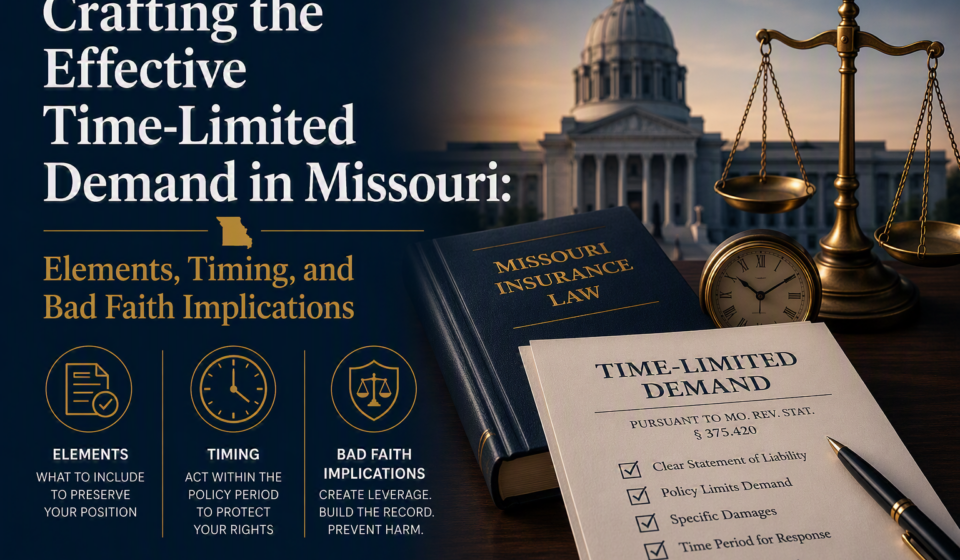
Crafting the Effective Time-Limited Demand in Missouri: Elements, Timing, and Bad Faith Implications
A step-by-step framework for structuring demands that create and preserve excess judgment exposure
Missouri Injury & Insurance Law | missouriinjuryandinsurancelaw.com
Key Takeaways
- Missouri’s time limited settlement demands must comply with § 537.058 RSMo to be admissible in bad-faith claims.
- The demand should include eight material terms and is required to be sent via certified mail.
- Combining demands under both § 537.058 and § 408.040 RSMo can maximize advantages like prejudgment interest.
- Open-ended demands do not trigger the same statutory requirements.
- Documentation and prompt action are crucial to preserve evidence for future claims and ensure compliance.
Introduction
The pre-suit settlement demand in a Missouri personal injury case is no longer a matter of common law and craftsmanship alone. Since the enactment of § 537.058 RSMo in 2017, every time-limited demand intended to support a later claim for extracontractual damages must conform to a detailed statutory checklist, or it will be inadmissible in a later bad-faith proceeding. Drafted correctly, the same demand letter can also satisfy § 408.040.3 RSMo — Missouri’s prejudgment interest statute — and place the carrier on the clock for a substantial interest award if it refuses to pay and the verdict exceeds the demand. Drafted carelessly, the demand may forfeit both levers at once.
This post walks through the statutory requirements of each provision, explains how they can and be paired in a single document, identifies a threshold issue — namely, that § 537.058 governs only demands that are by their terms time-limited — and addresses the contract-law trap exposed in Jameson v. Still, 643 S.W.3d 306(Mo. banc 2022).
I. The Statutory Landscape: Two Statutes, One Strategic Document
Missouri’s common-law cause of action against a liability insurer for bad-faith refusal to settle remains intact. The familiar elements are a settlement demand within policy limits, a reasonable probability of an excess judgment, refusal by the insurer, and an excess judgment in fact. Scottsdale Ins. Co. v. Addison Ins. Co., 448 S.W.3d 818, 827 (Mo. banc 2014). What changed in 2017 was the statutory imposition of an evidentiary gate for proving such a claim. § 537.058.7 RSMo provides that in any lawsuit filed by a claimant as assignee of the tort-feasor — a typical posture of a Missouri bad-faith case under prior versions of § 537.065 RSMo — a time-limited demand that does not comply with § 537.058 “shall not be considered as a reasonable opportunity to settle for the insurer and shall not be admissible in any lawsuit alleging extracontractual damages against the tort-feasor’s liability insurer.”
§ 408.040.3 RSMo operates separately from § 537.058 but on a parallel track. It provides that, in tort actions, if the claimant has made a “demand for payment of a claim or an offer of settlement of a claim” to the party, the party’s representatives, and the liability insurer if known, and the verdict exceeds the demand, prejudgment interest “shall be awarded” — calculated either from ninety days after the insurer received the demand (as shown by the certified-mail return receipt) or from the date the demand was “rejected without counter offer,” whichever is earlier. The rate is the intended Federal Funds Rate plus three percent per annum. § 408.040.4 RSMo. The two statutes share procedural DNA — both require certified mail return receipt requested, both contemplate a ninety-day open period — and a properly drafted demand can satisfy them simultaneously.
II. § 537.058: The Gateway to Bad-Faith Admissibility
§ 537.058 RSMo defines a “time-limited demand” as “any offer to settle any claim for personal injury, bodily injury, or wrongful death made by or on behalf of a claimant to a tort-feasor with a liability insurance policy for purposes of settling a claim against such tort-feasor within the insurer’s limit of liability insurance, which by its terms must be accepted within a specified period of time.” § 537.058.1(2) RSMo. The italicized phrase is the triggering condition, and Section III below addresses what follows when it is not met.
A. The Eight Material Terms
Subsection 2 requires that the demand be in writing, that it reference § 537.058 RSMo, and that it be sent certified mail return receipt requested to the tort-feasor’s liability insurer. The demand must contain eight material terms: the time period for acceptance, which “shall not be less than ninety days from the date such demand is received by the liability insurer”; the amount of monetary payment requested or a request for the applicable policy limits; the date and location of the loss; the claim number, if known; a description of all known injuries sustained by the claimant; the party or parties to be released if the demand is accepted; a description of the claims to be released; and an offer of unconditional release for the insurer’s insureds from all present and future liability for the occurrence under § 537.060 RSMo. § 537.058.2 RSMo.
B. Required Accompaniments
Subsection 3 requires the demand to be accompanied by a list of the names and addresses of all health-care providers who treated or evaluated the claimant from the date of injury until the date of the demand, together with Health Insurance Portability and Accountability Act (HIPAA)–compliant written authorizations sufficient to allow the insurer to obtain the records. § 537.058.3(1) RSMo. If wage loss is claimed, the demand must also be accompanied by a list of all employers from the date of first injury until the date of the demand, with corresponding written authorizations. § 537.058.3(2) RSMo. The statute thus eliminates the historical defense that the carrier “needed more information to evaluate.”
C. The Ten-Day Payment Floor
Subsection 5 expressly permits the claimant to require payment within a specified period after acceptance, but that period “shall not be less than ten days after the insurer’s receipt of a fully executed unconditional release.” § 537.058.5 RSMo. This is the statutory minimum tender window, and a shorter tender deadline is itself a basis for the carrier to challenge compliance.
D. The Ninety-Days-Before-Trial Exception
Subsection 6 carves out a meaningful litigation-stage exception: “Nothing in this section applies to offers or demands or time-limited demands issued within ninety days of the trial by jury of any claim on which a lawsuit has been filed.” § 537.058.6 RSMo. Practitioners with cases in active trial posture are therefore free to make shorter, sharper demands as trial approaches without the procedural overhead of the statute, and those demands remain admissible to the extent traditional bad-faith principles permit.
E. The Admissibility Consequence
The teeth of the statute are in subsection 7. A non-compliant time-limited demand “shall not be considered as a reasonable opportunity to settle” and “shall not be admissible” in any lawsuit alleging extracontractual damages against the tort-feasor’s liability insurer. § 537.058.7 RSMo. If it is not in available as evidence, the bad-faith claim is functionally over.
III. The Critical Threshold: § 537.058 Applies Only to Time-Limited Demands
A point that has not received enough attention in the practitioner literature: § 537.058 governs only demands that are time-limited. The statute defines its subject as an offer “which by its terms must be accepted within a specified period of time.” § 537.058.1(2) RSMo. An open-ended demand — one that contains no expiration date and no acceptance deadline — is not a “time-limited demand” within the statutory definition, and the requirements of § 537.058 simply do not attach. Equally important, the inadmissibility sanction in subsection 7 by its terms reaches only “a time-limited demand that does not comply with the terms of this section.” A demand that is not time-limited cannot be “non-compliant” with § 537.058 because § 537.058 does not govern it in the first place.
The strategic implication is two-sided. A practitioner who wants to preserve maximum flexibility — for example, where the case is too undeveloped for a defensible ninety-day demand or where the medical authorizations are not yet in hand — can send an open-ended pre-suit demand without triggering the § 537.058 checklist or the subsection 7 admissibility bar. The bad-faith claim, if one later develops, will rise or fall on traditional common-law principles rather than on statutory compliance. The trade-off, however, is that an open-ended demand will not satisfy § 408.040.3 either, because the prejudgment interest statute presumes a fixed receipt date from which the ninety-day clock runs and contemplates either expiration or rejection of a defined offer. A practitioner who deliberately omits a time limit should understand that the omission takes the prejudgment interest lever off the table as well, unless and until a separate statutorily compliant demand is issued.
IV. § 408.040: Prejudgment Interest as the Companion Lever
§ 408.040 RSMo is the older of the two statutes and the more often-overlooked. Its operative requirements in tort actions are: a written demand sent certified mail return receipt requested; an accompanying affidavit by the claimant describing the nature of the claim, the nature of any injuries claimed, and a general computation of any category of damages sought, with supporting documentation if reasonably available; transmission to the party, the party’s representatives, and the liability insurer if known; an offer that remains open for ninety days; and the filing of suit in circuit court within one hundred twenty days after the demand is received, unless the parties agree in writing to a longer period. § 408.040.3 RSMo.
If those requirements are satisfied and the verdict exceeds the demand, prejudgment interest is mandatory — “shall be awarded” is the statutory language — at a per-annum rate equal to the intended Federal Funds Rate plus three percent. § 408.040.4 RSMo. Interest accrues from the earlier of (a) ninety days after the insurer’s receipt of the demand or (b) the date the demand was rejected “without counter offer.” § 408.040.3 RSMo. A flat rejection therefore starts the clock immediately; a counteroffer keeps the carrier on the ninety-day timer but does not accelerate accrual. On a seven-figure verdict in a case that takes two or three years to try, the prejudgment interest figure will run well into six figures, recoverable as part of the judgment.
The capacity provisions in § 408.040.3 RSMo are also worth noting. The required affidavit may be signed by any person reasonably qualified to act as next friend, conservator, or personal representative for a minor, incompetent, or deceased claimant, and in wrongful death cases by any person qualified under § 537.080 RSMo to bring the claim. The affidavit requirement is not a barrier in capacity-limited cases.
V. Drafting a Single Demand That Satisfies Both Statutes
The two statutes are independent, a party can make a § 537.058 RSMo or § 408.040.3 RSMo separately but they can easily be read together, and a single demand letter can satisfy both. The drafting framework is straightforward. The letter should be captioned to reference both § 537.058 RSMo and § 408.040 RSMo, should be sent certified mail return receipt requested to both the tort-feasor and the liability insurer, and should expressly state that the offer remains open for not less than ninety days from the date of receipt by the insurer. It should include, in a single integrated structure, every one of the eight material terms required by § 537.058.2; the medical-provider list and HIPAA-compliant authorizations required by § 537.058.3(1); the employer list and authorizations under § 537.058.3(2) where wage loss is claimed; an offer of unconditional release of the insureds under § 537.060 RSMo; a tender window of not less than ten days after receipt of the executed release; and a sworn claimant affidavit, attached as an exhibit, describing the nature of the claim, the nature of the injuries, and a general computation of damages with supporting documentation.
Two calendar items must then be docketed immediately: the ninety-day acceptance deadline and the one-hundred-twenty-day suit-filing deadline under § 408.040.3 RSMo. The latter is the trap most often missed. A demand can be perfect in every other respect, but if suit is not filed in circuit court within one hundred twenty days after the insurer received the demand — and the parties have not agreed in writing to extend that period — the claimant forfeits the prejudgment interest remedy entirely.
VI. The Counteroffer Issue: Jameson v. Still
Practitioners must also understand how the demand interacts with common-law contract principles, because the ninety-day open period in §§ 537.058 and 408.040 does not override them. In Jameson v. Still, 643 S.W.3d 306 (Mo. banc 2022), the claimant sent a demand expressly invoking both statutes, the insurer responded with a counteroffer, and the insurer later attempted to “accept” the original demand within the ninety-day window. The Missouri Supreme Court held that the counteroffer constituted a rejection that terminated the original offer under standard contract principles, that nothing in §§ 408.040 or 537.058 expressly or by necessary implication renders such offers irrevocable for ninety days, and that the insurer’s later purported acceptance was therefore ineffective.
The strategic takeaways are several. First, an insurer’s counteroffer is a rejection, and the claimant should treat it as such — file suit promptly, both to preserve litigation posture and to satisfy the one-hundred-twenty-day filing requirement of § 408.040.3 RSMo. Second, although a counteroffer is a rejection for contract-formation purposes, it is not a “rejection without counter offer” within § 408.040.3, so the prejudgment interest accrual date defaults to the ninety-day-post-receipt prong rather than running from the counteroffer date. Third, an outright rejection — a flat refusal with no counter — is more advantageous to the claimant on prejudgment interest accrual because it triggers the earlier-of-two-dates clause. From the carrier’s side, the lesson of Jameson is that any modification of the demand’s terms is a counteroffer, and any counteroffer terminates the right to accept. From the claimant’s side, Jameson is the reason the demand should be docketed for prompt action the moment the insurer responds with anything other than full acceptance.
VII. Documentation and Record Preservation
Both statutes are written around a paper trail, and the file should be built to function as trial-exhibit preparation from the first letter forward. Every demand should be sent certified mail return receipt requested with the green card retained. The certified-mail receipt is statutorily designated as the proof of “receipt” date for both the ninety-day prejudgment-interest accrual clock under § 408.040.3 and the ninety-day acceptance period under § 537.058.2(1). The complete file should include the demand, the certified-mail receipt and return-receipt card, the claimant’s affidavit, the medical-provider and employer lists with authorizations, every responsive communication from the insurer, the date and form of any acceptance or rejection, and a contemporaneous chronology. In the bad-faith trial that may follow an excess judgment, this file is critical evidence of compliance with the § 537.058.evidence gate and the bad faith claim.
Conclusion
§ 537.058 RSMo and § 408.040 RSMo are not adversaries; they are complementary tools which counsel for the claimant may use together in the same demand. A single statute-compliant demand can preserve the admissibility of the rejected offer in a future bad-faith case, place the carrier on a ninety-day clock that begins to run prejudgment interest at Federal Funds Rate plus three percent on any judgment in excess of the demand, and force the carrier to evaluate its insured’s exposure with full medical and employment information in hand. § 537.058 RSMo and § 408.040 RSMo are not adversaries; they are complementary tools designed to be invoked together in the same letter when the practitioner chooses to make a time-limited demand.
A settlement demand in a Missouri personal injury case can be made in either of two postures. The first is the time-limited demand — an offer that by its terms must be accepted within a specified period. When the practitioner chooses that posture, § 537.058 RSMo governs and the demand must comply with the statute, or it will be inadmissible in any future bad-faith proceeding. In nearly every such case it makes strategic sense to draft the same letter to satisfy § 408.040 RSMo as well, so that a single integrated demand preserves the admissibility of the rejected offer for a future bad-faith trial and simultaneously starts the prejudgment interest clock at Federal Funds Rate plus three percent on any judgment that exceeds the demand.
The second posture is the demand made without any acceptance deadline. Neither § 537.058 nor § 408.040 governs that demand. The analysis falls back on common-law contract principles, on the strategic reasons a claimant might prefer that approach in a given case, and on the separate question of how an insurer’s offer or counteroffer fits into that framework — including whether the carrier’s response can itself be a time-limited offer with consequences for the claimant. That discussion is the subject of the next post in this series: The Common-Law Demand in Missouri Personal Injury Cases: Open-Ended Offers, Insurer Counteroffers, and Settlement Practice Outside § 537.058 and § 408.040.
For further reading on related topics see: